8.4 Task Scheduling
Goal
- Minimize the time of running all tasks
Condition
- N tasks given
- T = { | = required time to finish task i, i = 1, 2, 3, ... , n}
- M machines
- After a job is assigned to a machine, we can not change the machine in its running time
- If a machine is running for a job, we can not assign another job
Greedy Search에서는 각 작업의 시작 시간과 종료 시간만 주어지고 사용 가능한 기계수의 제한이 없었다.
반면 근사 알고리즘에서는 전체 작업 수와 사용할 수 있는 기계 수가 미리 정해져 있고 각 작업의 처리 시간이 주어졌을 때 모든 작업을 수행하는 스케줄 중에서 전체 완료 시간이 가장 짧은 해를 목표로 한다.
Greedy Algorithm for Task Scheduling
- Different from what we covered in the greedy algorithm chapter
- Early ending machine first
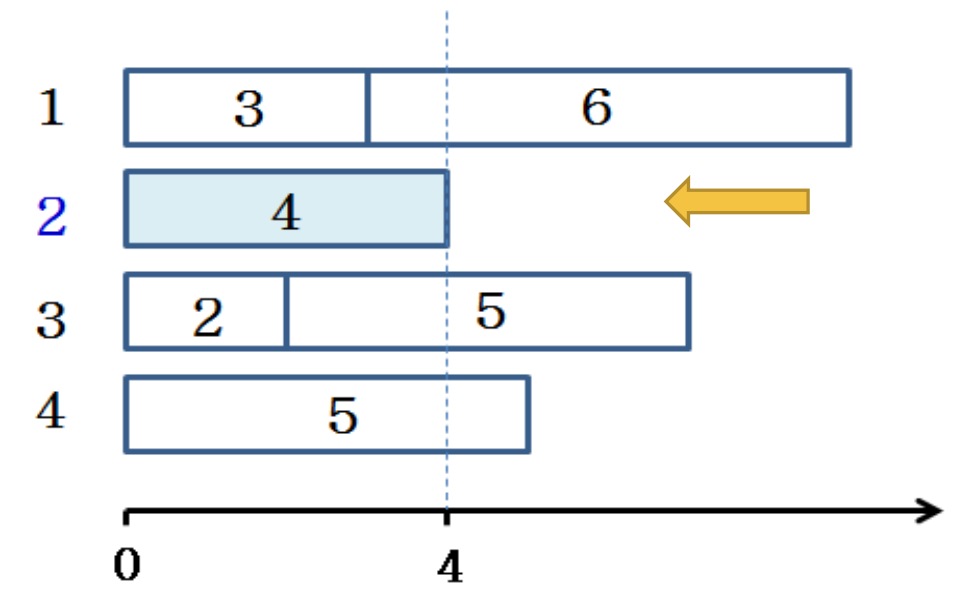
절대 시간 4를 기준으로 하면 제일 빨리 끝나는 게 2번 기계이다. 같은 시간이면 여러 개 중에서 앞에서부터 채운다.
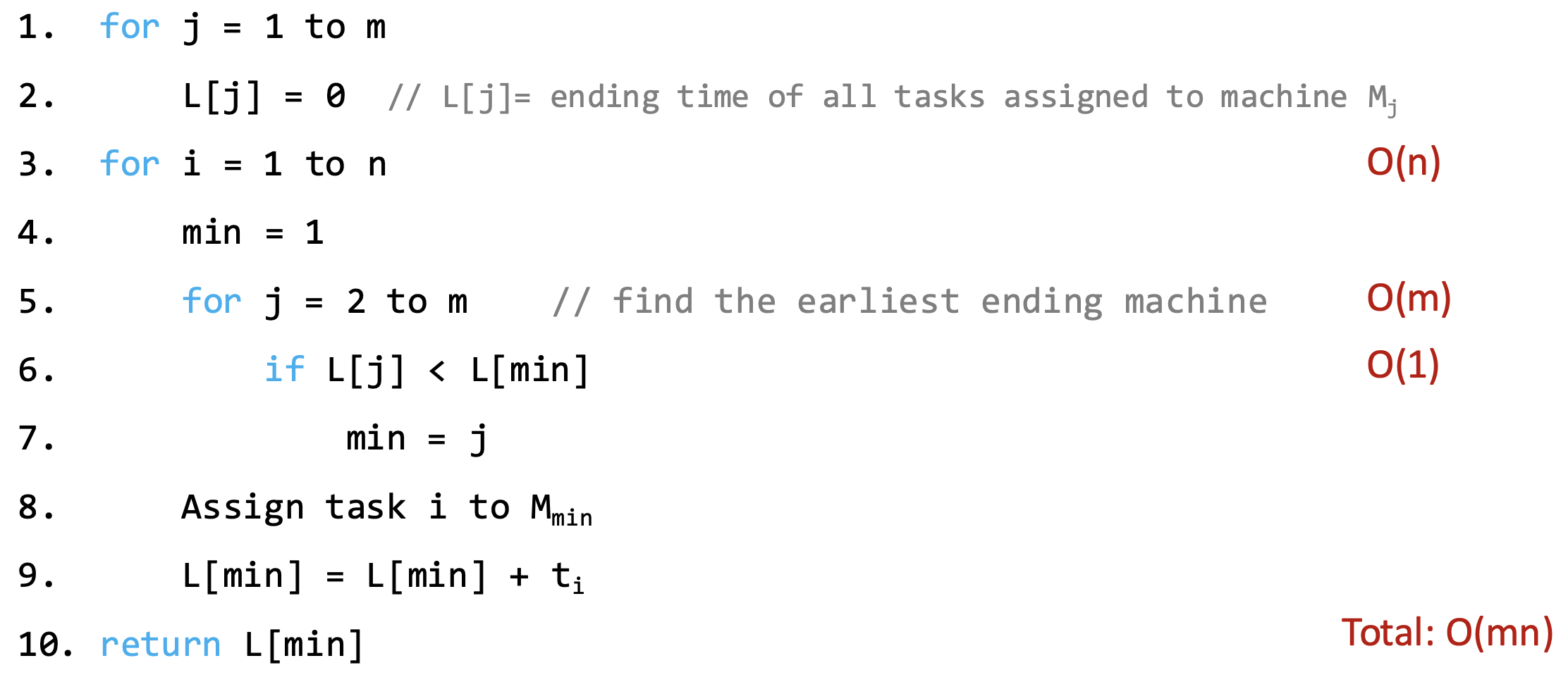
8.4.1 Approx_JobScheduling(T, M)
- Input: n tasks, task , i = 1, 2, ..., n, machine , j = 1, 2, ... , m
- Output: the ending time of finishing all tasks
E.g.,
- T = {5, 2, 4, 3, 4, 7, 9, 2, 4, 1}
- 4 machines
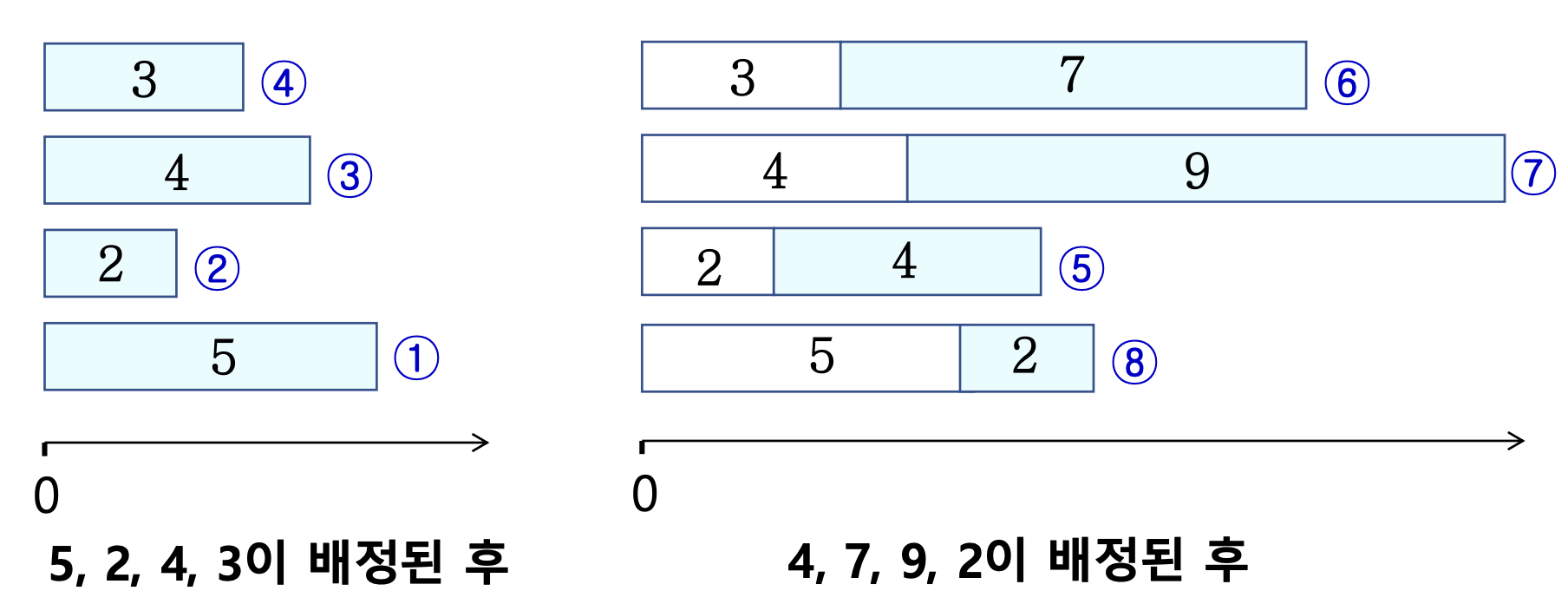
- Finishing time: 13
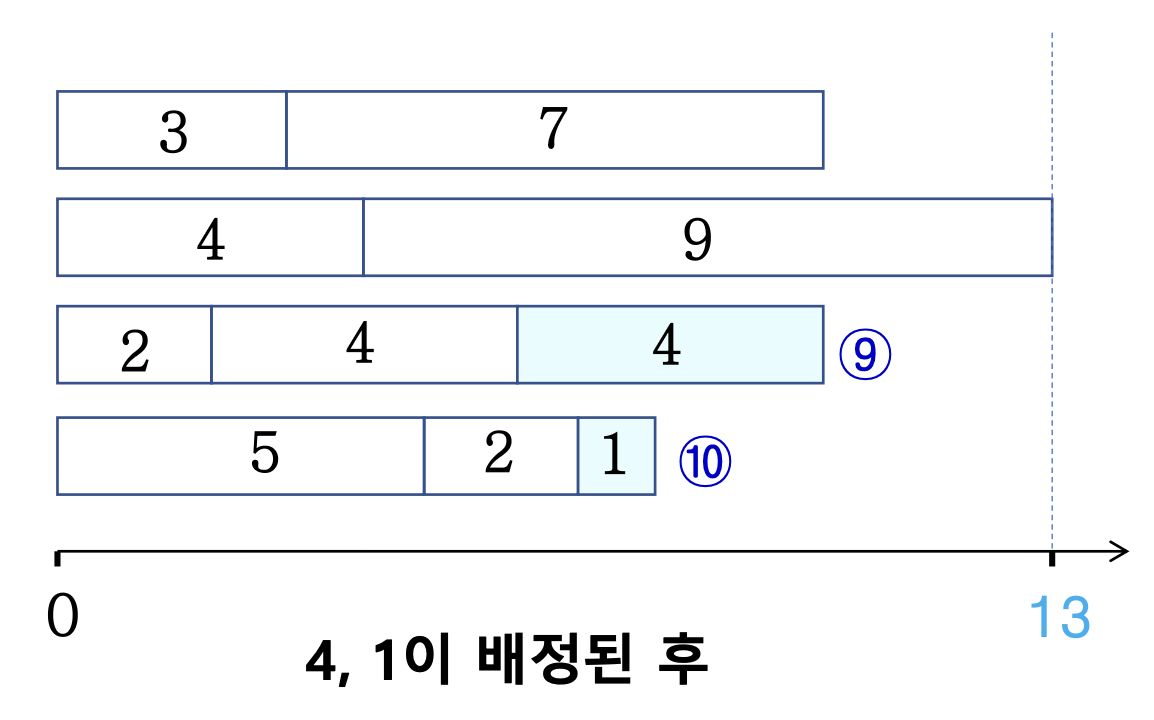
8.4.2 Approximation Ratio
Theorem 1: OPT'/OPT < 2
- OPT': approximation by Approx_JobScheduling
- OPT: optimal solution
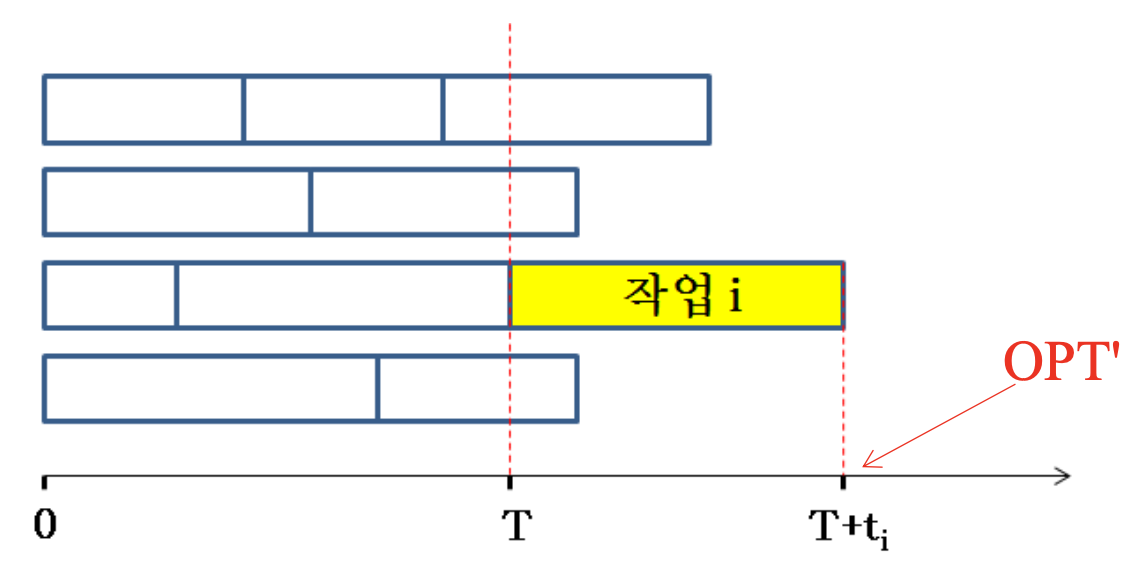
T + t' = OPT'
m: Machine size
Lemma 1: T <= T'
- T = OPT' -
- M = T + E[ending time of all machine - T]
- = total task running time / m lower bound
- T 기준으로 앞을 다 빼고난 뒤에서의 평균
- T' = T + E[ending times except the machine running - T]
- = M - / m
- The expectation for T' is positive or 0, so T <= T'

Lemma 2: M <= OPT
- M = T + E[ending time of all machine - T]
= total task running time / m - OPT is the earliest ending time of the latest ending time in machines
- Ending time of each machine < OPT
- If M(lower bound) > OPT
- OPT >= E[ending time of all machine] contradiction
contradiction: 이게 성립하면 모순이 생긴다.
Lemma 3: <= OPT
- No doubt
- OPT should max() by definition
OPT가 하나의 task보다 작을 수는 없다.
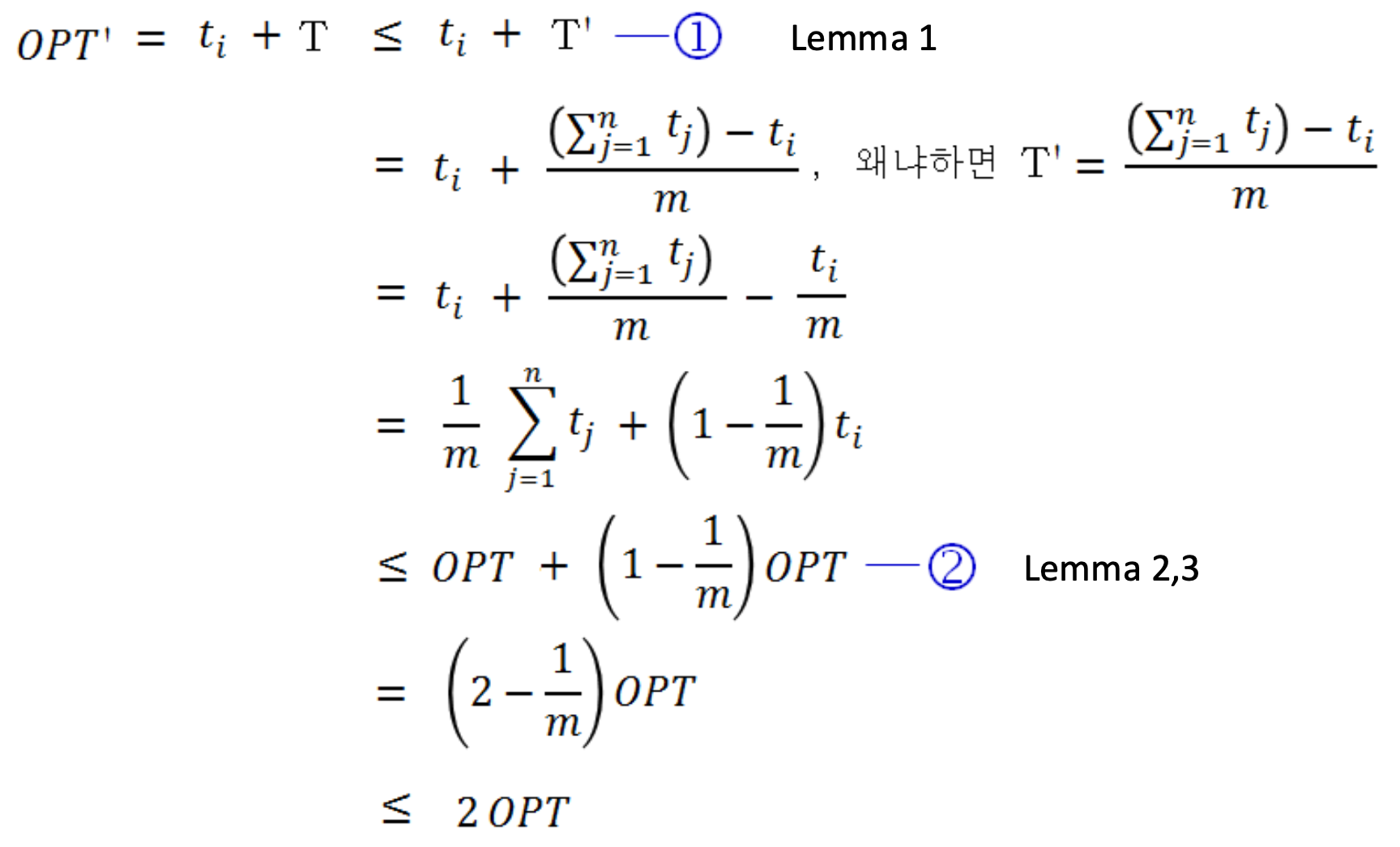
최악의 경우 2배까지 느려질 수 있다.
8.5 Clustering
- Grouping similar data regard as a type of data (cluster)
- Modeling
- What data is in which type? - find the closet cluster
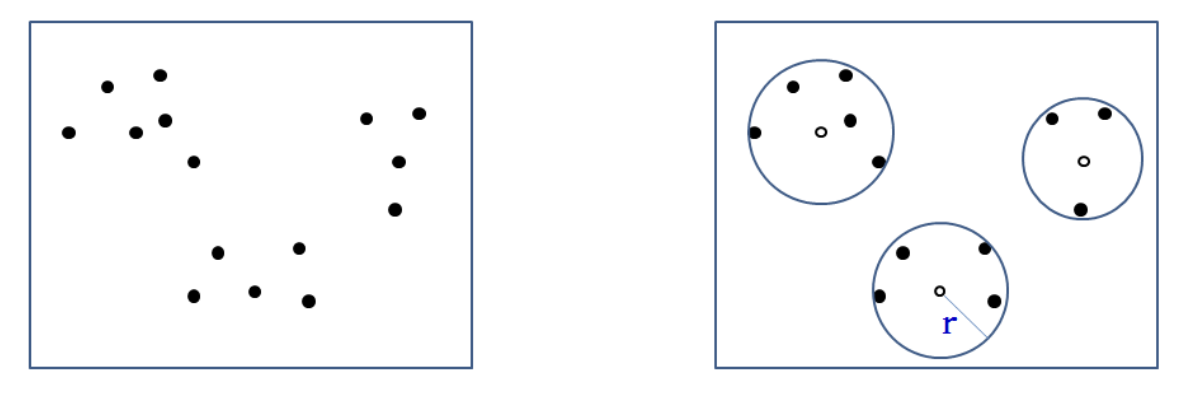
How to Determine a Cluster?
- Minimize the expected distance of data points to the centroid of their cluster
- Find the expected minimum radius of k-clusters to cover all data
반경을 작게 잡을수록 정확도가 올라간다.
- In 2D space, find k clusters
- E.g., k = 3
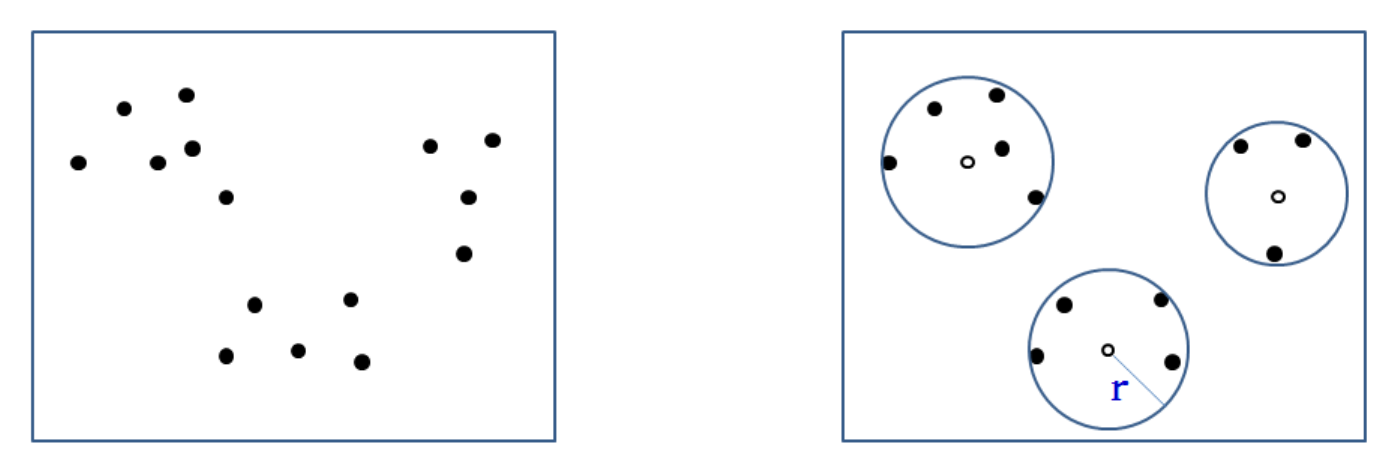
위 상황에서 new data를 넣는다면 1, 2, 3 cluster group 중에 어디로 가야할까?
8.5.1 Greedy Algorithm of Clustering
- Select one by one and determine its cluster at each iteration
How to select next one?
- Find the closet one and assign it to the same cluster until the radius is larger than a threshold
- Or find the furthest point and assign to a different cluster
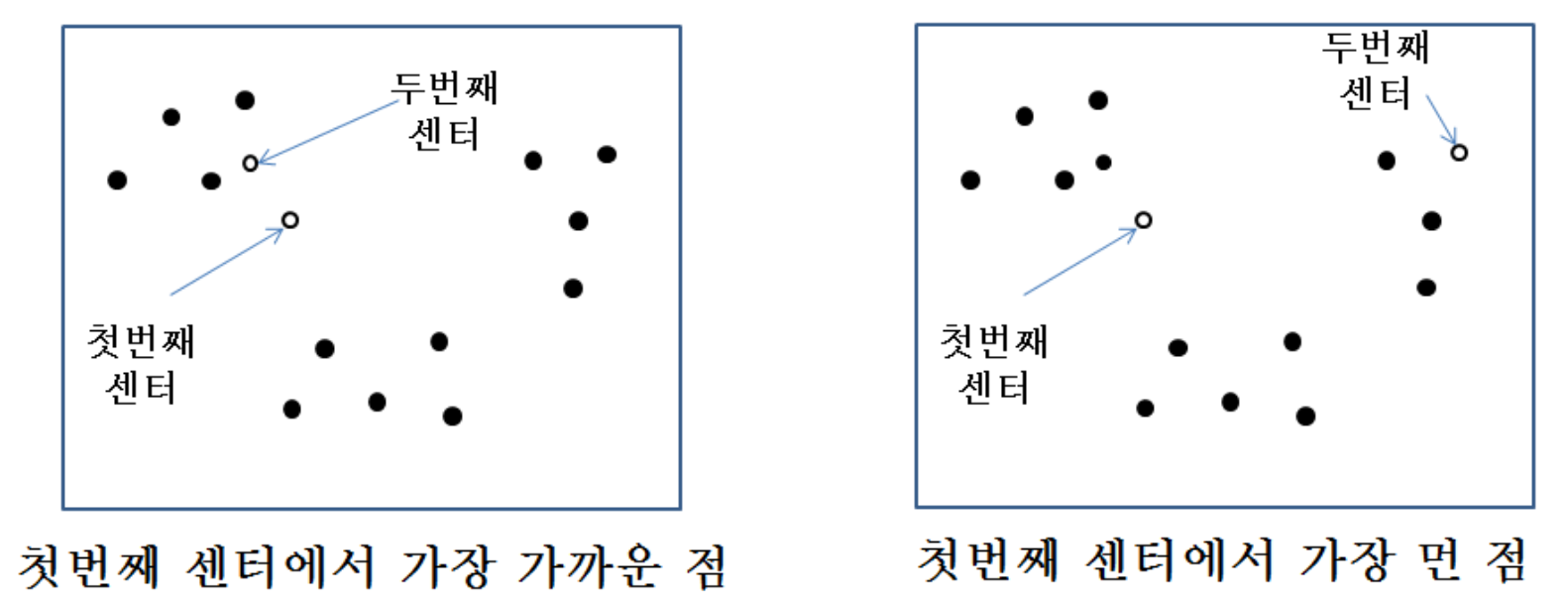
첫 번째 센터를 정할 때는 완전한 random이지만, 두 번째 센터는 첫 번째로부터 가장 먼 점을 선택한다.
Next?
- The furthest point from selected two points
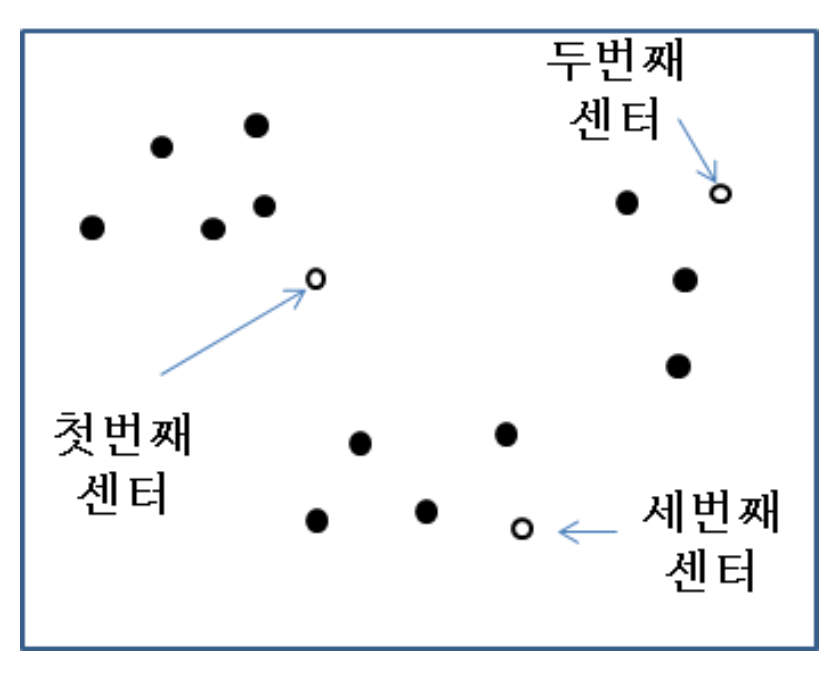
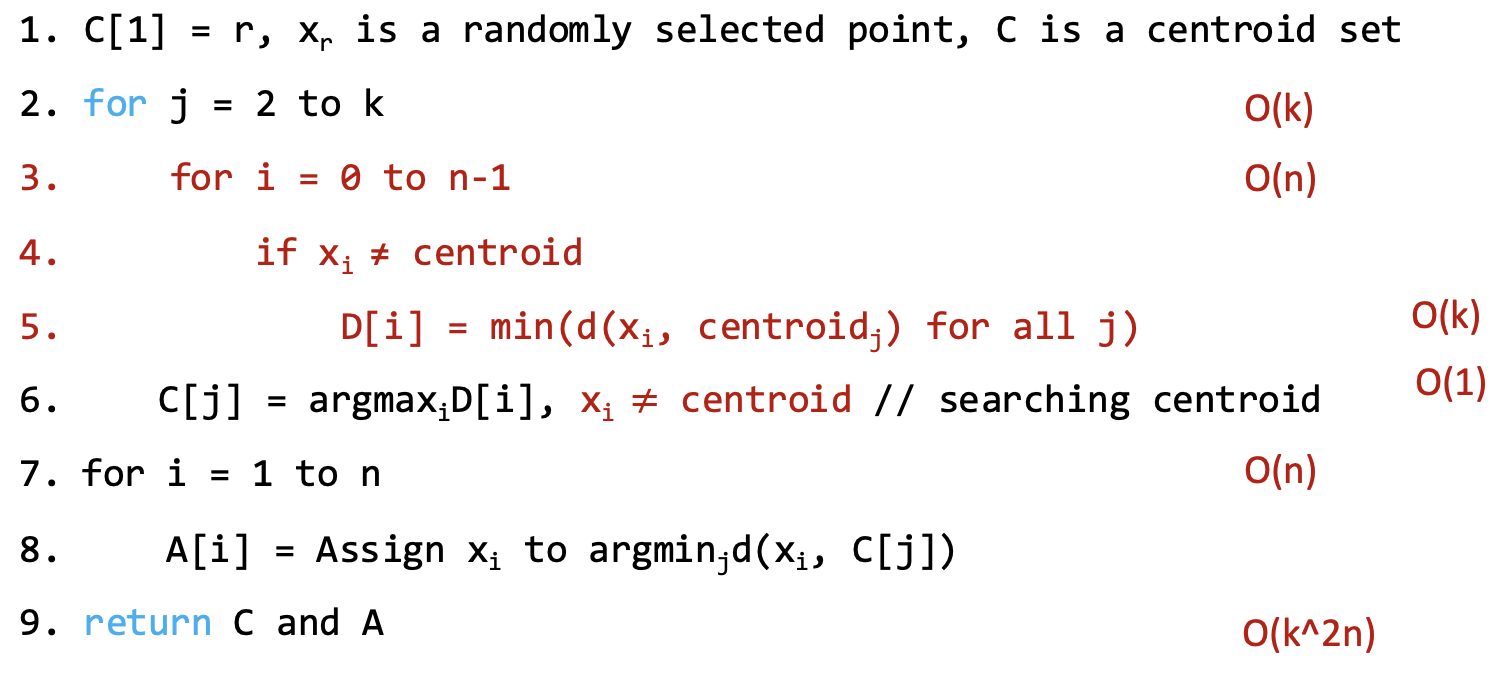
8.5.2 Approx_k_Clusters()
- Input: 2D n vectors ,. i = 0, 1, ... , n-1, cluster size k, k > 1
- Output: k centroid and cluster arrangement for all points
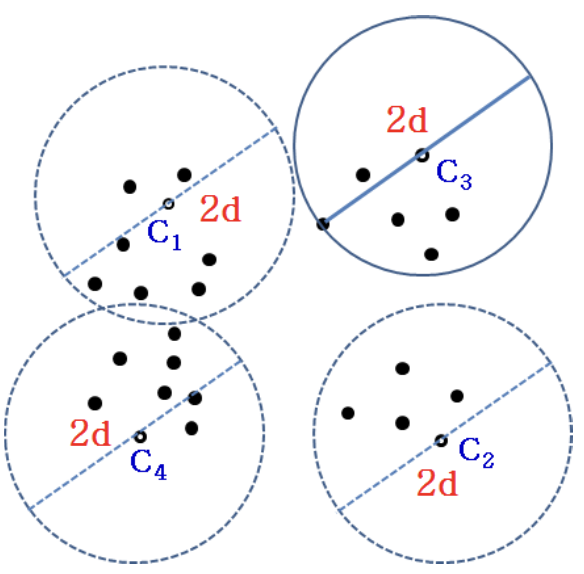
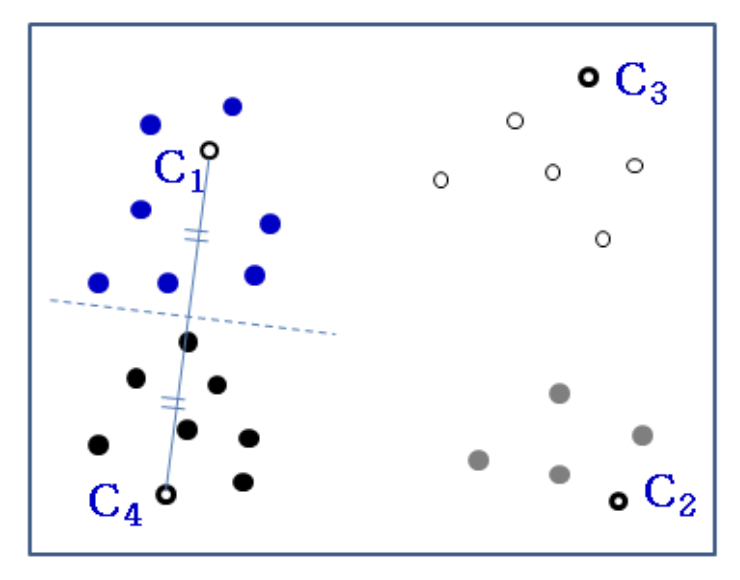
E.g., k = 4
- Random selection of centroid of
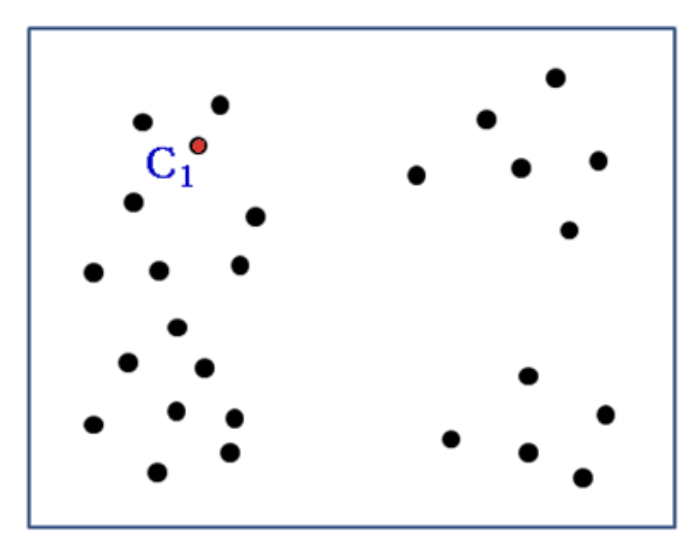
- Evaluate distance of all points from & Select the furthest one as

- Let's assume that maximum of minimum distance was 20 is selected

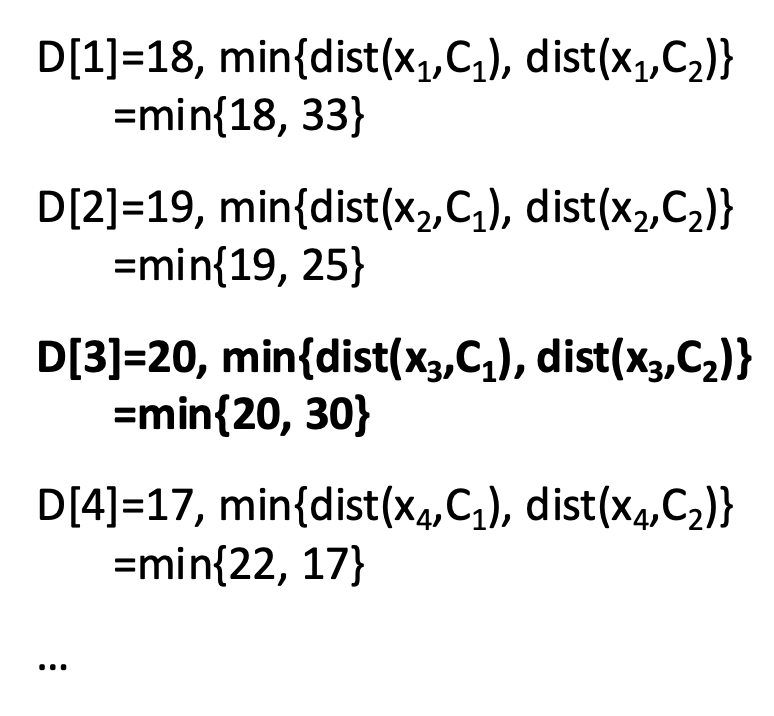
min 중에서 최댓값을 선택하면
- is selected
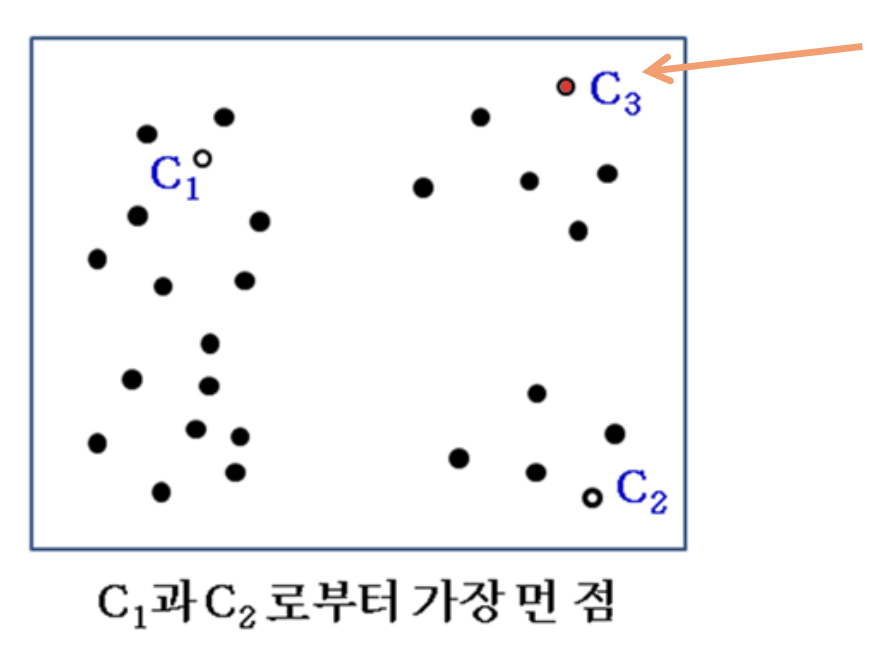
- In the same way, we can select
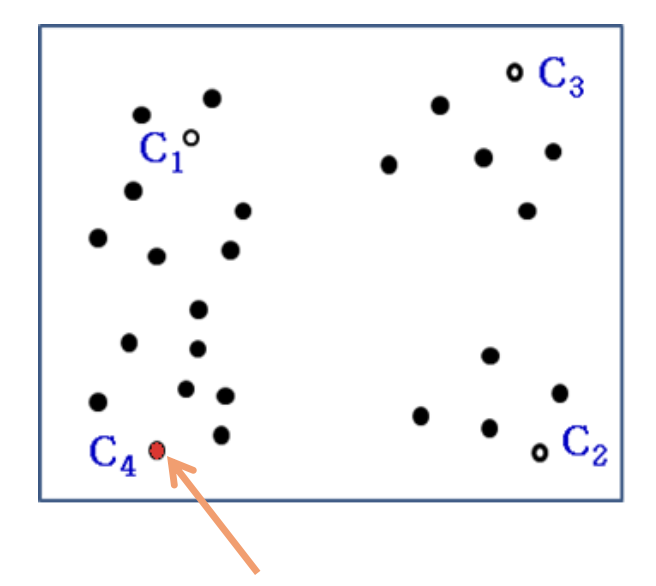
- Evaluate distance of to
- Find the closet cluster
- Assign to the cluster
8.5.3 Time Complexity
- 3~5 line의 outer loop =>
- Inner1: - i = 0 to n - 1
- Inner2: - all j니까 최악의 경우 k
- Total:
8.5.4 Quality of a Solution
- Min-Max Distance: max(d(, )) over all i where j = argmind(, )
- M': Minimal min-max distance (optimal)
- M: A lower bound of M'
- M": Approximated max-min distance; 근사 알고리즘으로 구한 값
Lemma 1: 2M' >= d
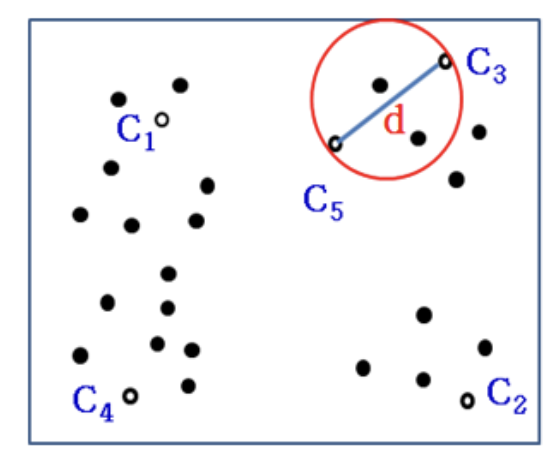
- d = d(C[k], C[k+1]) = max(min(d(, C[j]))
- Select k + 1 centroids through the greedy algorithm
- Any algorithm should put two of the centroids into one cluster
- A cluster in an optimal solution should have large diameter than d
- M': max(all radius of k clusters)
- 2M' >= d
Lemma 2: M" <= d
- Any has shorter distance to its closest cluster
- = d(, C[j]), is assigned to C[j]
- Therefore, any cluster has a radius smaller than or equal to d
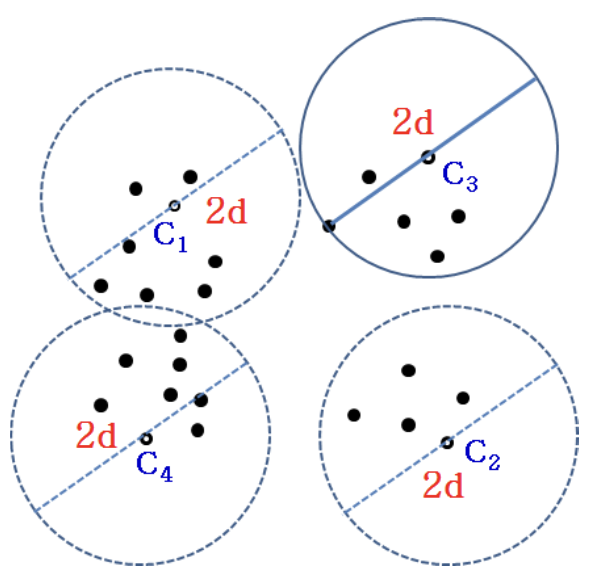
Theorem 1: M" / M' <= 2
- 2M' >= d (by lemma 1)
- M" < d (by lemma 2)
- M" / M' <= 2