문제
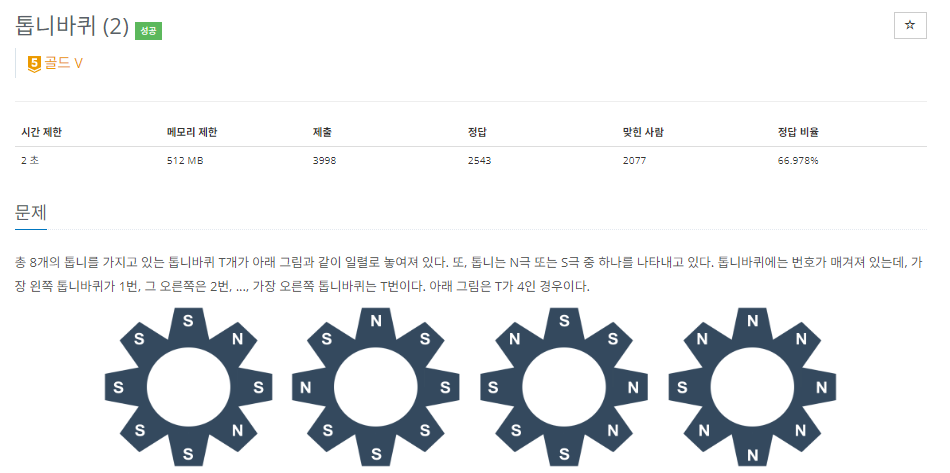
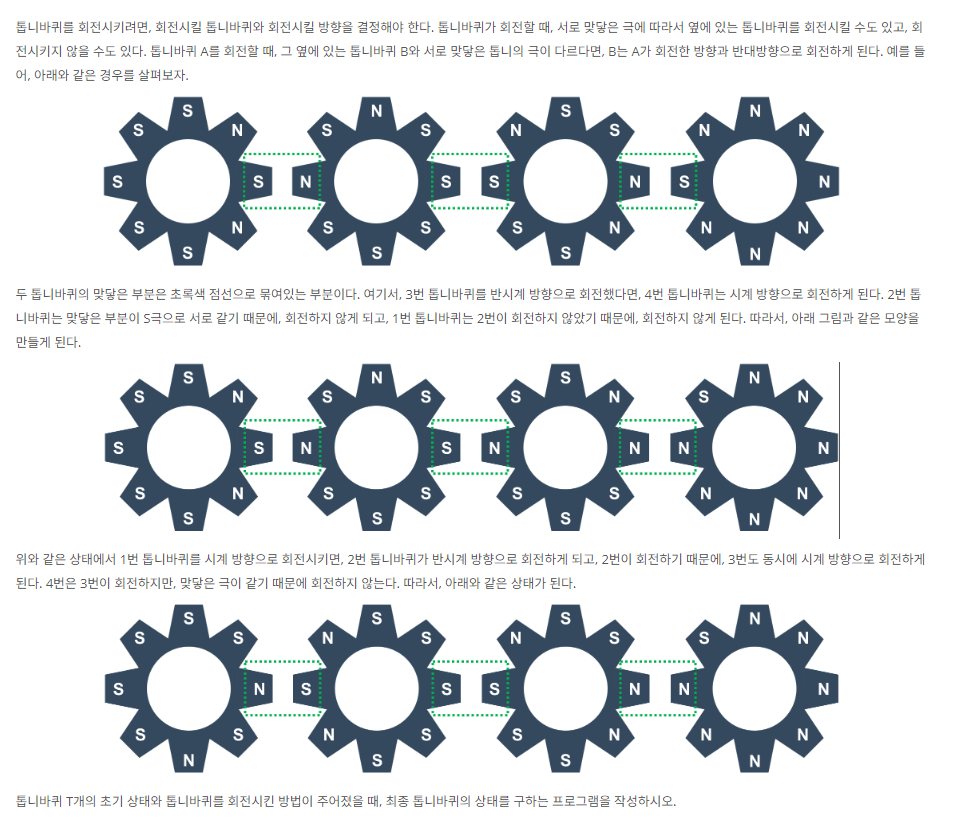
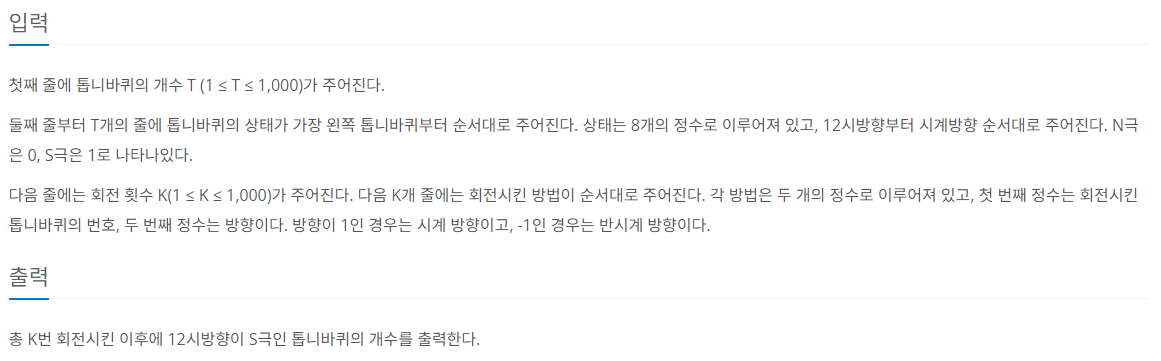
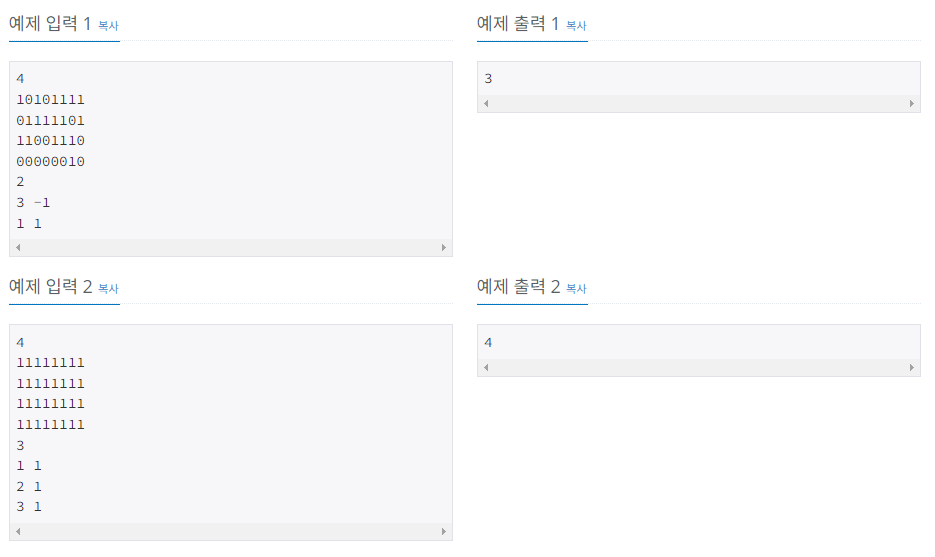
구상
- 톱니바퀴가 조건에따라 연결되어 회전한다.
- 제일 처음 회전시키는 톱니바퀴를 기준으로 왼쪽과 오른쪽을 확인하여 회전조건을 만족할 경우 하나의 자료형에 해당 톱니바퀴의 인덱스와 회전방향을 저장하여 한번에 회전시키면 되지않을까??
코드
#include<bits/stdc++.h>
using namespace std;
int t,k;
string a[1001];
void rotateGear(int idx, int d){
	if(d==1){ // 시계방향 회전
		int temp = a[idx][7];
		for(int i=7; i>0; i--){
			a[idx][i]=a[idx][i-1];
		}
		a[idx][0]=temp;
	}
	if(d==-1){ // 반시계 방향 회전
		int temp = a[idx][0];
		for(int i=0; i<8; i++){
			a[idx][i]=a[idx][i+1];
		}
		a[idx][7] = temp;
	}
}
int countS(){ //S극인 톱니바퀴 개수 count
	int cnt = 0;
	for(int i=0; i<t; i++){
		if(a[i][0]=='1'){
			++cnt;
		}
	}
	return cnt;
}
void go(int idx,int d){
	vector<pair<int,int>> v;
	v.push_back({idx,d});
	int now = idx;
	int nowd = d;
	while(now>0){ //왼쪽 맞닿은 톱니바퀴
		if(a[now][6]!=a[now-1][2]){
			--now;
			nowd*=-1;
			v.push_back({now,nowd});
		}
		else{
			break;
		}
	}
	now = idx;  //입력받은 index 기준으로 초기화
	nowd = d;
	while(now<t-1){ //오른쪽 맞닿은 톱니바퀴
		if(a[now][2]!=a[now+1][6]){
			++now;
			nowd*=-1;
			v.push_back({now,nowd});
		}
		else{
			break;
		}
	}
	for(int i=0; i<v.size(); i++){ //회전
		rotateGear(v[i].first,v[i].second);
	}
}
int main(){
	cin >> t; // 톱니바퀴 개수
	for(int i=0; i<t; i++){//톱니바퀴 입력
		cin>>a[i];
	}
	cin >> k; //회전 횟수
	for(int i=0; i<k; i++){//회전 방법 입력 (톱니바퀴 번호, 방향)
		int idx,d;
		cin>>idx>>d;
		go(idx-1,d);
	}
	// 12시 방향이 s극인 톱니바퀴의 개수 출력
	cout<< countS();
	return 0;
}
- 가장 처음 회전하려는 톱니바퀴의 인덱스를 기준으로 왼쪽을 탐색한다.
1.1. 왼쪽의 2번째 톱니바퀴와 현재의 6번째 톱니바퀴를 비교하여, 다르다면 벡터에 저장
1.2. 왼쪽으로 계속 진행하다가 끝에 다다르거나 같은 값이라면 break (종료조건)- 같은 방식으로 오른쪽을 탐색한다.
- 벡터에 든 톱니바퀴들을 회전방향에 맞게 회전시킨다.
하지만 회전하는 부분을 rotate 함수를 사용해 구현한다면 더 쉽게 구현할 수 있다!
rotate
rotate 함수는 값들을 왼쪽, 오른쪽으로 지정한 값만큼 회전시킬 수 있다.
Parameters
rotate(first,seocnd,third);| Parameters | description |
|---|---|
| first | 회전할 범위의 시작 iterator |
| second | 회전하여 첫번째 요소가 될 범위 내 iterator |
| third | 회전할 범위의 마지막 iterator |
활용 예시
vector<int> v = {10,20,30,40,50};

//왼쪽으로 1칸 이동
rotate(v.begin(),v.begin()+1,v.end());
-> 20,30,40,50,10

//왼쪽으로 3칸 이동
rotate(v.begin(),v.begin()+3,v.end());
-> 40,50,10,20,30

//오른쪽으로 1칸 이동
rotate(v.begin(),v.end()-1,v.end());
-> 50,10,20,30,40

//오른쪽으로 3칸 이동
rotate(v.begin(),v.end()-1,v.end());
-> 30,40,50,10,20
rotate 활용하여 수정한 코드
#include<bits/stdc++.h>
using namespace std;
int t,k;
string a[1001];
void rotateGear(int idx, int d){
	if(d==1){ // 시계방향 회전
		rotate(a[idx].begin(),a[idx].end()-1,a[idx].end());
	}
	if(d==-1){ // 반시계 방향 회전
		rotate(a[idx].begin(),a[idx].begin()+1,a[idx].end());
	}
}
int countS(){ //S극인 톱니바퀴 개수 count
	int cnt = 0;
	for(int i=0; i<t; i++){
		if(a[i][0]=='1'){
			++cnt;
		}
	}
	return cnt;
}
void go(int idx,int d){
	vector<pair<int,int>> v;
	v.push_back({idx,d});
	int now = idx;
	int nowd = d;
	while(now>0){ //왼쪽 맞닿은 톱니바퀴
		if(a[now][6]!=a[now-1][2]){
			--now;
			nowd*=-1;
			v.push_back({now,nowd});
		}
		else{
			break;
		}
	}
	now = idx;  //입력받은 index 기준으로 초기화
	nowd = d;
	while(now<t-1){ //오른쪽 맞닿은 톱니바퀴
		if(a[now][2]!=a[now+1][6]){
			++now;
			nowd*=-1;
			v.push_back({now,nowd});
		}
		else{
			break;
		}
	}
	for(int i=0; i<v.size(); i++){ //회전
		rotateGear(v[i].first,v[i].second);
	}
}
int main(){
	cin >> t; // 톱니바퀴 개수
	for(int i=0; i<t; i++){//톱니바퀴 입력
		cin>>a[i];
	}
	cin >> k; //회전 횟수
	for(int i=0; i<k; i++){//회전 방법 입력 (톱니바퀴 번호, 방향)
		int idx,d;
		cin>>idx>>d;
		go(idx-1,d);
	}
	// 12시 방향이 s극인 톱니바퀴의 개수 출력
	cout<< countS();
	return 0;
}
백엔드 개발자로 살아남기