[논문 리뷰] Generative Agent Simulations of 1,000 People
Generative Agent Simulations of 1,000 People
Park, J. S., Zou, C. Q., Shaw, A., Hill, B. M., Cai, C., Morris, M. R., ... & Bernstein, M. S. (2024). Generative agent simulations of 1,000 people. arXiv preprint arXiv:2411.10109.
Abstract
- 연구 목적
- 다양한 domains에 걸쳐 인간의 행동을 복제하는 general-purpose computational agents를 만드는 것
- 연구 방법
- 참가자 1,052명의 삶에 대한 qualitative interviews에 large language models를 적용한 뒤, 이 agents들이 자신이 대변하는 개인의 태도와 행동을 얼마나 잘 복제하는지 측정
- 연구 결과
- generative agents는 General Social Survey(GSS) 응답에서 실제 인간이 2주 뒤 자신의 답변을 재현하는 수준의 85% 정확도를 보여줌
- personality traits를 파악하거나 다양한 experimental replications의 결과를 예측하는 데 있어 인간과 대등한 성능을 기록함
- 단순히 demographic descriptions(나이, 성별 등)만 입력한 agents보다, 이번 연구의 architecture가 racial and ideological groups의 accuracy biases 를줄임
Main Text
- 연구의 의의
- 다양한 social, political, or informational contexts를 넘나드는 general-purpose simulation을 통해 연구자들이 다양한 interventions 및 theories를 테스트할 수 있는 실험실 역할을 수행함
- 개별 에이전트들이 collectives로 결합될 때, 경제·사회·정치학 등 다양한 분야의 institutions and networks 구조에 대한 이해를 확장하고 복잡한 causal and contextual interactions를 포착할 수 있음.
- 실제 응용 사례로 새로운 보건 정책, 신제품 출시 반응, 혹은 major shocks에 대한 사회적 반응 등을 미리 시뮬레이션해 볼 수 있음
- 기존 모델의 한계 -> LLMs
- Traditional agent architectures: interpretability는 높지만 수동으로 지정된 행동(manually specified behaviors)에 의존하기 때문에, 컨텍스트가 제한적이고 실제 인간 행동을 지나치게 단순화함
- LLMs: 인간 행동에 대한 방대한 지식을 갖춘 large language models는 다양한 컨텍스트에서 행동을 정확히 시뮬레이션할 수 있는 새로운 가능성을 제공함
- 해결해야하는 것: 에이전트가 단순한 demographic stereotypes로 고착되는 것을 방지하고, 평균 이상의 정교한 측정이 필요함
- 연구 접근 방식
- 2시간 분량의 qualitative interviews를 large language model과 결합하여 1,000명 이상의 실제 개인을 복제하는 generative agent architecture를 구축함
- General Social Survey(GSS), Big Five Personality Inventory, 5가지 behavioral economic games, 5개의 social science experiments를 통해 성능을 검증함
Creating 1,000 Generative Agents of Real People
-
데이터 수집 방법론 (Data Collection Methodology)
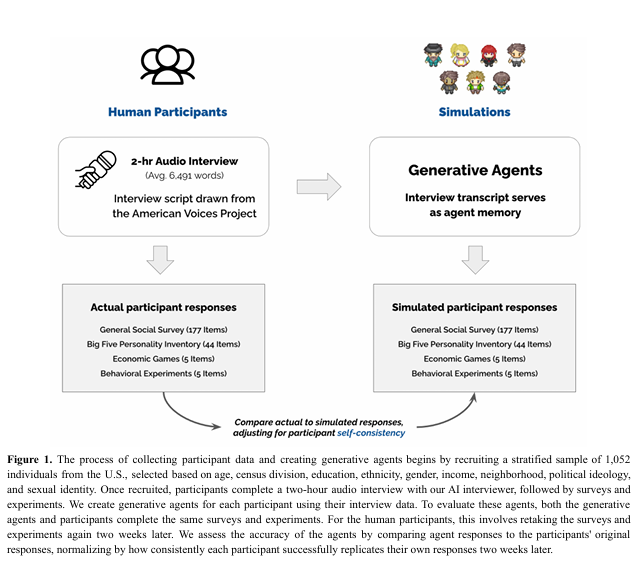
- 개인의 태도와 행동에 영향을 미치는 idiosyncratic한 요인들을 포착하기 위해 in-depth interviews 방식을 채택함
- 미국 인구 통계를 반영하여 age, gender, race, region, education, and political ideology 등을 기준으로 stratified sample된 1,052명의 참가자를 모집함
- 연구진이 개발한 AI interviewer가 semi-structured interview protocol에 따라 2시간 동안 음성 인터뷰를 진행했으며, 인당 평균 6,491 단어 분량의 transcripts를 생성함
- 특정 지표에 치우치지 않도록 사회학 프로젝트인 American Voices Project의 기존 인터뷰 프로토콜을 활용하여 인생 이야기부터 사회적 이슈까지 폭넓게 다룸
- e.g., “Tell me the story of your life—from your childhood, to education, to family and relationships, and to any major life events you may have had”
- e.g., “How have you responded to the increased focus on race and/or racism and
policing? -
Agent Architecture
- 인터뷰 전체 transcript를 model prompt에 주입하여, 해당 인물의 데이터를 기반으로 모델이 그 사람을 모사(imitate)하도록 설계함
- 여러 단계의 의사결정이 필요한 실험의 경우, 에이전트에게 이전 질문-응답 대한 memory를 텍스트 형태로 제공함
- 결과적으로 에이전트는 forced-choice prompts, surveys, surveys, and multi-stage interactional settings 기반 stimulus에 응답할 수 있음.
-
Evaluation and Validation
- 평가 구성
- the core module of the General Social Survey
- the 44-item Big Five Inventory (BFI-44)
- five well-known behavioral economic games (including the dictator game, trust game, public goods game, and prisoner’s dilemma)
- five social science experiments with control and treatment conditions
- Self-consistency 측정
- 사람의 응답 가변성을 고려하여, 참가자들이 2주 간격으로 두 번 설문에 참여하게 함으로써 개인별 응답 일관성을 측정함
- Normalized accuracy
- 에이전트의 예측 정확도를 참가자의 재현 정확도(replication accuracy)로 나누어 계산함
- normalized accuracy가 1.0에 도달하면, 에이전트가 그 사람의 응답을 예측하는 능력이 본인이 2주 후 자신의 답변을 다시 맞히는 것만큼 정확하다는 것을 뜻함
- 평가 구성
Predicting Individuals’ Attitudes and Behaviors
-
Comparison Baselines 설정
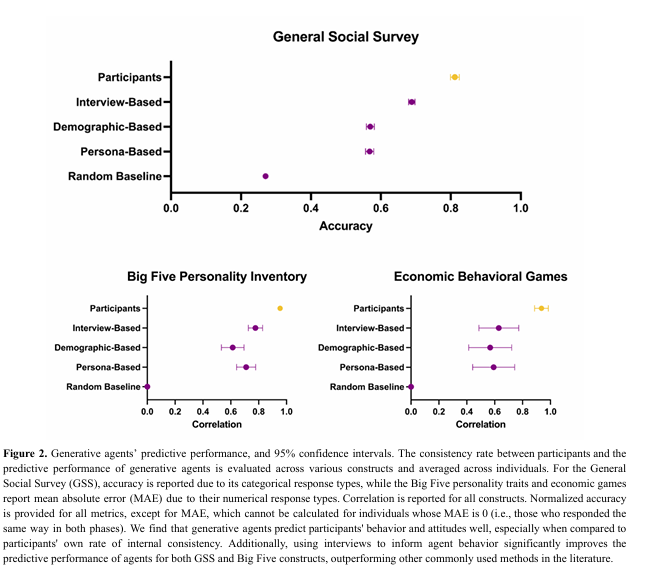
- 목적: 인터뷰가 generative agents의 예측 정확도에 기여하는 정도를 평가하기 위해 두 가지 방식과 비교함
- demographic-based agents: GSS 응답을 활용하여 age, gender, race, and political ideology 등 demographic attributes 정보를 에이전트에 제공함
- persona-based agents: 인터뷰 후 참가자들이 직접 작성한 personal background, personality, demographic details 정보를 포함한 짧은 요약 문단을 사용함
-
GSS (General Social Survey) 결과
- 평가 지표: 177개의 핵심 질문을 벤치마크로 사용 (random 확률 27.03%).
- 결과
- interview-based: normalized accuracy 0.85
- baseline 비교
- demographic-based: 0.71
- persona-based: 0.70
-> generative agents가 약 14~15 포인트 더 높음
-
Big Five Personality Traits (BFI-44) 결과
- 평가 방식: 5가지 성격 차원(openness, conscientiousness, extraversion, agreeableness, neuroticism)에 대한 응답 예측
- 결과
- interview-based: normalized correlation 0.80
- participants: 0.85
- baseline 비교
- demographic-based: 0.55
- persona-based: 0.75
-
Economic Games 결과
- 평가 항목: Dictator Game, Trust Games, Public Goods Game, Prisoner’s Dilemma 등 5가지 게임
- interview-based: normalized correlation 0.66
-
Composite Agents와의 비교
- Composite agents: 인터뷰 데이터 대신 참가자의 GSS, Big Five, Economic Games 응답 데이터를 조합하여 만든 베이스라인
- 성능 비교
- GSS: Composite(0.76) vs Interview-based(0.85)
- Big Five: Composite(0.64) vs Interview-based(0.80)
- Economic Games: Composite(0.31) vs Interview-based(0.66)
- 결론: 평가 지표와 의미적으로 유사한 설문 데이터를 직접 제공한 composite agents보다도 interview-based agents의 예측력이 더 높게 나타남. 이는 인터뷰가 개인의 정체성을 포착하는 데 독보적인 효과가 있음을 시사함
-
Impact of Content Volume - Ablation Test
- 인터뷰 transcript의 80%(전체 120분 중 약 96분 분량)를 무작위로 제거하는 ablating 실험을 진행함
- 정보량이 대폭 감소했음에도 불구하고, interview-based generative agents는 GSS에서 평균 normalized accuracy 0.79를 기록함
-
Linguistic Cues vs. Knowledge
- 인터뷰의 예측력이 linguistic cues(특유의 말투 등 언어적 스타일)에서 오는지, 아니면 지식의 깊이에서 오는지 확인하기 위해 "interview-summary" agents를 생성함
- GPT-4o를 사용하여 인터뷰 원문을 핵심 응답 쌍 위주의 bullet-pointed summaries로 변환함으로써, factual content(사실 관계)는 유지하되 본래의 언어적 특징은 제거함
- 결과
- GSS에서 normalized accuracy 0.83 달성
-> 이는 composite agents의 성능을 능가하며, 말투보다는 인터뷰를 통해 얻은 구체적인 정보 자체가 중요함을 시사함
- GSS에서 normalized accuracy 0.83 달성
-
결론
when informing language models about human behavior, interviews are more effective and efficient than survey - based methods.