배열
- 배열의 메모리 할당 (객체 생성)
배열선언
- int num[ ] = int[ ] num
- int[ ] num로 쓰는 것도 가능
정렬하는 방법 : Selection Sort(선택정렬) / Bubble Sort(버블정렬) / Insertion Sort(삽입정렬)
大 [>] 小 = 내림차순(小 -> 大)
小 [>] 大 = 오름차순(大 -> 小)내림차순 정렬방법 (데이터의 처리과정을 가독성 좋게 하기위해)
- Selection Sort = 0,1 / 0,2.. = j , j+1 / j , j+2..(왼쪽부터 채워짐)
- Bubble Sort = 0,1 / 1,2..= j , j+1 / j+1 , j+2.. (오른쪽부터 큰 수 채워짐)
🔎 [Eclipse] - [package] - [class] 생성
📌 Note Code
Test1. 10명 이내의 이름과 점수를 입력받아 점수를 내림차순(큰->작은)으로 출력
💻 입력
import java.util.Scanner;

public class Test1 {

	public static void main(String[] args) {

		Scanner sc = new Scanner(System.in); // new가 붙으면 거의 다 메모리 할당
		// java langue? - string int class 등 new가 안받는 것도 메모리에 다 올라가있음

		// 선언
		String[] name; // 조금있다가 밑에서 만들거야
		int[] score, rank;

		int inwon, i, j, t1, t3; // 인원, 정렬 2개, 점수 temp1
		String t2;// 이름 temp2

		// 10명을 넘어선 안되고, 값하나는 받아봐야하니
		do {
			System.out.print("인원수[1~10]?");// 3
			inwon = sc.nextInt();
		} while (inwon < 1 || inwon > 10);

		// 배열의 메모리 할당(name이라는 객체 생성)
		name = new String[inwon]; // 인원수만큼
		score = new int[inwon];
		rank = new int[inwon]; // 사용자에게 받는거 아님 그래서 아래에 안씀 (초기값 0)

		for (i = 0; i < inwon; i++) { // 인원수(inwon)까지 배열 반복
			System.out.print((i + 1) + "번째 이름?");
			name[i] = sc.next();

			System.out.print("점수");
			score[i] = sc.nextInt();

		}

		// 석차 초기화
		for (i = 0; i < inwon; i++) { // rank[0] = 0 (초기값 0)
			rank[i] = 1;// rank[i]+=1;
		}

		// 석차만들기
		for (i = 0; i < inwon - 1; i++) {
			for (j = i + 1; j < inwon; j++) {

				if (score[i] > score[j]) {
					rank[j]++;
				} else if (score[i] < score[j]) { // else를 쓰면 안되는 이유는 동점일 때 1,2등 승부를 내버림
					rank[i]++;
				}

			}
		}

		// 점수 내림차순 정렬
		// Selection Sort

		for (i = 0; i < inwon - 1; i++) {
			for (j = i + 1; j < inwon; j++) { // 공식 : j = i+1

				if (score[i] < score[j]) {

					t1 = score[i];
					score[i] = score[j];
					score[j] = t1;

					t2 = name[i];
					name[i] = name[j];
					name[j] = t2;

					t3 = rank[i];
					rank[i] = rank[j];
					rank[j] = t3;

				}
			}
		}

		// 출력
		// 지금 확장 x - 2개라서 ! 확장 for문 : 하나의 데이터에서 하나의 데이터(name에 있는 값)을 가져와서 순서대로 하겠다
		for (i = 0; i < inwon; i++) {
			System.out.printf("%6s %4d%4d\n", name[i], score[i], rank[i]);
		}

		/*
		 * System.out.print("이름?");//suzi 위에 for문으로 압축 name[0] = sc.next();
		 *
		 * System.out.print("점수?");//40 score[0] = sc.nextInt();
		 *
		 *
		 * System.out.print("이름?");//inna name[1] = sc.next();
		 *
		 * System.out.print("점수?");//60 score[1] = sc.nextInt();
		 *
		 *
		 * System.out.print("이름?");//edam name[2] = sc.next();
		 *
		 * System.out.print("점수?");//90 score[2] = sc.nextInt();
		 */

	}
}
💡 **출력**
인원수[1~10]?3
1번째 이름?aa
점수70
2번째 이름?bb
점수80
3번째 이름?cc
점수75
    bb   80   1
    cc   75   2
    aa   70   3
📌 Note Code
Test2. 1~45까지의 수 중 6개의 난수를 발생시켜 크기순으로 정렬 (로또)
💻 입력
import java.util.Scanner;

public class Test2 {

	public static void main(String[] args) {

		Random rd = new Random(); // Random 클래스가 메모리 할당 (객체생성)했다.
		int[] num = new int[6];

		int i, j, n, temp;

		// 랜덤다루는 방법
		n = 0; // 0번지~5번지까지 자리값 {0,1,2,3,4,5}
		while (n < 6) { // while) 몇번을 반복해야할지 모를 때!! (random이라 반복으로 꺼낼 수도 있기때문에 겹치면 다시 뽑아야함)
			num[n] = rd.nextInt(45) + 1; // 0~44까지인데 로또번호는 1~45라서 44번지(45) + 1 =45

			for (i = 0; i < n; i++) { // 공식 외우기* - i<n은 i=0처음 이므로 n<0,1,2,3...이므로 x,한번돌고,두번돌고,,,
				if (num[i] == num[n]) {
					n--;
					break;
				}
			}
			n++; // 안해주면 계속 0=>1=>0=>1로 돌기때문에
		}

		//Bubble Sort (비교가 0,1 / 1,2 /... 오른쪽 가장 큰 값) 뒤에서 부터 값이 채워짐  , , , ,5 -> , , ,4,5
		// Selection Sort (비교가 0이 기준- 0,1/0,2/,0,3....)
		for (i = 0; i < num.length - 1; i++) {

			for (j = i + 1; j < num.length; j++) { // j = i+1

				if (num[i] > num[j]) {

					temp = num[i];
					num[i] = num[j];
					num[j] = temp;
				}
			}
		}


		// 출력***
		for (int su : num) {
			System.out.printf("%4d", su);
		}

	}

}
💡 **출력**
//Random
  10  20  25  31  40  45
📌 Note Code
Test3. 주어진 배열을 오름차순으로 정렬하여라
💻 입력
import java.util.Scanner;

public class Test3 {

	public static void main(String[] args) {

		int num[] = { 28, 65, 7, 4, 10 };

		int i, j, temp;

		System.out.print("Source Data : ");
		for (i = 0; i < num.length; i++) {
			System.out.printf("%4d", num[i]);
		}
		System.out.println();

		// Bubble Sort
		for (i = 1; i < num.length; i++) {
			for (j = 0; j < num.length - i; j++) {

				if (num[j] > num[j + 1]) { // 0,1/1,2/2,3 ... = j,j+1/j+1,j+2....

					temp = num[j];
					num[j] = num[j + 1];
					num[j + 1] = temp;
				}
			}
		}

		System.out.print("Sorted Data : ");
		for (i = 0; i < num.length; i++) {
			System.out.printf("%4d", num[i]);
		}
		System.out.println();

	}

}
💡 **출력**
Source Data :   28  65   7   4  10
Sorted Data :    4   7  10  28  65
📌 Note Code
Test4. 주민번호 검사기
💻 입력
import java.util.Scanner;

public class Test4 {

	public static void main(String[] args) {


		Scanner sc = new Scanner(System.in);

		String jumin;
		int[] chk = {2,3,4,5,6,7,8,9,2,3,4,5};
		int i,tot,su;

		System.out.print("주민번호[xxxxxx-xxxxxxx]?");
		jumin = sc.next();

		if(jumin.length()!=14) { //배열의 length는 괄호 x  , 나머지 length (= 개수)는 괄호 O
			System.out.print("입력오류!!");
			return; // = stop (아래코딩 실행하지마 -> 프로그램 종료) , return(값) = 값 돌려주기
		}

		tot = 0; //(쓰레기값이기때문에 초기화하고 시작한다)
		//index: 0 1 2 3 4 5 6 7 8 9 0 1 2 3
		//jumin: 9 4 1 0 1 0 - 2 0 8 7 6 5 4
		//chk  :{2,3,4,5,6,7   8,9,2,3,4,5};

		for(i=0;i<12;i++) { // 12인이유 : -랑 맨마지막 부호비트 빼서 12 - 0~11까지 12번 돎

			if(i>=6) { //주민번호 뒷자리
				tot+=chk[i] * Integer.parseInt(jumin.substring(i+1, i+2));

			}else {//주민번호 앞자리
				tot+=chk[i] * Integer.parseInt(jumin.substring(i, i+1));


			}
		}

		su = 11 -tot%11;
		su = su%10;//[0~9]


		if(su==Integer.parseInt(jumin.substring(13))) {
			System.out.println("정확한 주민번호!");
		}else {
			System.out.println("틀린 주민번호!");
		}
	}
}

//Example
//856131-2123215
//234567 892345
/*
합 = (8*2)+(5*3)...
합 = 11 - (합%11) : 11-나머지(1~10)
합 = 합%10 = 맨마지막 식별숫자 5
*/


/*
String str = "seoul korea";
//index :     01234564789
//-> 고유인덱스 번호 부여 / 특정값을 찾을 때 없으면 -1 (0부터 시작해서 없기 때문에)!!!

//문자 추출 (str.substring) - 0부터인거 까먹지 말기
System.out.println(str.substring(0, 3));//seo [0에서부터2(항상 마지막 숫자 endIndex - 1)까지]
System.out.println(str.substring(6, 8));//ko
System.out.println(str.substring(6));//korea [6번째 자리부터 끝까지]
*/
💡 **출력**
주민번호[xxxxxx-xxxxxxx]?111111-1111118
정확한 주민번호!
📌 Note Code
Test5. 배열의 배열 (6*6표)
💻 입력
	public static void main(String[] args) {

		int[] [] arr = new int[6][6]; // 실행하는 순간 몽땅 0

		int i,j,n;

		n=0;

		for(i=0;i<5;i++) {//(i=0;i<arr.length-1;i++)

			for(j=0;j<5;j++) {
				//System.out.println(i+":"+j);

				n++; // 1이 먼저 들어가게
				arr[i][j] = n;

				arr[5][j] += n;
				arr[i][5] += n;
				arr[5][5] += n;


				/*
				0.5
				1.5
				2.5
				-------
				[i][5] += n        ->         5고정 +=누적
				*/

			}

		}
		//표 모두 출력해야하므로 최대값에 개수(변수.length) 넣기
		for(i=0;i<arr.length;i++) {
			for(j=0;j<arr.length;j++) {

				System.out.printf("%4d",arr[i][j]);
			}
			System.out.println();
		}

	}

}
💡 **출력**
   1   2   3   4   5  15
   6   7   8   9  10  40
  11  12  13  14  15  65
  16  17  18  19  20  90
  21  22  23  24  25 115
  55  60  65  70  75 325
📌 Note Code
- 2차원 배열이란 ?
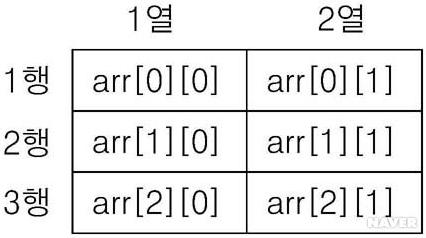
[3행 2열의 요소를 갖는 배열 arr]
출처 : 컴퓨터 개론
Test6. 2차원 배열
💻 입력
	public static void main(String[] args) {

		int[][] a = {{5,6,7},{3,4,5},{7,8,9}};
		int[][] b = {{6,7,8},{1,2,3},{4,5,6}};
		int[][] sum = new int[3][3];

		int i,j;
		for(i=0;i<a.length;i++) {
			for(j=0;j<a.length;j++) {
				sum[i][j] = a[i][j] + b[i][j];

				System.out.printf("%4d",sum[i][j]);

			}
			System.out.println();
		}

	}

}
💡 **출력**
  11  13  15
   4   6   8
  11  13  15