- python3
📎 Problem
Design a stack that supports push, pop, top, and retrieving the minimum element in constant time.
Implement the MinStack class:
MinStack()initializes the stack object.void push(int val)pushes the element val onto the stack.void pop()removes the element on the top of the stack.int top()gets the top element of the stack.int getMin()retrieves the minimum element in the stack.
You must implement a solution with O(1) time complexity for each function.
Example 1:
Input
["MinStack","push","push","push","getMin","pop","top","getMin"]
[[],[-2],[0],[-3],[],[],[],[]]

Output
[null,null,null,null,-3,null,0,-2]

Explanation
MinStack minStack = new MinStack();
minStack.push(-2);
minStack.push(0);
minStack.push(-3);
minStack.getMin(); // return -3
minStack.pop();
minStack.top();    // return 0
minStack.getMin(); // return -2
Constraints:
- -231 <= val <= 231 - 1
- Methods pop, top and getMin operations will always be called on non-empty stacks.
- At most 3 * 104 calls will be made to push, pop, top, and getMin.
Plan Solution
Min 값을 스택에서 O(1) 시간으로 검색하는 법은 가장 윗 스택에 Min값을 함께 저장하는 것이다. 그러므로 값을 넣으면서 최소값과 현재값을 비교해 현재값, 최소값을 쌍으로 저장한다.
Code
class MinStack:

    def __init__(self):
        self.stack = []

    def push(self, val: int) -> None:
        if not self.stack:
            self.stack.append((val,val))
        else:
            self.stack.append((val, min(val, self.stack[-1][1])))


    def pop(self) -> None:
        if self.stack:
            self.stack.pop()


    def top(self) -> int:
        if self.stack:
            return self.stack[-1][0]
        else:
            return None


    def getMin(self) -> int:
        if self.stack:
            return self.stack[-1][1]
        else:
            return None


# Your MinStack object will be instantiated and called as such:
# obj = MinStack()
# obj.push(val)
# obj.pop()
# param_3 = obj.top()
# param_4 = obj.getMin()
Result
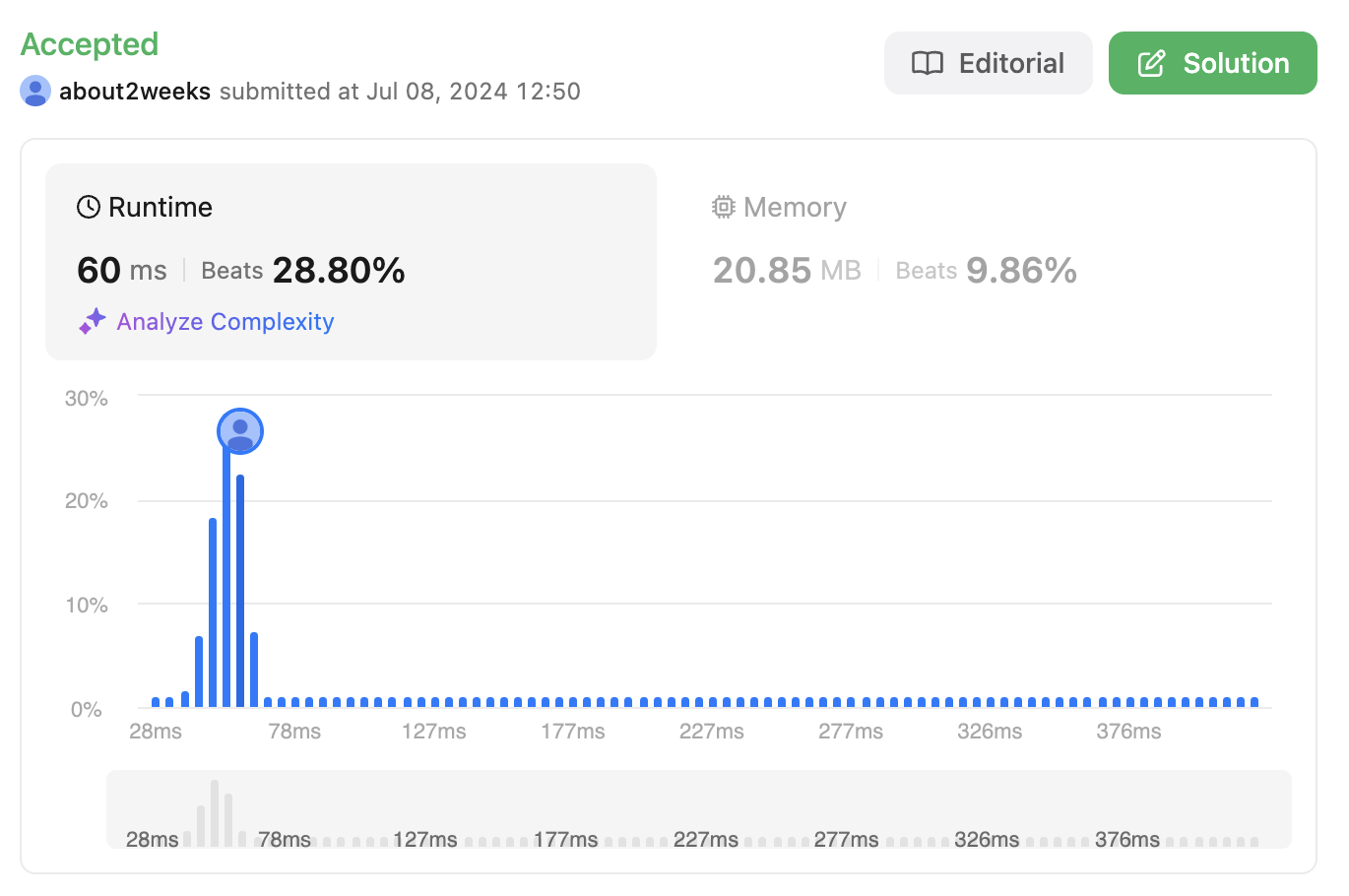
- Time Complexity : O(1) each func
- Space Complexity : O(n) for stack

알쏭달쏭혀요