Content Moderation Outsourcing: How Can Platforms Protect Users and Their Brands?
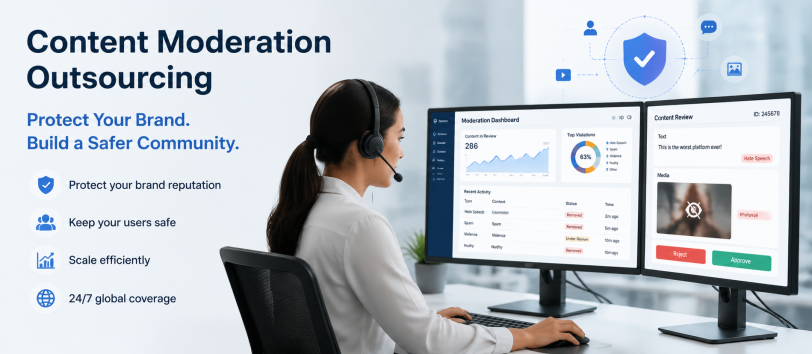
User-generated content is one of the main drivers of engagement for social platforms, marketplaces, entertainment services, and online communities. But as the number of posts, comments, images, videos, and live interactions grows, reviewing that content becomes increasingly difficult to manage internally.
A single piece of harmful content can affect more than one user. Hate speech, explicit material, scams, harassment, or misleading content can damage trust, create complaints, and put additional pressure on platform operators.
This is why many digital businesses consider content moderation outsourcing. Instead of building a large internal moderation operation, companies can work with specialized teams that combine trained reviewers, defined moderation policies, and technology-assisted workflows.
The goal is not simply to remove inappropriate content. Effective moderation helps platforms maintain consistent community standards while allowing internal teams to focus on product growth, user engagement, and other business priorities.
What Is Content Moderation Outsourcing?
Content moderation outsourcing means using an external service provider to review and manage user-generated content according to a platform's policies and moderation requirements.
Depending on the platform, this may include text, images, videos, comments, product reviews, live-stream content, or user reports. Moderators may identify policy violations, review flagged content, escalate complex cases, and apply community guidelines consistently across different markets.
The exact scope depends on the platform's needs. A company may outsource its entire moderation operation or use an external team for specific languages, content types, markets, or periods of higher demand.
The important consideration is maintaining clear operational control. The platform should still define its community standards, escalation rules, and policy requirements while the outsourcing partner provides the people and operational capacity needed to apply them.
Why Is Content Moderation Becoming More Difficult?
The challenge is not simply the amount of content. It is also the variety and complexity of that content.
A growing platform may receive thousands or millions of interactions across multiple channels. Moderators must distinguish between acceptable and harmful content while considering context, language, cultural differences, and constantly changing platform policies.
For international businesses, the challenge becomes even greater. A phrase, image, or behavior that appears acceptable in one market may have a completely different meaning in another.
At the same time, users expect platforms to respond quickly when they encounter harmful or inappropriate material. Slow moderation can allow problematic content to remain visible for too long, potentially affecting user trust and brand reputation.
These factors make moderation a continuous operational responsibility rather than a one-time technology project.
What Does a Content Moderation Team Typically Handle?
A professional moderation operation can cover several different types of work.
Reviewing User-Generated Content
Moderators may review text, images, videos, comments, profiles, or live content against the platform's community guidelines.
The objective is not simply to identify prohibited material. Moderators also need to understand the context behind a piece of content and apply the relevant policy consistently.
Managing User Reports
Platforms often rely on users to report content they believe violates community standards. These reports require timely review and appropriate action.
An outsourced moderation team can help process large numbers of reports while escalating cases that require additional investigation or specialized judgment.
Handling Complex and Borderline Cases
Automated systems can identify obvious violations, but some cases are more difficult.
Satire, cultural references, ambiguous language, and context-dependent content may require human judgment. A structured escalation process allows experienced reviewers to handle these cases rather than relying entirely on automated decisions.
Supporting Multiple Markets and Languages
International platforms may need moderation teams that understand different languages and cultural contexts.
Local knowledge can be particularly important when reviewing slang, regional references, sensitive topics, and content that may have different interpretations across markets.
AI and Human Moderation: Which Approach Works Best?
AI has become an important part of modern content moderation, particularly when platforms need to process large volumes of content quickly.
Automated systems can help identify obvious policy violations, prioritize potentially harmful material, and reduce the amount of content that requires manual review.
However, automation has limitations.
A system may recognize certain patterns but struggle to understand context, irony, cultural references, or ambiguous cases. Human reviewers remain important when a moderation decision requires interpretation or judgment.
For this reason, many platforms use a hybrid model in which AI handles high-volume screening while human moderators review more complex cases.
The effectiveness of this model depends on how well the two layers work together. Clear escalation rules, quality monitoring, reviewer training, and regular policy updates are just as important as the underlying technology.
How Content Moderation Affects the Customer Experience
Content moderation is sometimes treated as a separate function from customer experience, but the two are closely connected.
When users encounter spam, harassment, inappropriate material, or fraudulent activity, their perception of the platform can change quickly. Poor moderation can make users feel that the platform is difficult or unsafe to use.
This is particularly relevant for e-commerce and retail platforms. Customer interactions increasingly take place across websites, apps, social channels, messaging platforms, and other digital touchpoints. Businesses working toward an omnichannel customer experience retail model need to consider not only how customers receive service, but also how they interact with user-generated content across these environments.
A consistent moderation approach can therefore support the broader digital customer experience. It helps create a more reliable environment for customers while reducing the operational burden on internal teams.
When Should a Business Consider Outsourcing Content Moderation?
There is no single point at which every company should outsource moderation. However, several operational situations can indicate that external support may be useful.
Rapid growth is one common trigger. When content volume increases faster than an internal team can handle, response times and moderation quality may begin to suffer.
International expansion is another. Supporting multiple languages and markets can require additional recruitment, training, quality assurance, and management resources.
Seasonal or unpredictable demand can also create challenges. A platform may need significantly more moderation capacity during product launches, major campaigns, or periods of unusually high user activity without wanting to maintain that staffing level year-round.
Outsourcing can also make sense when moderation is taking experienced employees away from higher-value responsibilities. In these situations, external operational capacity can allow internal teams to focus on policy ownership, product development, and strategic decisions.
What Are the Benefits of Content Moderation Outsourcing?
The biggest advantage is additional operational capacity without requiring the business to build every part of the moderation function internally.
An experienced provider may already have recruitment processes, reviewer training, quality assurance procedures, multilingual teams, and moderation workflows in place. This can reduce the amount of infrastructure the business needs to establish itself.
Scalability is another important benefit. External teams can potentially adjust staffing as content volumes change, which can be useful for businesses with seasonal demand or rapidly growing user communities.
Outsourcing can also provide access to specialized knowledge. Moderation providers may have experience handling different content categories, languages, markets, and policy environments.
The technology component can provide another advantage. When AI-assisted workflows are combined with trained human reviewers, platforms can process large volumes efficiently while retaining human judgment for more complicated decisions.
What Challenges Should You Consider Before Outsourcing?
Outsourcing moderation does not eliminate operational risks. It changes how those risks are managed.
Data Security
Moderation workflows may involve user-generated content and potentially sensitive information. Businesses should understand how content is accessed, stored, transferred, and protected by the service provider.
Security requirements should be established before operations begin rather than treated as an afterthought.
Quality and Consistency
Different reviewers may interpret the same piece of content differently without proper training and calibration.
A strong moderation operation should therefore include quality monitoring, clear decision standards, regular training, and escalation procedures for uncertain cases.
Cultural Context
Global platforms need more than language coverage. Moderators must understand the cultural context behind the content they review.
Native-language capabilities and market-specific training can help reduce incorrect decisions caused by unfamiliar terminology or cultural references.
Moderator Wellbeing
Moderators may regularly encounter disturbing or highly sensitive material. Businesses evaluating an outsourcing provider should therefore ask how the provider supports its moderation teams.
Training, appropriate workload management, psychological support, and clear procedures for handling sensitive content can all contribute to a more sustainable operation.
How Should You Choose a Content Moderation Outsourcing Partner?
Choosing a provider should begin with your own operational requirements.
Consider the types of content that need to be reviewed, the languages and markets involved, expected content volumes, required coverage hours, and the level of human judgment involved.
It is also important to understand how the provider combines technology and human review. Instead of simply asking whether a company uses AI, ask what AI handles, which cases are escalated to humans, and how moderation decisions are monitored.
Reporting is another important consideration. A provider should be able to give you visibility into moderation volumes, policy violations, quality results, escalation patterns, and other metrics relevant to your operation.
Businesses should also evaluate how the moderation operation interacts with broader customer service functions. For platforms where users may move between social channels, messaging, websites, and customer support, coordinated operations can help create a more consistent experience. In some cases, Customer Service Outsourcing Services can complement moderation by giving businesses additional support capacity for customer inquiries, reports, and escalations.
What Does a Strong Moderation Operation Look Like?
A mature moderation operation is not simply a large team reviewing content around the clock.
It combines clear policies, trained reviewers, appropriate technology, quality management, escalation procedures, and regular performance analysis.
AI can help process high volumes and identify potential violations. Human reviewers can provide context and judgment. Quality teams can monitor decisions and identify areas where policies or training need to be improved.
This creates a continuous operating cycle rather than a simple approve-or-reject process.
As platforms grow, moderation policies may also need to evolve. New features create new types of user behavior, while new markets introduce additional cultural and regulatory considerations. A flexible moderation operation needs to adapt alongside the platform.
Frequently Asked Questions
Is content moderation outsourcing suitable for small businesses?
Yes. Smaller platforms can outsource specific moderation tasks, languages, or peak-period workloads instead of building a large internal team. The appropriate model depends on content volume, risk level, and operational requirements.
Can AI completely replace human content moderators?
Not in every situation. AI can process large volumes and identify many obvious violations, but complex cases often require context and human judgment. A combination of automated screening and human review can provide a more flexible approach.
How can businesses maintain control after outsourcing moderation?
The business should retain ownership of its community guidelines, policies, escalation rules, and performance standards. Regular reporting and quality reviews can also provide visibility into how moderation decisions are being made.
What should businesses look for in a moderation provider?
Important factors include moderation experience, language coverage, scalability, AI and human capabilities, quality assurance, data security, reporting, and support for moderator wellbeing.
Conclusion
As digital platforms grow, the amount and complexity of user-generated content can quickly become difficult to manage with a small internal team.
Content moderation outsourcing can give businesses access to additional capacity, multilingual expertise, moderation technology, and trained human reviewers without requiring them to build every operational function themselves.
However, the right partner should be evaluated on more than staffing capacity. Policy consistency, quality management, cultural understanding, security, technology, and human oversight all influence the effectiveness of a moderation operation.
For platforms serving customers across multiple channels and markets, moderation can also become part of the broader customer experience. The stronger the connection between moderation, customer support, and digital operations, the easier it becomes to maintain a reliable experience as the platform scales.
Website: www.nexlence.com
Nexlence: https://www.nexlence.com/about-us
Office: #17-02B, Suntec Tower 3, 8 Temasek Boulevard, Singapore 038988
Email: contact@nexlence.com
LinkedIn: https://www.linkedin.com/company/nexlence1