How to Choose the Right MLM Software for Your Small Business in 2026
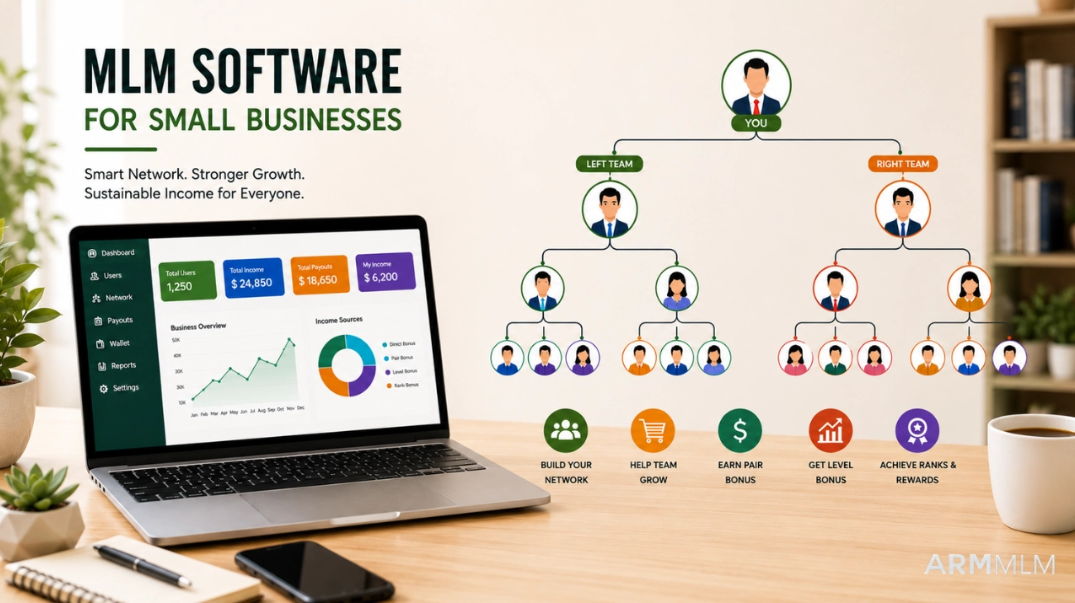
Starting a network marketing business may be relatively simple, but managing it efficiently as it grows is a different challenge. A small business may begin with a handful of distributors and basic spreadsheets, but increasing sales, distributor registrations, commissions, team structures, and payouts can quickly make manual management difficult.
This is why choosing the right MLM software for small businesses has become an important decision in 2026. The right platform can help automate repetitive tasks, organize distributor information, manage compensation plans, track performance, and provide a better digital experience for both administrators and distributors.
However, not every MLM software platform is the same. Businesses need to look beyond feature lists and choose a solution that matches their compensation model, current requirements, future growth plans, and budget.
1. Start With Your Compensation Plan
The first thing a small business should consider is its compensation structure.
Different MLM businesses use different models, including:
- Binary MLM plan
- Unilevel MLM plan
- Matrix MLM plan
- Hybrid MLM plan
- Stair Step or customized plans
Your software should be capable of supporting the compensation structure you actually use.
For example, a Binary business may need features for two-leg management, volume tracking, and placement, while a Unilevel business may require level-based commission calculations. A Hybrid model may require more customization because it combines different compensation mechanisms.
Before choosing software, clearly document how distributors earn commissions and what qualifications apply.
2. Look for Commission Automation
Commission processing can become one of the most time-consuming tasks in an MLM business.
As the network grows, commissions may depend on personal sales, team sales, levels, ranks, bonuses, and other qualification rules.
Manual calculations can take considerable time and may increase the risk of errors.
A good MLM commission software solution should allow businesses to configure commission rules and automate eligible calculations.
This can help administrators spend less time working on spreadsheets and more time focusing on business development and distributor support.
3. Check Distributor Management Features
Distributors are the foundation of a network marketing business, so managing their information efficiently is essential.
The software should provide a centralized way to manage distributor profiles, registrations, account status, sales activity, team information, and other relevant data.
A good distributor management system should also make it easy for administrators to search, update, and review information without moving between multiple tools.
For distributors, access to their own business information through a dashboard can make the overall experience more convenient.
4. Consider Genealogy Management
Genealogy is another important part of MLM software.
A genealogy tree shows how distributors are connected within the organization. Depending on the compensation plan, the structure may contain levels, legs, positions, or other relationships.
The software should make the genealogy easy to understand and navigate.
Visual genealogy tools can help administrators monitor network growth while allowing distributors to see their own teams and organizational structure.
This becomes especially valuable when the network grows beyond a size that can be comfortably managed through spreadsheets.
5. Choose Software That Can Scale
Small businesses should not choose software only according to their current distributor count.
A company may start with 50 distributors but eventually grow to thousands. If the software cannot handle this expansion, migrating to another platform later can become expensive and disruptive.
When evaluating MLM software for small businesses, consider:
- Maximum user capacity
- Database performance
- Transaction handling
- Genealogy scalability
- Reporting capabilities
- Server requirements
- Upgrade options
The goal is to choose technology that can grow with the business.
6. Evaluate the Distributor Experience
Software should not only work well for administrators.
Distributors are also users, and their experience can influence how effectively they interact with the platform.
A distributor dashboard should make it easy to access information such as:
- Commission earnings
- Team performance
- Sales activity
- Genealogy
- Rank progress
- Payout history
A clean and mobile-friendly interface can make these features easier to use, especially for distributors who manage their business primarily from smartphones.
7. Check Payment and Payout Options
Commission management does not end when the software calculates earnings.
Businesses also need a reliable process for managing payouts.
Depending on the platform, MLM software may provide e-wallet functionality and integrations with payment gateways or other financial services.
Before choosing a solution, businesses should check whether the available payment options support their target markets and business requirements.
It is also important to understand applicable financial, tax, and regulatory requirements in each market.
8. Look for Reporting and Analytics
Data can help small businesses understand how their network is performing.
Instead of relying on assumptions, administrators can use reports to monitor:
- Sales performance
- Distributor activity
- Team growth
- Commission expenses
- Rank progression
- Network performance
Good reporting tools should make information easy to understand rather than simply displaying large amounts of raw data.
As the business grows, analytics can also help management identify trends and areas that may need additional attention.
9. Consider Security and Data Protection
MLM platforms handle important information, including distributor details, transaction data, commission information, and business records.
Security should therefore be an important part of the selection process.
Ask the software provider about:
- Data protection
- User access controls
- Backups
- Authentication
- Server security
- Software updates
- Data recovery
Businesses should also understand how their data is stored and what security responsibilities are shared between the software provider and the company.
10. Check Integration Capabilities
An MLM business rarely operates in isolation.
As it grows, the company may need to connect its MLM platform with an e-commerce website, payment gateway, CRM, accounting system, communication platform, or other business tools.
API and integration support can make it easier to connect these systems.
This is particularly useful for businesses that want to create a more connected digital ecosystem rather than maintaining separate databases.
11. Think About Customization
Every network marketing business has slightly different requirements.
Some businesses may need a standard compensation plan, while others may have customized commissions, ranks, bonuses, or qualification rules.
The software should provide enough flexibility to accommodate these requirements.
However, customization should not make the platform unnecessarily difficult to manage. Businesses should find a balance between flexibility and simplicity.
12. Don't Ignore Technical Support
Even good software may require technical assistance during setup, customization, updates, or troubleshooting.
Before purchasing an MLM platform, understand what support is included.
Consider:
- Implementation support
- Technical assistance
- Software updates
- Maintenance
- Training
- Response times
- Custom development availability
Reliable support can be particularly valuable for small businesses that do not have a large internal IT team.
How ARM MLM Software Supports Small Businesses
ARM MLM Software provides a centralized platform designed to help businesses manage their MLM operations through digital tools and automation.
The platform supports compensation models such as Binary, Unilevel, Matrix, and Hybrid and provides features for distributor management, genealogy, commission processing, rank management, e-wallets, payouts, reporting, KYC, mobile access, and integrations.
For a small business, these capabilities can provide a structured foundation for managing its distributor network while leaving room for future expansion.
The platform can also help businesses reduce reliance on manual processes by bringing important MLM activities into one system.
Final Thoughts
Choosing the right MLM software for small businesses is ultimately about finding a platform that fits the way the business operates today while providing enough flexibility for tomorrow.
A strong solution should support the company's compensation plan, automate commissions, simplify distributor management, provide clear genealogy and reporting, support secure payouts, and deliver a user-friendly experience.
Price is certainly an important consideration for a small business, but it should not be the only one. Scalability, security, customization, integrations, support, and ease of use can have a much greater impact on the long-term value of the software.
As network marketing continues to become more technology-driven in 2026, choosing the right software early can help small businesses build organized operations and create a stronger foundation for sustainable growth.
Learn more: https://www.armmlm.com/mlm-software-for-small-businesses/