
객체 지향 프로그래밍 (Object-Oriented Programming, OOP)
💡 기계적인 부품들을 조립해 제품을 만들 듯이 개발 할 때에도 객체들을 조립해 프로그램을 작성할 수 있도록 한 프로그래밍 기법
- 장점
- 상속을 통한 재사용과 시스템의 확장이 용이
- 코드의 재활용성이 높음
- 자연적인 모델링에 의해 분석과 설계가 효율적
- 사용자와 개발자 사이의 이해력 높임
- 대형 프로그램의 작성이 용이
- 소프트웨어 개발 및 유지보수가 용이
- 단점
- 프로그래밍 구현을 지원하는 정형화된 분석 및 설계 방법이 없음
- 구현 시 처리 시간이 지연됨
객체
💡 데이터(속성)와 이를 처리하기 위한 연산(메소드)를 결합시킨 실체
데이터 구조와 그 위에서 수행되는 연산들을 가지고 있는 모듈
-
속성
한 클래스 내에 속한 객체들이 가지고 있는 데이터 값을 단위별로 정의하는 것
ex) 성질, 분류, 식별, 수량, 현재상태 -
메소드
객체가 메시지를 받아 실행해야 할 때 구체적인 연산을 정의하는 것
객체의 상태를 참조하거나 변경하는 수단
객체지향 프로그래밍의 특징
캡슐화 (Encapsulation)
데이터(속성)와 데이터를 처리하는 함수를 하나로 묶는 것
캡슐화된 객체의 세부 내용은 외부에 은폐(정보 은닉)되어 변경이 발생할 때 오류의 파급 효과가 적다.
캡슐화된 객체는 재사용이 용이
- 정보은닉
다른 객체에게 자신의 정보를 숨기고 자신의 연산만을 통하여 접근을 허용하는 것 (캡슐화에 의해 이루어짐)
class Encap:
  def __init__(self,value):
  	self.value = value
  	print('init :', self.value)

  def _set(self):
  	print('set :', self.value)

  def printTest(self):
  	print('printTest :', self.value)

# object 생성
e = Encap(10)

# object 실행
e.__init__(20)
e._set()
e.printTest()


# result
>> init : 20
>> set : 20
>> printTest : 20
추상화 (Abstraction)
중요한 부분에 중점을 두어 개략화하는 것
불필요한 부분을 생략하고 객체의 속성 중 가장 중요한 것에만 중점을 두어 개략화 하는 것.(즉 모델화)
- 추상화의 종류
- 과정추상화
- 데이터 추상화
- 제어 추상화
# 추상화 코드

from abc import *    # abc 모듈의 클래스와 메소드를 갖고온다.(abc : abstract base class)

# 추상 클래스
class People(metaclass=ABCMeta):

# 추상 메소드
    @abstractmethod # 추상 메소드에는 @abstractmethod를 선언해줘야 함
    def charecter(self):
        pass        # 추상 메소드는 기능 내 실제 실행내용은 없다.

# 상속받는 클래스
class Student(People):
    def charecter(self, pow, think):
        self.pow = pow
        self.think = think

        print('체력: {0}'.format(self.pow))
        print('생각: {0}'.format(self.think))

# 상속받는 클래스
class Driver(People):
    def charecter(self, pow, think):
        self.pow = pow
        self.think = think

        print('체력: {0}'.format(self.pow))
        print('생각: {0}'.format(self.think))

# Student object 생성
peo1 = Student()
print('Student : ')

# Student object 실행
peo1.charecter(30, 10)

print()

# Driver object 생성
peo2 = Driver()
print('Driver : ')

# Driver object 실행
peo2.charecter(10, 10)
result
Student :
체력: 30
생각: 10

Driver :
체력: 10
생각: 10
상속성 (Inheritance)
상위 클래스의 속성을 하위 클래스가 물려받는 것
이미 정의된 부모 클래스의 모든 속성과 연산은 하위 클래스에서 동일하게 적용 됨
- 상속성의 종류
- 단일 상속 : 하나의 상위 클래스로부터 상속받는 것
- 다중 상속 : 여러 개의 상위 클래스로부터 상속받는 것
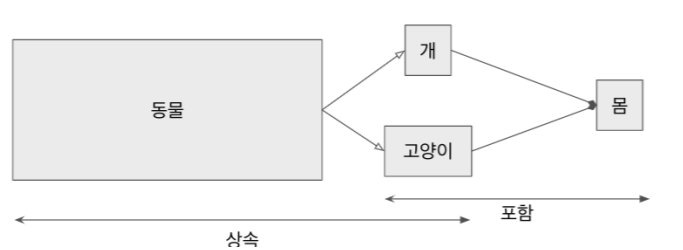
Code
# 클래스 선언
class Person:
    def __init__(self, name):
        self.name = name

class Student(Person):      # Person 클래스 상속받음(name 변수를 파라미터로 재사용)
    def study(self):
        print (self.name + " studies hard")

class Employee(Person):     # Person 클래스 상속받음(name 변수를 파라미터로 재사용)
    def work(self):
        print (self.name + " works hard")

# object 생성
s = Student("Dave")
e = Employee("David")

# object 실행
s.study()
e.work()
result
Dave studies hard
David works hard
포함 Code
# 클래스 선언
class Person:
    def __init__(self, age):
        self.age = age

    def printPerson(self):          # 포함을 사용하기 위한 Person 클래스의 다른 함수
        print('Person_printPerson')

class Student:
    def __init__(self, age):
        self.age = age
        self.p = Person(self)       # Student가 Person에 포함되기 위해, Person 클래스에 대한 object 생성

    def aging(self):
        return self.age

    def personComposit(self,age):
        return age, self.p.printPerson()  # 포함개념적용된 Student 클래스의 Person object의 함수


# object 생성
s = Student(10) # 한 번 생성된 object는 파라미터가 변하지 않는 이상 출력값 또한 변하지 않는다.
p = Person(20)

# object 실행
print("s.aging() :", s.aging())   # result : 10


print('test')
print('print with test', "s.personComposit() :", s.personComposit(40))


print('test2')
print('print with test2', "p.printPerson() :", p.printPerson())
result
s.aging() : 10

test
Person_printPerson
print with test s.personComposit() : (40, None)

test2
Person_printPerson
print with test2 p.printPerson() : None
다형성 (Polymorphism)
객체가 가지고 있는 고유한 응답하는 능력
객체는 동일한 메소드명을 사용하며 같은 의미의 응답을 한다.
Code
class Person:
  def run(self):
    print('run')

  def play(self):
    print('play')

class Student(Person):
  def run(self):
    print('fast run')

  def play(self):
    print('play')

class teacher(Person):
  def teach(self):
    print('teach')

  def play(self):
    print('teach play')


# 리스트를 생성한다.
number = list()

# 생성한 리스트에 다형성 개념을 위해 다른 클래스(Student, teacher)가 상위 클래스(Person)를 참조할 수 있도록 한다.
number.append(Student())  # 리스트 끝에 서브 클래스 Student()를 넣습니다.
number.append(teacher())  # 다시 리스트 끝에 서브 클래스 teacher()를 넣습니다.

print("=========")
for Student in number:
    Student.run()     # 상위클래스인 Person의 run은 상속하여 사용하지만 내용은 다르다.


print("=========")
for teacher in number:
    teacher.play()    # 상위클래스인 Person의 play는 상속하여 사용하지만 내용은 다르다.
result
=========
fast run
run
=========
play
teach play
절차적 프로그래밍(PP, Procedural Programming) 과 비교
절차적 프로그래밍(PP)
Code
# 케이스 1 : 함수활용
def carAttribute():
  speed = 50
  color = 'black'
  model = 'CarModel'
  return speed,color,model


# 케이스 2 : 변수활용
speed = 20
color = 'yello'
model = 'AnotherCar'

print("Car Procedural Create Complete")
print("#Case 1 : Car Attribute ", carAttribute()) # return값을 통해 함수 요소값을 확인할 수 있다.
print("#Case 2 : Car Attribute ", speed,color,model) # 변수를 통해서만 값을 호출하므로, 소스코드가 증가한다.
result
Car Procedural Create Complete
#Case 1 : Car Attribute  (50, 'black', 'CarModel')
#Case 2 : Car Attribute  20 yello AnotherCar
객체지향 프로그래밍(OOP)
Code
# 아래와 같이 클래스 선언 순서에 관계없이 실행된다.
# 절차 프로그래밍과 다르게 기능별로 수행되기 때문이다.
class Bus:
  def __init__(self, speed, color):
      self.speed = speed
      self.color = color

  def drive_bus(self):
    self.speed = 70

class Car:
  def __init__(self, speed, color, model):
    self.speed = speed
    self.color = color
    self.model = model

  def drive(self):
    self.speed = 50


print("Car Speed by drive :", myCar.speed) # speed 변수에 값이 할당되지 않았기 때문에 0 출력
print("Bus Speed by drive :", myBus.speed)


#Car object method Call
myCar.drive()
myBus.drive_bus()
print("\ndriving speed")
print("Car Speed by drive :", myCar.speed) # 입출력순서에 상관없이 speed 개체를 변경하여 볼 수 있다.
print("Bus Speed by drive :", myBus.speed)
result
Car Speed by drive : 0
Bus Speed by drive : 0

driving speed
Car Speed by drive : 50
Bus Speed by drive : 70
life is dancing