✅ 한 것들
- 윤성우의 열혈 TCP/IP 소켓 프로그래밍
- 프로그래머스
📖 윤성우의 열혈 TCP/IP 소켓 프로그래밍
10-3 시그널 핸들링
시그널 핸들링: signal()로 자식이 종료되면 실행할 함수를 운영체제에 등록
시그널과 signal 함수
signal()
- 매개변수 :
int signo,void(*func)(int) - 반환형 : 매개변수가 int고 반환형이 void인 함수 포인터
- int로 특정 상황에 대한 정보를, 함수 포인터로 특정 상황에 호출될 함수 포인터 전달
- SIGARLM : alarm()으로 등록된 시간이 지난 상황
- SIGINT : CTRL+C가 입력된 상황
- SIGCHLD : 자식 프로세스가 종료된 상황
- 예시 : signal(SIGCHLD, mychild);
alarm()
- 지정한 시간 이후 SIGALRM 시그널 발생
- 0을 인자로 전달하면 이전에 설정된 SIGALRM 시그널 예약 취소
- alarm()으로 예약만 해두고 signal()로 함수 호출 지정 안 하면 프로세스 그냥 종료됨
void timeout(int sig)
{
	if(sig==SIGALRM)
		puts("Time out!");
	alarm(2);
}

void keycontrol(int sig)
{
	if(sig==SIGINT)
		puts("CTRL+C pressed");
}

int main(int argc, char *argv[])
{
	int i;
	signal(SIGALRM, timeout);
	signal(SIGINT, keycontrol);
	alarm(2);

	for(i=0; i<3; i++)
	{
		puts("wait...");
		sleep(100);
	}
	return 0;
}- 100초를 3번, 300초를 기다리지 않고 10초 이내에 종료된다
- alarm()이 프로세스를 깨운 뒤에 다시 재워주진 않기 때문이다
- CTRL+C를 누르면 더 빨리 끝난다
sigaction 함수를 이용한 시그널 핸들링
sigaction()
- signal() 대체 가능
- signal()과 달리 운영체제 별 동작 방식에 차이가 없다
- 그래서 대부분 sigaction() 쓴다
struct sigaction
{
    void (*sa_handler)(int);
    sigset_t sa_mask;
    int sa_flags;
}
sigaction() 호출하려면 sigaction이라는 구조체 선언 및 초기화해야 함
- sa_handler에 시그널 핸들러 함수 포인터 지정
- sa_mask는 모든 비트를 0으로 초기화
- sa_flags는 0으로 초기화
- sa_mask와 sa_flag는 시그널 관련 옵션 및 특성 지정에 사용됨
void timeout(int sig)
{
	if(sig==SIGALRM)
		puts("Time out!");
	alarm(2);
}

int main(int argc, char *argv[])
{
	int i;
	struct sigaction act;
	act.sa_handler=timeout;
	sigemptyset(&act.sa_mask);
	act.sa_flags=0;
	sigaction(SIGALRM, &act, 0);

	alarm(2);

	for(i=0; i<3; i++)
	{
		puts("wait...");
		sleep(100);
	}
	return 0;
}
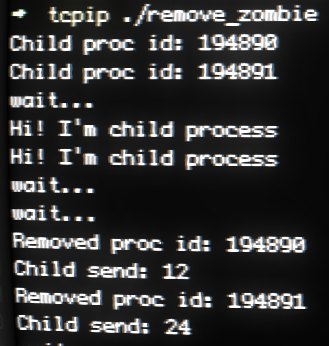
시그널 핸들링을 통한 좀비 프로세스의 소멸
void read_childproc(int sig)
{
	int status;
	pid_t id=waitpid(-1, &status, WNOHANG);
	if(WIFEXITED(status))
	{
		printf("Removed proc id: %d \n", id);
		printf("Child send: %d \n", WEXITSTATUS(status));
	}
}

int main(int argc, char *argv[])
{
	pid_t pid;
	struct sigaction act;
	act.sa_handler=read_childproc;
	sigemptyset(&act.sa_mask);
	act.sa_flags = 0;
	sigaction(SIGCHLD, &act, 0);

	pid=fork();
	if(pid==0) /* 자식 프로세스 실행 영역 */
	{
		puts("Hi! I'm child process");
		sleep(10);
		return 12;
	}
	else /* 부모 프로세스 실행 영역 */
	{
		printf("Child proc id: %d \n", pid);
		pid=fork();
		if(pid==0) /* 또 다른 자식 프로세스 실행 영역 */
		{
			puts("Hi! I'm child process");
			sleep(10);
			exit(24);
		}
		else
		{
			int i;
			printf("Child proc id: %d \n", pid);
			for(i=0; i<5; i++)
			{
				puts("wait...");
				sleep(5);
			}
		}
	}
	return 0;
}
⚔️ 프로그래머스
리틀 프렌즈 사천성
string solution(int m, int n, vector<string> board) {
    string answer = "";

    // 시작
    // 전체를 훑는다
    //   흰 칸은 전부 visited 처리
    //   바로 짝이 연결되는 문자들은 우선순위 큐에 넣고 visited 처리
    //   흰 칸에 노출된 문자는 알파벳 배열에 기록한 뒤 visited 처리

    // 제거 시도
    //   알파벳 배열을 훑으며 두번째 배열이 차 있으면 제거 시도한다
    //   (하우, 우하 두 방향 시도)
    //   제거가 가능하다면 우선순위 큐에 넣는다
    //   우선순위 큐에서 하나를 꺼내고 제거 가능한지 확인한다.
    //   제거 가능 여부 확인 중 벽을 만났다면 바로 IMPOSSIBLE

    // 추가 탐색
    //   우선순위 큐에서 하나 뺀 후에 제거한다
    //   제거 시 해당 문자의 알파벳 배열 값은 초기화한다
    //   제거된 문자 두개와 붙어있고 visited하지 않은 타일들을 알파벳 배열에 기록한다
    //   알파벳 배열을 다시 훑으며 연결이 가능한 값이 있는지 확인한다

    // 종료
    //   우선순위 큐가 비었으면 while문을 종료한다
    //   알파벳 배열을 확인하고, 아직 값이 남아있다면 IMPOSSIBLE

    vvp alpbt = vvp(26, vp(2, {-1,-1}));
    vvb visited = vvb(m,vb(n));
    vi diri = {0,0,1,-1};
    vi dirj = {1,-1,0,0};
    priority_queue<int, vector<int>, greater<int>> pq;

    for(int i=0; i<m; i++)
    {
        for(int j=0; j<n; j++)
        {
            if(visited[i][j]) continue;
            char b = board[i][j];
            if(b=='.' || b=='*')
            {
                visited[i][j] = true;
            }
            else
            {
                for(int k=0; k<4; k++)
                {
                    int newi = i+diri[k];
                    int newj = j+dirj[k];
                    if(newi<0||m<=newi||newj<0||n<=newj) continue;
                    int idx = b-'A';
                    if(board[newi][newj] == b)
                    {
                        alpbt[idx][0] = {i,j};
                        alpbt[idx][1] = {newi, newj};
                        visited[i][j]==true;
                        visited[newi][newj]=true;
                        pq.push(idx);
                        break;
                    }
                    else if (board[newi][newj] == '.')
                    {
                        if(alpbt[idx][0].first == -1)
                        {

                        }
                    }
                }
            }
        }
    }


    return answer;
}
코드가 말도 안되게 길어지길래 정답을 봤더니
내 코드는 과최적화를 하고 있었다.
타일들 기록해두고 계속 순회하면서 제거 가능한지만 보면 됐다.
그럼 시간 복잡도는 O((알파벳개수^2*(m+n)) 라서, 충분히 가능
배열도 알파벳을 인덱스로 그대로 사용하고, 순서대로 훑으니까 우선순위 큐로 억지 정렬 해줄 필요도 없다
using namespace std;
typedef pair<int, int> pii;
typedef vector<pii> vp;
typedef vector<vp> vvp;

bool HorizontalEmpty(int li, int hi, int j, vector<string>& board, char tileC)
{
    for(int i=li; i<=hi; i++)
    {
        char b = board[i][j];
        if(b!='.'&&b!=tileC) return false;
    }
    return true;
}

bool VerticalEmpty(int i, int lj, int hj, vector<string>& board, char tileC)
{
    for(int j=lj; j<=hj; j++)
    {
        char b = board[i][j];
        if(b!='.'&&b!=tileC) return false;
    }
    return true;
}

bool CanPop(pii t1, pii t2, vector<string>& board)
{
    int t1i, t1j, t2i, t2j;
    tie(t1i, t1j) = t1;
    tie(t2i, t2j) = t2;
    char tileC = board[t1i][t1j];

    bool f1 = t1i <= t2i;
    bool f2 = t1j <= t2j;

    int li, hi, lj, hj;
    li = f1 ? t1i : t2i;
    hi = f1 ? t2i : t1i;
    lj = f2 ? t1j : t2j;
    hj = f2 ? t2j : t1j;

    bool leftEmpty = VerticalEmpty(li,lj,hj,board,tileC);
    bool rightEmpty = VerticalEmpty(hi,lj,hj,board,tileC);
    bool downEmpty = HorizontalEmpty(li,hi,lj,board,tileC);
    bool topEmpty = HorizontalEmpty(li,hi,hj,board,tileC);

    if((f1&&f2) || (!f1&&!f2)) // 좌상 대각선
    {
        // 좌+상이 비었거나, 우+하가 비었거나
        if(leftEmpty&&topEmpty) return true;
        if(rightEmpty&&downEmpty) return true;
    }
    else // 우하 대각선
    {
        // 좌+하가 비었거나, 우+상이 비었거나
        if(leftEmpty&&downEmpty) return true;
        if(rightEmpty&&topEmpty) return true;
    }

    return false;
}

// 전역 변수를 정의할 경우 함수 내에 초기화 코드를 꼭 작성해주세요.
string solution(int m, int n, vector<string> board) {
    string answer = "";
    vvp tiles = vvp(26,vp());
    int idx = 0;

    // 타일을 전부 순회하면서 vvp에 정보를 기록해둔다
    for(int i=0; i<m; i++)
    {
        for(int j=0; j<n; j++)
        {
            char b=board[i][j];
            if(b!='.'&&b!='*')
            {
                tiles[b-'A'].push_back({i,j});
                idx++;
            }
        }
    }

    // 알파벳을 계속 훑으면서, 터진게 있는지 확인
    // 터졌다면 vvp를 초기화시키고 터진 char 반환
    // 아무것도 안 터졌으면 종료
    // 종료됐을 때 cnt!=0이면 IMPOSSIBLE 출력, cnt면 이제까지 모았던 char 출력

    bool explosion = true;
    while(explosion)
    {
        explosion = false;
        for(int i=0; i<size(tiles); i++)
        {
            if(size(tiles[i])==0) continue;
            int t1i, t1j, t2i, t2j;
            tie(t1i, t1j) = tiles[i][0];
            tie(t2i, t2j) = tiles[i][1];
            if(CanPop(tiles[i][0],tiles[i][1],board))
            {
                explosion = true;
                answer+=board[t1i][t1j];
                board[t1i][t1j] = '.';
                board[t2i][t2j] = '.';
                tiles[i]=vp();
                idx-=2;
                break;
            }
        }
    }

    cout << answer;

    if(idx==0) return answer;
    else return "IMPOSSIBLE";
}
실수
- idxMap으로 억지 최적화 하다가 알파벳 순서대로 정렬 놓침. 어차피 continue하면 나머지 연산 안 해서 거의 의미도 없으니 알파벳 범위 매번 전부 순회해줘도 괜찮다.