what is a uvicorn?
Uvicorn is a lightning-fast ASGI web server implementation for Python.
Let's break down what that means:
-
Web Server: At its core, Uvicorn is software that listens for incoming network requests (typically HTTP requests from web browsers or API clients) and serves responses. It handles the low-level details of network communication, such as managing connections, parsing HTTP headers, and sending back data.
-
ASGI (Asynchronous Server Gateway Interface): This is the crucial part. ASGI is a modern, standardized interface specification for Python web servers and web applications. It's the successor to WSGI (Web Server Gateway Interface), which was the standard for synchronous Python web applications (like Flask and older Django).
The key difference is that ASGI is designed from the ground up to support asynchronous operations. This means it can handle many concurrent connections efficiently without blocking, making it ideal for high-performance applications like those built with FastAPI, Starlette, or Django Channels.
An ASGI application is typically an async callable that takes three arguments: scope, receive, and send. Uvicorn acts as the bridge between the incoming HTTP requests and your ASGI-compatible Python application (like your FastAPI app).
-
"Lightning-fast": Uvicorn achieves its speed by leveraging:
uvloop: A fast, Cython-based drop-in replacement for Python's built-in asyncio event loop.httptools: A fast HTTP parser, also implemented in Cython. These optimized C/Cython components make Uvicorn extremely efficient at handling concurrent connections and processing requests.
Why is Uvicorn important for FastAPI?
FastAPI is built on top of Starlette, which is an ASGI framework. This means FastAPI applications are inherently asynchronous. Uvicorn is the recommended and most commonly used web server for running FastAPI applications because:
- ASGI Compatibility: It fully implements the ASGI specification, allowing FastAPI to communicate with it effectively and leverage its asynchronous capabilities.
- Performance: Uvicorn's "lightning-fast" performance perfectly complements FastAPI's high-performance design.
- Ease of Use: It's incredibly simple to use. During development, you can typically run your FastAPI app with a command like uvicorn main:app --reload.
Uvicorn in Production vs. Development:
-
Development: For local development, running uvicorn main:app --reload (or fastapi dev main.py with the FastAPI CLI) is common. The --reload flag automatically restarts the server when you save changes, which is very convenient.
-
Production: While Uvicorn is fast, it's generally recommended to run it behind a process manager like Gunicorn in a production environment. Gunicorn handles:
-
Process management: Spawning multiple Uvicorn worker processes to utilize multiple CPU cores.
-
Graceful restarts: Allowing you to update your application without downtime.
-
Monitoring: Ensuring that if a worker crashes, a new one is spawned. This is why you'll often see gunicorn --worker-class uvicorn.workers.UvicornWorker main:app in production Dockerfiles for FastAPI.
In summary, Uvicorn is the ASGI web server that takes your asynchronous Python web application (like FastAPI) and makes it accessible over HTTP, handling the underlying network communication with high efficiency.
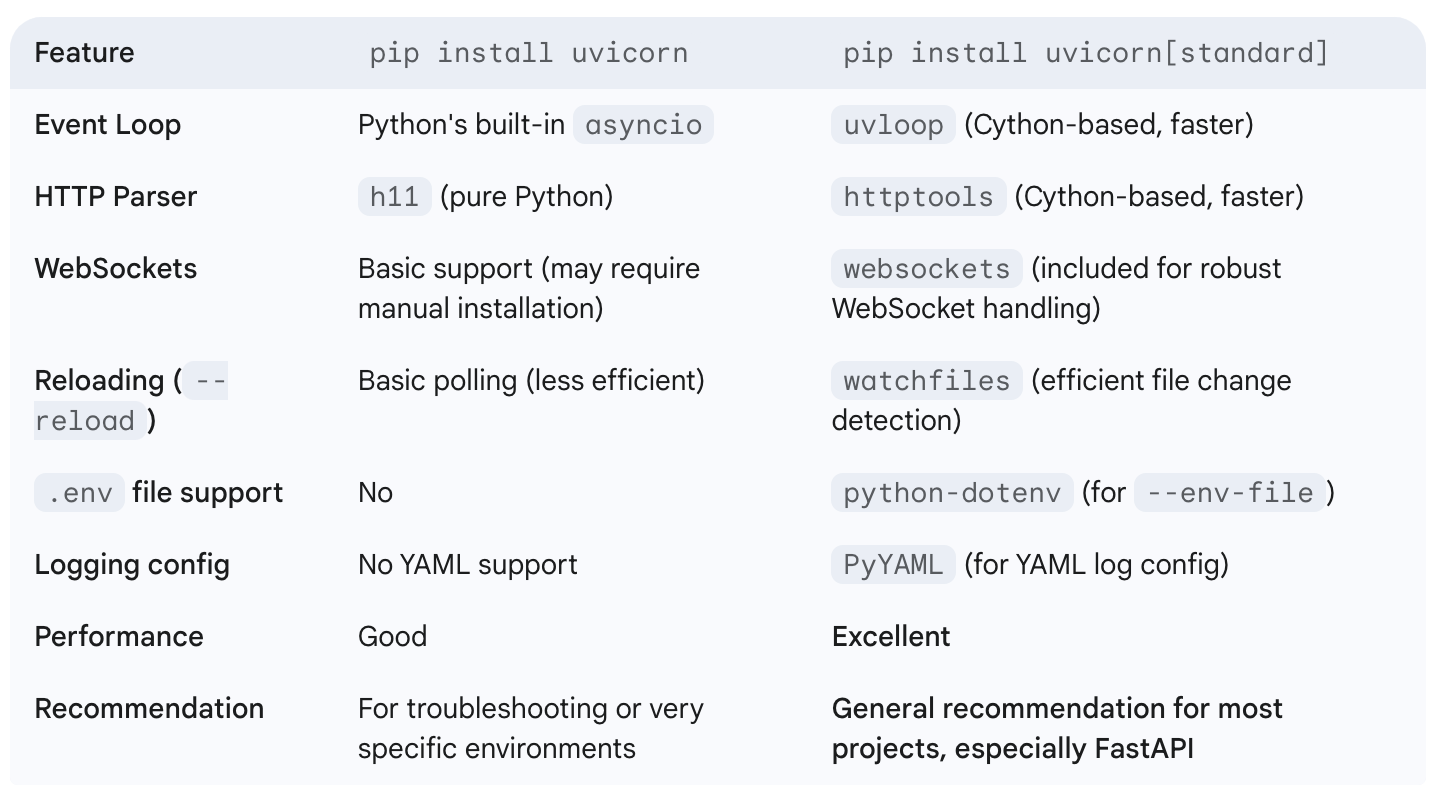
Uvicorn vs Uvicorn[standard]?
When you install Uvicorn, you have two main options:
-
pip install uvicorn: This installs Uvicorn with its minimal, pure Python dependencies. This version will still work, but it uses Python's standard asyncio event loop and h11 for HTTP parsing. While functional, it might not offer the best performance. -
pip install uvicorn[standard]: This is the recommended way to install Uvicorn, especially for production or performance-critical applications. The[standard]extra tells pip to install additional, optimized dependencies:-
uvloop: A fast, drop-in replacement for the built-in asyncio event loop. uvloop is implemented in Cython and provides significant performance improvements for asynchronous operations. -
httptools: A high-performance HTTP protocol parser, also implemented in Cython. This replaces the pure Pythonh11for faster HTTP request and response processing. -
websockets: A library for WebSocket protocol implementation. If your application uses WebSockets, this dependency ensures they are handled efficiently. -
watchfiles: Used for the --reload feature during development. This provides more efficient file change detection than Uvicorn's default polling mechanism. -
python-dotenv: Allows Uvicorn to load environment variables from a .env file if you use the --env-file option. -
PyYAML: Allows you to provide a .yaml file for logging configuration if desired.
-
Why use uvicorn[standard]?
-
Performance: The primary reason to use uvicorn[standard] is the significant performance boost provided by uvloop and httptools. These Cython-based libraries are much faster than their pure Python counterparts.
-
Feature Completeness: It ensures you have all the recommended "optional extras" that enhance Uvicorn's capabilities, such as efficient hot-reloading for development and robust WebSocket support.
-
Best Practice for FastAPI: When you install
fastapi[standard], it already includesuvicorn[standard]as a dependency, making it the default and recommended way to get the full performance benefits.
When might you just use uvicorn?
-
Windows or PyPy:
uvloopandhttptoolsare Cython-based and may have compatibility issues on certain platforms like Windows (though these are less common now with WSL) or PyPy. If you encounter installation errors or specific platform limitations, falling back to uvicorn (without [standard]) might be necessary. However, it's generally worth troubleshooting to get [standard] working if performance is a concern. -
Minimalist Environments: In extremely constrained environments where every kilobyte matters, or if you're absolutely sure you don't need any of the extra features/performance, you could opt for the bare uvicorn. This is rare for most practical applications.
Uvicorn[full]?
In addition to everything in standard, it also includes:
gunicorn— production WSGI/ASGI server (mainly useful if you want to run uvicorn workers via gunicorn)
So uvicorn[full] = uvicorn[standard] + gunicorn
Use this if:
- You plan to run uvicorn with gunicorn (e.g., gunicorn -k uvicorn.workers.UvicornWorker)
- You want everything uvicorn supports bundled in