Key Tools and Technologies in Java Full Stack Development
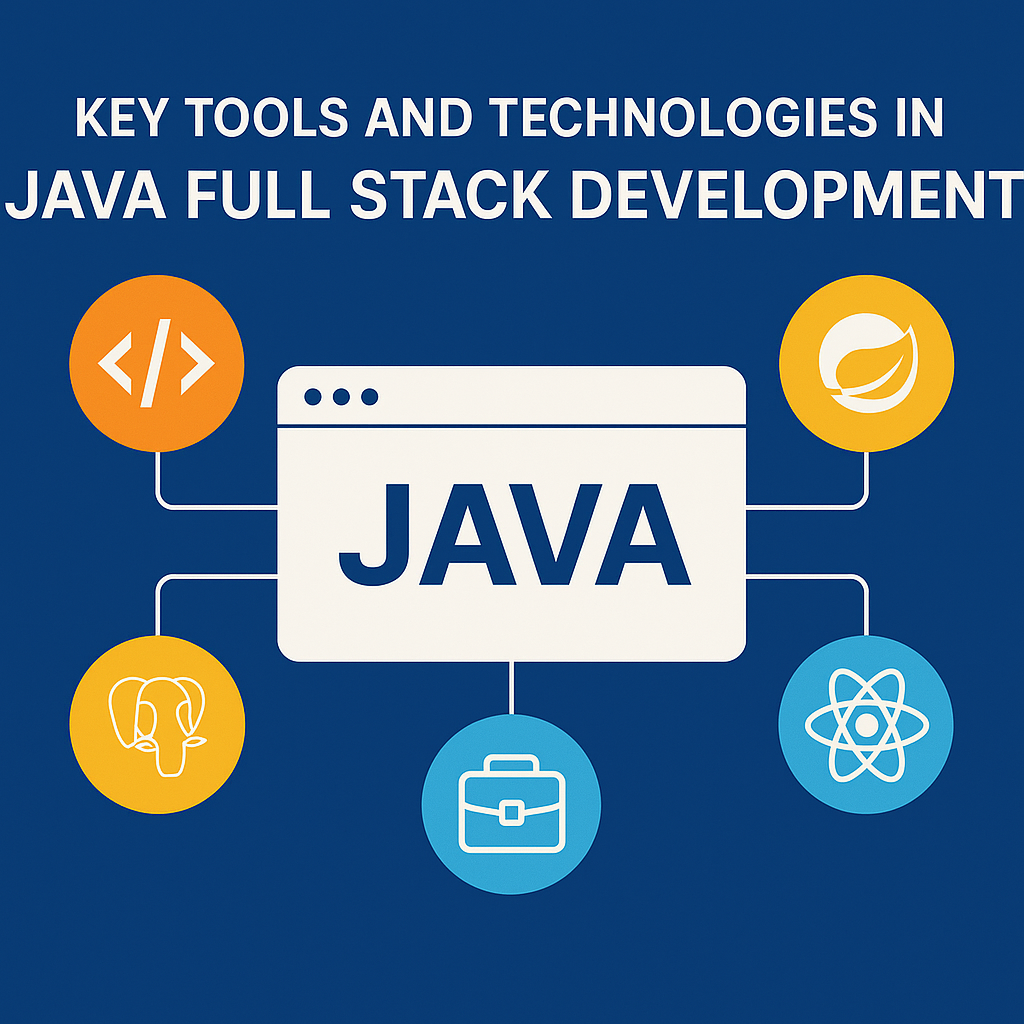
Java Full Stack Development is one of the most powerful and versatile skills in the IT industry today. As more companies build modern, scalable, cloud-based applications, the demand for Full Stack Java Developers continues to rise. But to succeed in this field, it’s not enough to know just Java — you must master a wide range of tools and technologies across front-end, backend, database, DevOps, and cloud deployment.
This is where many learners struggle. They know they want to become a full stack developer, but they don’t know which technologies to learn, why they matter, or how they work together in real applications.
This blog will break down all the essential tools and technologies required for Java full stack development, explaining them in simple terms and helping you understand how they fit into real-world projects. If you’re planning to enroll in a java full stack developer course with placement, this guide will show you exactly what a strong curriculum should include.
What Is Java Full Stack Development?
Java Full Stack Development means building complete web applications — from the frontend (what users see) to the backend (server logic and API), along with database management, continuous deployment, and cloud hosting.
A full stack developer is expected to know:
How to design user interfaces (UI)
How to write backend logic using Java
How to create RESTful APIs
How to manage databases
How to use DevOps tools to deploy applications
How to secure applications
How to work with cloud services
To master all this, you must understand a complete ecosystem of tools and technologies.
This blog covers each of them — starting from front-end tools all the way to cloud deployment platforms.
FRONT-END TECHNOLOGIES
Front-end development is the client-facing part of software development. Users interact with the UI you create — buttons, forms, layouts, animations, dashboards, and more.
Below are the must-have front-end tools for Java full stack developers.
- HTML5, CSS3, and JavaScript
These three core technologies form the foundation of front-end development.
HTML5
Defines webpage structure using tags like
CSS3
Adds design, colors, styling, spacing, animations, and layouts.
JavaScript
Makes web pages interactive (like dropdowns, popups, and dynamic content).
As a full stack developer, you must understand:
DOM manipulation
Event handling
Responsive UI design
ES6+ concepts like let/const, arrow functions, promises, async-await
- Front-End Frameworks: Angular and React
In modern applications, HTML and JavaScript alone are not enough. You need frameworks for scalable, efficient UI development.
ReactJS
A popular JavaScript library for building dynamic UIs.
Features:
Component-based architecture
Virtual DOM for performance
Reusable UI components
Strong community support
Angular
A TypeScript-based front-end framework popular in enterprise applications.
Features:
Powerful CLI
Two-way data binding
In-built routing
Support for large-scale applications
A strong java full stack development course trains you in at least one of these frameworks.
- Bootstrap / Tailwind CSS
CSS frameworks simplify design and provide ready-made UI components.
Bootstrap
Helps create responsive layouts with grid systems, modals, cards, and more.
Tailwind
More flexible, utility-first CSS framework for custom designs.
Most full stack projects use at least one of these frameworks.
BACK-END TECHNOLOGIES (Java)
Backend development is where Java full stack developers shine. This is the most critical part of the stack, handling logic, security, data processing, and business workflows.
- Core Java
Everything starts with Java fundamentals.
Key Topics:
OOP (Object-Oriented Programming)
Collections
Multithreading
Exception handling
Streams and Lambda expressions
File handling
JVM architecture
Without Core Java, you cannot master Spring Boot or backend development.
- Spring and Spring Boot
Spring Boot is the backbone of Java full stack development.
Why Spring Boot?
Reduces configuration
Helps build REST APIs quickly
Supports microservices architecture
Highly scalable
Industry standard in Java development
You must learn:
Spring Core
Spring MVC
Spring Boot starters
REST API development
Spring Data JPA
Hibernate ORM
Spring Security
Microservices (Spring Cloud)
A good full stack java developer course gives you multiple Spring Boot projects.
- Hibernate / JPA (ORM Tools)
ORM (Object-Relational Mapping) tools simplify database operations.
Instead of writing long SQL queries manually, Hibernate lets you use Java objects to interact with databases.
Key Concepts:
Entities
One-to-many & many-to-many relationships
JPQL
CRUD operations
Transaction management
DATABASE TECHNOLOGIES
Backend development requires strong database knowledge.
- SQL Databases
Every full stack developer must understand relational databases.
Popular SQL databases:
MySQL
PostgreSQL
Oracle
Concepts to master:
Table design
Joins
Functions
Stored procedures
Normalization
Indexing
Query optimization
- NoSQL Databases
Modern applications also rely on NoSQL.
Popular NoSQL Database:
Become a member
MongoDB
Why MongoDB?
Stores data as flexible JSON documents
Great for real-time apps
Easier to scale
A job-ready java full stack developer course includes both SQL and NoSQL training.
VERSION CONTROL & COLLABORATION
9. Git and GitHub
Every developer must know version control.
What you learn:
Cloning repositories
Branching
Committing changes
Merging conflicts
Pull requests
Issue tracking
GitHub is where you host your portfolio projects.
Recruiters check:
Your commits
Code quality
Activity
Open-source contributions
DEVOPS TOOLS (Deployment & Automation)
Modern development requires knowledge of DevOps tools.
- Maven or Gradle
Build tools used to:
Manage dependencies
Package applications
Run automated builds
Most Spring Boot projects use Maven.
- Docker
Docker allows you to package apps into containers that run anywhere.
You learn:
Building Docker images
Running containers
Writing Dockerfiles
Using Docker Compose
Companies prefer developers with Docker experience because it simplifies deployment.
- Jenkins / GitHub Actions
These tools automate deployment pipelines.
Developers use pipelines to:
Build code
Run tests
Deploy to servers
Implement CI/CD
Learning these tools makes you a more valuable full stack developer.
CLOUD TECHNOLOGIES
13. AWS / Azure / GCP
Cloud skills are essential in 2025.
You learn to:
Deploy Spring Boot apps
Set up EC2 servers
Use S3 for file storage
Manage databases (RDS)
Configure load balancers
Cloud knowledge boosts your resume significantly.
TESTING TOOLS
14. JUnit & Mockito
Testing ensures reliability.
You learn:
Writing unit tests
Mocking dependencies
Integration testing
- Postman
Used to test REST APIs:
Sending requests
Viewing responses
Debugging HTTP errors
Essential for backend developers.
OTHER IMPORTANT TOOLS
16. IntelliJ IDEA / Eclipse
These are Java development IDEs.
Features include:
Debuggers
Code suggestions
Build tools integration
Project explorer
Most full stack developers prefer IntelliJ IDEA.
How These Tools Work Together in a Real Full Stack Project
Let’s see how all the tools connect in a real project:
- Front-end built with
React / Angular + HTML + CSS
- Backend developed using
Java + Spring Boot
- Database using
MySQL + MongoDB
- Testing done through
JUnit + Postman
- Version control via
Git + GitHub
- Deployment on
Docker + AWS
This is exactly the type of project employers expect full stack developers to build — and exactly what a java full stack developer course with placement prepares you for.
Why You Should Learn These Tools in a Course (Not Alone)
Learning full stack development alone can be:
Confusing
Time-consuming
Unstructured
Hard without guidance
A full stack java developer training program provides:
Step-by-step instruction
Real-world projects
Mentor guidance
Doubt clearing
Portfolio building
Placement assistance
This fast-tracks your learning and helps you become job-ready in months.
Conclusion
Java Full Stack Development requires mastering a wide range of tools — from front-end frameworks to backend APIs, from SQL databases to cloud deployment, from Git to Docker. These tools work together to help you build robust, scalable, real-world applications.
If you want to become a job-ready Full Stack Java Online Training, mastering these tools is essential. And the best way to learn them is through a structured Java full stack developer course with placement, where you get:
Practical training
Real-time projects
Interview preparation
Professional certification
Placement support
Start learning the right tools today — and build a powerful full stack career for your future.
Start learning the right tools today — and build a powerful full stack career for your future.