메서드 (method)
: 객체에 속한 함수, 객체의 상태를 조작하거나 동작을 수행
메서드 호출 방법
데이터 타입 객체.메서드()
ex) 'hello'.capitalize()
비시퀀스 데이터 구조
세트 (set)
: 고유한 항목들(중복 x)의 정렬되지 않은(비시퀀스) 컬렉션
세트 메서드
- s.add(x) : 세트 s에 항목 x를 추가. 이미 x가 있다면 변화 없음
my_set = {'a', 'b', 'c', 1, 2, 3}

my_set.add(4)
print(my_set) #{'a', 1, 2, 3, 4, 'b', 'c'}

my_set.add(4)
print(my_set) #{'a', 1, 2, 3, 4, 'b', 'c'}- s.clear(x) : 세트 s의 모든 항목을 제거
my_set = {'a', 'b', 'c', 1, 2, 3}

my_set.clear()
print(my_set) #set()- s.remove(x) : 세트 s에서 항목 x를 제거. 항목 x가 없을 경우 Key error
my_set = {'a', 'b', 'c', 1, 2, 3}

my_set.remove(2)
print(my_set) #{1, 3, 'a', 'c', 'b'}

my_set.remove(10)
print(my_set) #KeyError: 10- s.pop() : 세트 s에서 랜덤하게 항목을 반환하고, 해당 항목을 제거
my_set = {'a', 'b', 'c', 1, 2, 3}

element = my_set.pop()

print(element) #1
print(my_set) #{2, 3, 'b', 'c', 'a'}- s.discard(x) : 세트 s에서 항목 x를 제거
my_set = {1, 2, 3}

my_set.discard(2)
print(my_set) #{1, 3}

my_set.discard(10)
print(my_set) #{1, 3}- s.update(iterable) : 세트 s에 다른 iterable 요소를 추가
my_set = {'a', 'b', 'c', 1, 2, 3}

my_set.update([1, 4, 5])
print(my_set) #{1, 2, 'c', 3, 'b', 4, 5, 'a'}
세트의 집합 메서드
- set1.difference(set2) : set1에는 들어있지만 set2에는 없는 항목으로 세트를 생성 후 반환 (set1 - set2)
- set1.intersection(set2) : set1과 set2 모두 들어있는 항목으로 세트를 생성 후 반환 (set1 & set2)
- set1.issubset(set2) : set1의 항목이 모두 set2에 들어있으면 True를 반환 (set1 <= set2)
- set1.issuperset(set2) : set1가 set2의 항목을 모두 포함하면 True를 반환 (set1 >= set2)
- set1.union(set2) : set1 또는 set2에(혹은 둘 다) 들어있는 항목으로 세트를 생성 후 반환 (set1 | set2)
set1 = {0, 1, 2, 3, 4}
set2 = {1, 3, 5, 7, 9}

print(set1.difference(set2)) #{0, 2, 4}
print(set1.intersection(set2)) #{1, 3}
print(set1.issubset(set2)) #False
print(set1.issuperset(set2)) #False
print(set1.union(set2)) #{0, 1, 2, 3, 4, 5, 7, 9}
딕셔너리 (dictionary)
: 고유한 항목들의 정렬되지 않은 컬렉션
딕셔너리 메서드
- D.clear() : 딕셔너리 D의 모든 키/값 쌍을 제거
person = {'name': 'Alice', 'age': 25}
person.clear()
print(person) #{}- D.get(k) : 키 k에 연결된 값을 반환 (키가 없으면 None을 반환)
- D.get(k, v) : 키 k에 연결된 값을 반환하거나 키가 없으면 기본 값으로 v를 반환
person = {'name': 'Alice', 'age': 25}
print(person.get('name')) #Alice
print(person.get('country')) #None
print(person.get('country', 'Unknown')) #Unknown- D.keys() : 딕셔너리 D의 키를 모은 객체를 반환
person = {'name': 'Alice', 'age': 25}
print(person.keys()) #dict_keys(['name', 'age'])

for k in person.keys():
    print(k)
"""
name
age
"""- D.values() : 딕셔너리 D의 값을 모은 객체를 반환
person = {'name': 'Alice', 'age': 25}
print(person.keys()) #dict_keys(['name', 'age'])

for v in person.values():
    print(v)
"""
Alice
25
"""- D.items() : 딕셔너리 D의 키/값 쌍을 모은 객체를 반환
person = {'name': 'Alice', 'age': 25}

print(person.items()) #dict_items([('name', 'Alice'), ('age', 25)])
for k, v in person.items():
    print(k, v)
"""
name Alice
age 25
"""- D.pop(k) : 딕셔너리 D에서 키 k를 제거하고 연결됐던 값을 반환 (없으면 오류)
- D.pop(k, v) : 딕셔너리 D에서 키 k를 제거하고 연결됐던 값을 반환 (없으면 v를 반환)
person = {'name': 'Alice', 'age': 25}
print(person.pop('age')) #25
print(person) #{'name': 'Alice'}
print(person.pop('country', None)) #None
print(person.pop('country')) #keyError- D.setdefault(k) : 딕셔너리 D에서 키 k와 연결된 값을 반환
- D.setdefault(k, v) : 딕셔너리 D에서 키 k와 연결된 값을 반환, k가 D의 키가 아니면 값 v와 연결한 키 k를 D에 추가하고 v를 반환
person = {'name': 'Alice', 'age': 25}
print(person.setdefault('country', 'KOREA')) #KOREA
print(person)- D.update(other) : other 내 각 키에 대해 D에 있는 키면 D에 있는 그 키의 값을 other에 있는 값으로 대체, other에 있는 각 키에 대해 D에 없는 키면 키/값 쌍을 D에 추가
person = {'name': 'Alice', 'age': 25}
other_person = {'name': 'Jane', 'gender': 'Female'}

person.update(other_person)
print(person) #{'name': 'Jane', 'age': 25, 'gender': 'Female'}

person.update(age=50)
print(person) #{'name': 'Jane', 'age': 50, 'gender': 'Female'}

person.update(country='KOREA')
print(person) #{'name': 'Jane', 'age': 50, 'gender': 'Female', 'country': 'KOREA'}
참고
해시 테이블 (Hash Table)
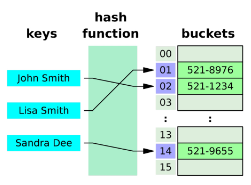
: 해시 함수를 사용하여 변환한 값을 색인(index)으로 삼아 키(key)와 데이터(value)를 저장하는 자료구조
-> 데이터를 효율적으로 저장하고 검색하기 위해 사용
해시 테이블 원리
- 키를 해시 함수를 통해 해시 값으로 변환하고, 이 해시 값을 인덱스로 사용하여 데이터를 저장하거나 검색
*데이터 검색이 매우 빠르게 이루어짐
해시 (Hash)
- 임의의 크기를 가진 데이터를 고정된 크기의 고유한 값으로 변환하는 것
- 이렇게 생성된 고유한 값은 주로 해당 데이터를 식별하는 데 사용될 수 있음
일종의 "지문"과 같은 역할
데이터를 고유하게 식별 - 파이썬에서는 해시 함수를 사용하여 데이터를 해시 값으로 변환하며, 이 해시 값은 정수로 표현됨
해시 함수 (Hash function)
- 임의의 길이의 데이터를 입력 받아 고정된 길이의 데이터(해시 값)를 출력하는 함수
- 주로 해시 테이블 자료구조에 사용되며, 매우 빠른 데이터 검색을 위한 컴퓨터 소프트웨어에서 유용하게 사용
set의 요소 & dictionary의 키와 해시테이블 관계
- 파이썬에서 세트의 요소와 딕셔너리의 키는 해시 테이블을 이용하여 중복되지 않는 고유한 값을 저장함
- 세트 내의 각 요소는 해시 함수를 통해 해시 값으로 변환되고, 이 해시 값을 기반으로 해서 해시 테이블에 저장됨
- 마찬가지로 딕셔너리의 키는 고유해야 하므로, 키를 해시 함수를 통해 해시 값으로 변환하여 해시 테이블에 저장
-> 따라서 딕셔너리의 키는 매우 빠른 탐색 속도를 제공하며, 중복된 값을 허용하지 않음
set의 pop 메서드 예시 - 정수
- 정수 값 자체가 곧 해시 값
- 출력 순서는 해시 테이블에 나열된 순서
my_set = {3, 2, 1, 9, 100, 4, 87, 39, 10, 52}

print(my_set.pop()) #1
print(my_set.pop()) #2
print(my_set.pop()) #3
print(my_set.pop()) #100
print(my_set.pop()) #4
print(my_set.pop()) #39
print(my_set.pop()) #9
print(my_set.pop()) #10
print(my_set.pop()) #52
print(my_set.pop()) #87
print(my_set) #set()
set의 pop 메서드 예시 - 문자열
- 반환 값이 매번 다름
my_str_set = {'a', 'b', 'c', 'd', 'e', 'f', 'g', 'h', 'i', 'j'}

print(my_str_set.pop())
print(my_str_set.pop())
print(my_str_set.pop())
print(my_str_set.pop())
print(my_str_set.pop())
파이썬에서의 해시 함수
- 파이썬에서 해시 함수의 동작 방식은 객체의 타입에 따라 달라짐
- 정수와 문자열은 서로 다른 타입이며, 이들의 해시 값을 계산하는 방식도 다름
print(hash(1)) #1
print(hash(1)) #1
*같은 정수는 항상 같은 해시 값을 가짐
*해시 테이블에 정수를 저장할 때 효율적인 방법
*예를 들어, hash(1)과 hash(2)는 항상 서로 다른 해시 값을 갖지만, has(1)은 항상 동일한 해시 값을 갖게 됨

print(hash('a')) #실행시마다 다름
print(hash('a')) #실행시마다 다름
*문자열은 가변적인 길이를 갖고 있고, 문자열에 포함된 각 문자들의 유니코드 코드 포인트 등을 기반으로 해시 값을 계산
*이로 인해 문자열의 해시 값은 실행 시마다 다르게 계산됨
set의 pop 메서드의 결과와 해시 테이블의 관계
- pop 메서드는 set에서 임의의 요소를 제거하고 반환
- 실행 때마다 다른 요소를 얻는다는 의미에서의 "무작위"가 아니라 "임의라는 의미에서 "무작위"
=> 해시 테이블에 나타나는 순서대로 반환하는 것
hashable
- hash() 함수의 인자로 전달해서 결과를 반환 받을 수 있는 객체를 hashable이라 함
- 대부분의 불변형 데이터 타입은 hashable
- 단, tuple의 경우 불변형이지만 해시 불가능한 객체를 참조할 때는 tuple 자체도 해시 불가능해지는 경우가 있음
print(hash(1))
print(hash(1.0))
print(hash('1'))
print(hash((1, 2, 3)))

#TypeError: unhashable type: 'list'
print(hash((1, 2, [3, 4])))
hashable과 불변성 간의 관계
- 해시 테이블의 키는 불변해야 함
*객체가 생성된 후에 그 값을 변경할 수 있어야 함 - 불변 객체는 해시 값이 변하지 않으므로 동일한 값에 대해 일관된 해시 값을 유지할 수 있음
- 단, "hash 가능하다 != 불변하다"
가변형 객체가 hashable 하지 않은 이유
- 값이 변경될 수 있기 때문에 동일한 객체에 대한 해시 값이 변경될 가능성이 있음 (해시 테이블의 무결성 유지 불가)
- 가변형 객체가 변경되면 해시 값이 변경되기 때문에, 같은 객체에 대한 서로 다른 해시 값이 반환될 수 있음 (해시 값의 일관성 유지 불가)
#TypeError: unhashable type: 'list'
print(hash([1, 2, 3]))
#TypeError: unhashable type: 'list'
my_set = {[1, 2, 3], 1, 2, 3, 4, 5}
#TypeError: unhashable type: 'set'
my_dict = {{3, 2}: 'a'}
hashable 객체가 필요한 이유
- 해시 테이블 기반 자료 구조 사용
- set와 dict의 키
- 중복값 방지
- 빠른 검색과 조회
- 불변성을 통한 일관된 해시 값
- 안정성과 예측 가능성 유지

멋쟁이 토마토 개발자 🍅