DL 입문
다층 퍼셉트론(MultiLayer Perceptron, MLP)
은닉층이 2개 이상인 신경망을 심층 신경망(Deep Neural Network, DNN)이라고 함
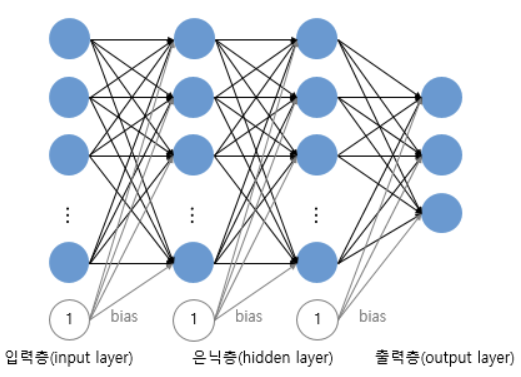
파이토치로 다층 퍼셉트론 구현하기
import torch
import torch.nn as nn

X = torch.FloatTensor([[0, 0], [0, 1], [1, 0], [1, 1]]).to(device)
Y = torch.FloatTensor([[0], [1], [1], [0]]).to(device)

model = nn.Sequential(
          nn.Linear(2, 10, bias=True), # input_layer = 2, hidden_layer1 = 10
          nn.Sigmoid(),
          nn.Linear(10, 10, bias=True), # hidden_layer1 = 10, hidden_layer2 = 10
          nn.Sigmoid(),
          nn.Linear(10, 10, bias=True), # hidden_layer2 = 10, hidden_layer3 = 10
          nn.Sigmoid(),
          nn.Linear(10, 1, bias=True), # hidden_layer3 = 10, output_layer = 1
          nn.Sigmoid()
          ).to(device)


criterion = torch.nn.BCELoss().to(device)
optimizer = torch.optim.SGD(model.parameters(), lr=1)  # modified learning rate from 0.1 to 1


for epoch in range(10001):
    optimizer.zero_grad()
    # forward 연산
    hypothesis = model(X)

    # 비용 함수
    cost = criterion(hypothesis, Y)
    cost.backward()
    optimizer.step()

    # 100의 배수에 해당되는 에포크마다 비용을 출력
    if epoch % 100 == 0:
        print(epoch, cost.item())


with torch.no_grad():
    hypothesis = model(X)
    predicted = (hypothesis > 0.5).float()
    accuracy = (predicted == Y).float().mean()
    print('모델의 출력값(Hypothesis): ', hypothesis.detach().cpu().numpy())
    print('모델의 예측값(Predicted): ', predicted.detach().cpu().numpy())
    print('실제값(Y): ', Y.cpu().numpy())
    print('정확도(Accuracy): ', accuracy.item())


모델의 출력값(Hypothesis):  [[1.1169249e-04]
 [9.9982882e-01]
 [9.9984229e-01]
 [1.8529959e-04]]
모델의 예측값(Predicted):  [[0.]
 [1.]
 [1.]
 [0.]]
실제값(Y):  [[0.]
 [1.]
 [1.]
 [0.]]
정확도(Accuracy):  1.0
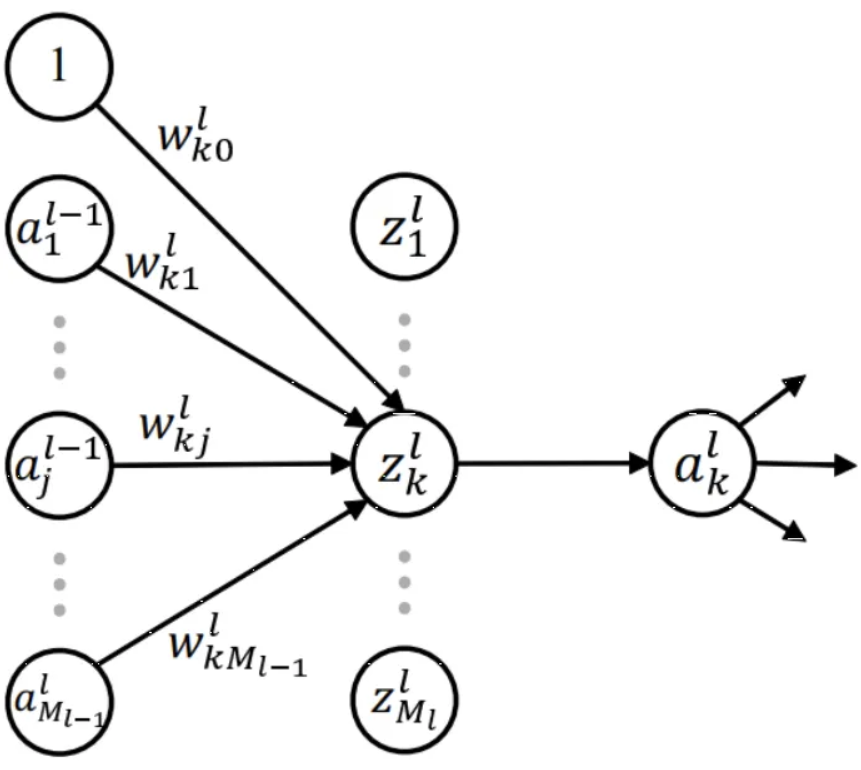
- 위 첨자 : layer 순서
- 아래 첨자 : neuron 순서
- l번째 layer에는 neuron이 개씩 있음
- ex) : l번째 layer의 k번째 neuron
- z → a 출력값은 w (weight)에 곱해져 다음 뉴런 z로 들어감
- ⇒ l : 도착하는 layer, j : 출발 neuron, k : 도착 neuron
과적합 방지하기
- 데이터의 양을 늘리기
- 모델의 복잡도 줄이기
- 가중치 규제(Regularization) 적용하기
- 드롭아웃(Dropout)