Cloud systems today are always active, always changing, and often more complex than they appear. Applications run across regions, services depend on each other, and even a small issue can ripple across the entire setup. In this kind of environment, waiting for something to break before fixing it no longer works.
That is where self-healing cloud management starts to feel less like an upgrade and more like a necessity.
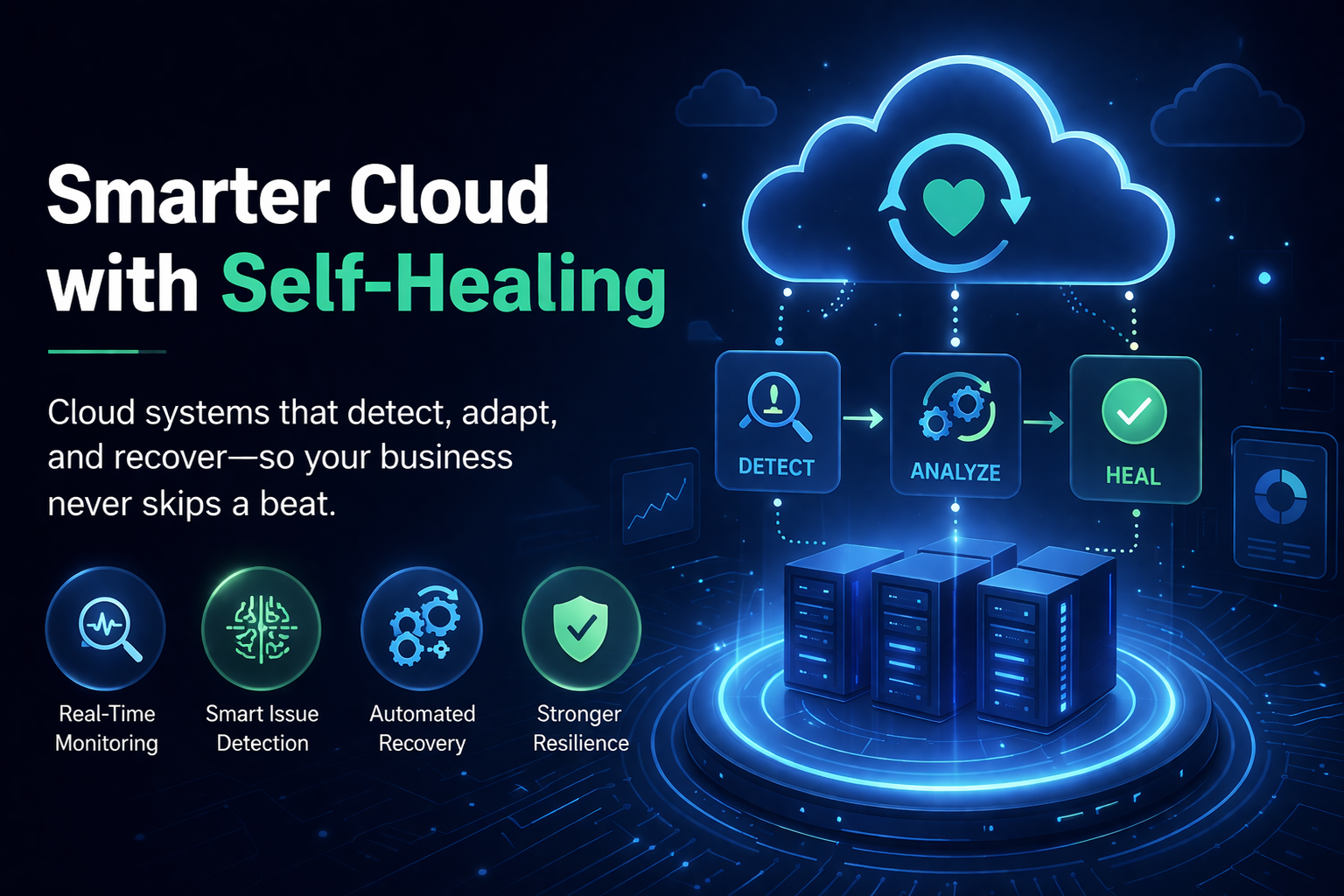
Instead of relying on teams to catch and resolve every issue, self-healing systems are built to take care of problems on their own. They monitor continuously, detect unusual behavior, and respond instantly. If a service fails, it restarts. If performance drops, resources adjust. If a deployment causes issues, it rolls back automatically.
This shift changes the way cloud operations are handled. It moves teams away from constant firefighting and toward more meaningful work.
One of the biggest challenges in modern cloud environments is the sheer volume of data. Logs, alerts, metrics, and events are generated every second. It becomes difficult for humans to keep track of everything in real time. Self-healing systems simplify this by understanding patterns. They learn what normal behavior looks like and quickly spot anything that does not fit.
Over time, this learning makes systems more proactive. Instead of just reacting to failures, they begin to anticipate them. That means fewer disruptions, faster recovery, and a more stable user experience.
Scalability is another area where this approach stands out. As businesses grow, their cloud environments naturally become more complicated. More services, more integrations, more chances for failure. Self-healing systems adapt to this growth without adding pressure on teams. They handle complexity quietly in the background.
This also improves how teams work. Engineers spend less time dealing with alerts and more time improving architecture, optimizing performance, and building better solutions. It creates space for innovation instead of constant maintenance.
Of course, none of this works without visibility. Systems need clear, real-time insights into what is happening at every level. This is where cloud management services become important, helping bring together monitoring, automation, and performance optimization in a way that actually supports business goals.
Adopting self-healing is not just about adding new tools. It requires thinking differently about how systems are designed. Resilience needs to be built in from the start. Automation needs to be intentional. And there must always be a balance between letting systems act independently and maintaining control.
Failures will still happen. That is part of any system. The difference is how quickly and effectively those failures are handled.
Self-healing cloud management is not just about fixing issues automatically. It is about building systems that can adapt, recover, and keep moving without disruption. And in a world where uptime and experience matter more than ever, that makes all the difference.
