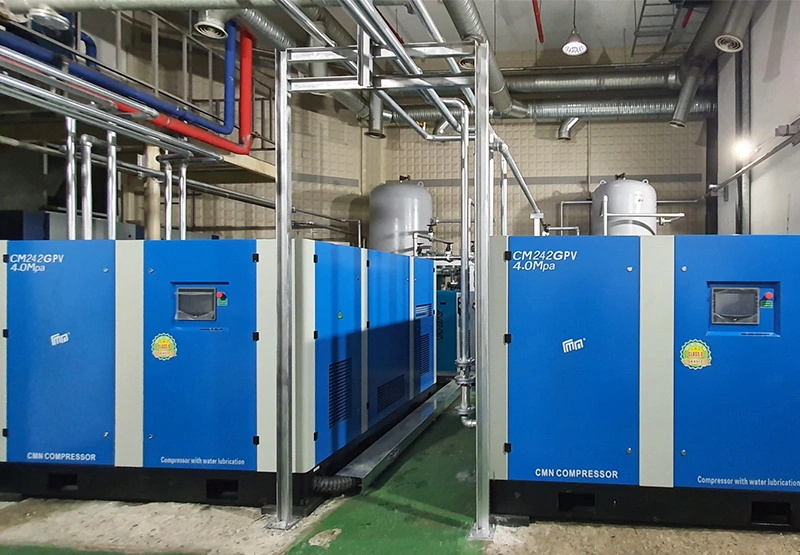
Oil Free Screw & Scroll Air Compressor in Pharmaceutical Industry
In pharmaceutical factories, compressed air is mainly used in filling machines for liquid preparations, granulators, pulping machines, filling machines, packaging machines, printers for solid preparations, and extraction tanks in the extraction process. In addition, there are gases for testing, material transportation, drying, purging, pneumatic instruments, automatic control gases, etc.
In pharmaceutical production, there are usually strict hygiene standards. Especially in clean rooms, production needs to be carried out in an environment free of bacteria, particles, water, and contaminated oil. Therefore, there are also high requirements for compressed air in hospitals. That is to say, air compressors for the pharmaceutical industry are also widely used because the compressed air often comes into direct contact with the product itself during the production process in the pharmaceutical industry, and the compressed air must be sterile or oil-free.
Although the pharmaceutical industry has many rules in place, such as IGMP, FDA, and European Pharmacopoeia, these rules do not define any compressed air quality class for individual applications. Therefore, every pharmaceutical company must determine which compressed air quality in the pharmaceutical industry is required for the production process according to ISO 8573-1. Different processes in the pharmaceutical industry have different requirements for compressed air. The following are some basic processes:
- Tablet pressing
Compressed air pharmaceutical industry is required during tablet production, and the compressed air comes into direct contact with the product. This direct product contact occurs after the tablet press, where compressed air is used to remove dust particles or remove problematic products. Oil-free and dry air is important in this case, otherwise, it can cause the compressed tablets to swell, for example. Compressed air can also be used to apply lubricant to the tablet press to make the tablets easier to eject.
But compressed air is already used when mixing powder mixtures or producing granules for tablet presses. Compressed air solution is also used in a post-pressing step known as coating, i.e. coating or encapsulation. A common process is the fluidized bed process, where airflow ensures that the tablets float and are in constant motion. Spray them with the help of a nozzle, moisten and dry them evenly. Compressed air is used here and in other processes as atomizing air and is then considered a processing aid; therefore, there are high demands on its purity. In addition to end-user health risks, typical problems in tablet production include blistering, tablet cracking, or color fluctuations. Moist and oily compressed air may be a cause.
Not only does the machine need to be cleaned, but the vials, ampoules, and bottles in which the medication is filled also need special cleaning. Air compressor in pharmaceutical industry is used here for drying. Another cleaning method is dry ice blasting. Dry ice strikes the surface to be cleaned and removes deposits. The separated sediments are then blown away with compressed air.
Filters must be cleaned in fluidized bed systems during production. This can be done by blowing out the filter system. Compressed air is used to return accumulated material to the process. Here, too, there is direct product contact, which results in high quality requirements for the compressed air. Another application is the cleaning of vials, bottles, and ampoules: compressed air is also used here to dry the containers and remove the last particles. This usually happens in clean rooms.
- Pneumatic conveying
Pneumatic conveying can be done with compressed air or under vacuum. When conveying under pressure, an air compressor for pharmaceutical is generated and fed into the mixing head. For example, it is there to pick up powder and transport it to the desired location. With this type of pneumatic conveying, the transported material is in direct contact with the compressed air. This method is used to empty silo carts and distribute materials in production. Compressed air treatment equipment is also frequently used in the pharmaceutical industry to transport components in the manufacturing process, such as bulk goods, liquids, powders, and granules.
Finished products such as tablets and capsules are also transported back and forth between the various processing units using compressed air. Transporting with compressed air prevents damage to pharmaceutical products, but this requires a constant quality of compressed air. According to DIN ISO 8573-1, the VDMA recommends the use of compressed air with a sterile mass ratio of 1:3:1 for transporting raw materials and finished products.
- Pharmaceutical packaging
Packaging is an indispensable part of the pharmaceutical industry. Compressed air in the pharmaceutical industry is used in packaging systems, for example, for the transport of products and packaging, or packaging products and closing packages. For highly hygroscopic (water-absorbing) products, such as B. pharmaceuticals, a controlled atmosphere is established around the product. Especially when packaging pharmaceuticals, very dry compressed air must be provided at the packaging point itself (inflatable bags, etc.).
There is usually a central compressed air preparation system, so the compressed air still has to be transported to the point of use. In this way, the compressed air is filled with water again. Hygroscopic substances react with moisture in the surrounding air. To ensure product quality, contact between humidity and the product must be avoided. Therefore, additional compressed air drying is required directly on the packaging machine. A sterile environment is even required if the active ingredients are filled into ampoules and injection vials and then sealed.
- Control valve and cylinder
Compressed air is used in the pharmaceutical industry as control air, for example by controlling valves and cylinders to regulate production systems. These will also apply if controlling air may affect the process compressor. Typically lower requirements apply to control air since it does not come into direct contact with the product. But there are exceptions: there are special requirements for controlling air in clean rooms.
If compressed air does not meet requirements, it can cause pneumatic tools and machines to malfunction, corrode pipes, cylinders, and other components, and freeze in exposed lines in cold weather. This has the potential to increase downtime and maintenance costs for pneumatic machinery, tools, and controls. Therefore, correct compressed air preparation as well as regular inspection and maintenance are necessary here.
As one of scroll compressor manufacturers, we will do our best to meet all the needs of customers.