9.1 Distinguish Between Different Types of Groups
-
A group is defined as two or more individuals, interacting and interdependent, who have come together to achieve particular objectives // 집단은 상호 작용하고 상호 의존적인 둘 이상의 개인으로 정의되며, 이들은 특정 목표를 달성하기 위해 함께 모인 사람들이다.
-
Groups can be either formal or informal.
- Formal groups: those defined by the organization’s structure. // 공식 그룹: 조직의 구조에 의해 정의된 그룹.
- Informal groups: alliances that are neither formally structured nor organizationally determined. // 비공식 그룹: 공식적으로 구조화되거나 조직적으로 결정되지 않은 동맹.
Social identity theory
considers when and why individuals consider themselves members of groups.// 사회 정체성 이론: 개인이 언제 그리고 왜 자신을 집단의 일원이라고 생각하는지를 고려합니다.
-
People have emotional reactions to the failure or success of their group because their self-esteem gets tied into the performance of the group. //사람들은 자신의 그룹의 실패나 성공에 대해 감정적인 반응을 보입니다. 왜냐하면 그들의 자존감이 집단의 성과와 연관되어 있기 때문입니다.
-
Social identities help us understand who we are and where we fit in with people. //사회적 정체성은 우리가 누구인지 그리고 사람들과 어디에 어울리는지를 이해하는 데 도움을 준다.
Ingroups and Outgroups
Ingroup favoritism occurs when we see members of our group as better than other people, and people not in our group as all the same.
Whenever there is an ingroup, there is by necessity an outgroup, which is sometimes everyone else, but is usually an identified group known by the ingroup’s members.
Ingroup 및 Outgroup
인그룹 편애는 우리 그룹의 구성원을 다른 사람들보다 더 잘 보고, 우리 그룹에 없는 사람들을 모두 똑같이 볼 때 발생합니다.
집단이 있을 때마다, 반드시 집단이 존재하는데, 이는 때때로 다른 모든 집단이지만, 대개 집단의 구성원들이 알고 있는 식별된 집단이다.
Social Identity Threat
- Ingroups and outgroups pave the way for social identity threat, which is akin to stereotype threat.
- Individuals believe they will be personally negatively evaluated due to their association with a devalued group, and they may lose confidence and performance effectiveness.
- 집단과 아웃그룹은 고정관념 위협과 유사한 사회적 정체성 위협의 길을 닦는다.
- 개인들은 평가절하된 그룹과의 연관성 때문에 개인적으로 부정적인 평가를 받을 것이고, 자신감과 성과효과를 잃을 수 있다고 믿는다.
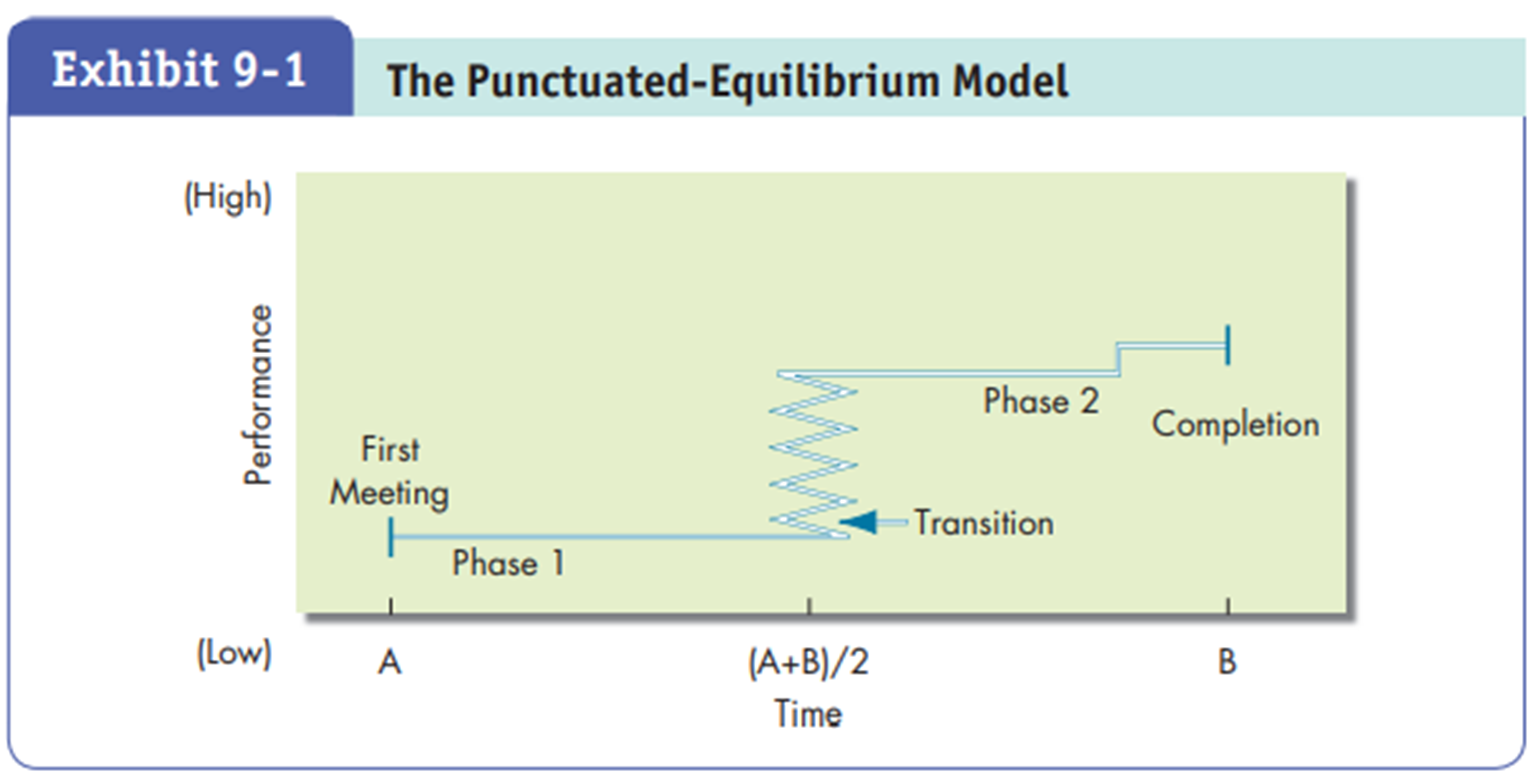
9.2 Describe the Punctuated Equilibrium Model
9.3 Show How Role Requirements Change (1/3)
-
Role: a set of expected behavior patterns attributed to someone occupying a given position in a social unit.
-Role perception: one’s perception of how to act in a given situation.
-Role expectations: how others believe one should act in a given situation. -> Psychological contract역할: 사회 단위에서 주어진 지위를 점유하는 누군가에 기인하는 예상되는 행동 패턴의 집합.
역할 인식: 주어진 상황에서 어떻게 행동해야 하는지에 대한 인식.
역할 기대: 주어진 상황에서 어떻게 행동해야 한다고 다른 사람들이 믿는가. -?심리계약 -
Role conflict: situation in which an individual faces divergent role expectations.
-We can experience interrole conflict when the expectations of our different, separate groups are in opposition.역할 충돌: 개인이 다양한 역할 기대에 직면하는 상황입니다.
우리는 서로 다른, 분리된 집단의 기대가 반대일 때 역할 간 갈등을 경험할 수 있습니다. -
Role Play and Assimilation
Philip Zimbardo’s prison experiment
Participants easily and rapidly assumed roles that were very different from their inherent personalities역할극과 동화
필립 짐바르도의 감옥 실험
참가자들은 자신의 고유한 성격과는 매우 다른 역할을 쉽고 빠르게 수행했습니다.
9.4 Show How Norms Exert Influence On An Individual’s Behavior
Norms:
Acceptable standards of behavior within a group that are shared by the group’s members.
규범:
그룹 구성원이 공유하는 그룹 내 허용 가능한 동작 표준입니다.
-
Norms and Emotions
A recent study found that, in a task group, individuals’ emotions influenced the group’s emotions and vice versa.
Researchers have also found that norms dictated the experience of emotions for the individuals and for the groups – in other words, people grew to interpret their shared emotions in the same way.규범과 감정
최근의 한 연구는 작업 그룹에서 개인의 감정은 그룹의 감정에 영향을 미치고 그 반대도 마찬가지라는 것을 발견했다.
연구자들은 또한 규범이 개인과 집단을 위한 감정의 경험을 좌우한다는 것을 발견했다 - 다시 말해서, 사람들은 그들의 공유된 감정을 같은 방식으로 해석하도록 성장했다. -
Positive Norms and Group Outcomes
One goal of every organization with corporate social responsibility (CSR) initiatives is for its values to hold normative sway over employees.
If employees aligned their thinking with positive norms, these norms would become stronger and the probability of positive impact would grow exponentially.
Positive group norms may well beget positive outcomes, but only if other factors are present.긍정적인 규범 및 그룹 결과
기업의 사회적 책임(CSR) 이니셔티브가 있는 모든 조직의 한 가지 목표는 기업의 가치가 직원들에 대해 규범적인 지배력을 갖는 것입니다.
직원들이 자신의 사고를 긍정적인 규범과 일치시킨다면, 이러한 규범들은 더 강해질 것이고 긍정적인 영향을 미칠 확률은 기하급수적으로 증가할 것입니다.
긍정적인 집단 규범은 긍정적인 결과를 얻을 수 있지만, 다른 요소들이 존재할 경우에만 그렇다. -
Norms and Culture
Do people in collectivist cultures have different norms than people in individualist cultures? Of course they do.
But did you know that our orientation may be changed, even after years of living in one society.규범과 문화
집단주의 문화권의 사람들은 개인주의 문화권의 사람들과 다른 규범을 가지고 있는가? 물론 그들은 그렇다.
하지만 여러분은 한 사회에서 몇 년을 살아왔음에도 불구하고 우리의 지향이 바뀔 수 있다는 것을 알고 있었나요?
9.5 Show How Status and Size Differences Affect Performance (1/3)
Status: a socially defined position or rank given to groups or group members by others.
Status characteristics theory: status is derived from one of three sources:
The power a person wields over others.
A person’s ability to contribute to a group’s goals.
An individual’s personal characteristics.
지위: 다른 사람들에 의해 그룹 또는 그룹 구성원에게 주어지는 사회적으로 정의된 지위 또는 지위.
상태 특성 이론: 상태는 다음 세 가지 소스 중 하나에서 파생됩니다.
한 사람이 다른 사람에게 휘두르는 힘.
집단의 목표에 기여할 수 있는 개인의 능력.
개인의 특징.
Status and Norms: high status individuals often have more freedom to deviate from norms.
Status and Group Interaction: high status people are often more assertive.
Status Inequity: perceived inequity creates disequilibrium and can lead to resentment and corrective behavior.
Status and Stigmatization: stigma by association.
Group Status: “us and them” mentality and ensuing polarization.
지위와 규범: 높은 지위의 개인들은 종종 규범에서 벗어날 수 있는 더 많은 자유를 가집니다.
지위 및 그룹 상호 작용: 높은 지위의 사람들은 종종 더 적극적이다.
신분 불평등: 인식된 불평등은 불균형을 만들고 원망과 시정 행동으로 이어질 수 있습니다.
지위 및 낙인화: 연관성에 의한 낙인.
그룹 상태: "우리들과 그들"의 사고방식과 그에 따른 양극화.
Group size affects the group’s overall behavior.
Large groups are good for gaining diverse input.
Smaller groups are better doing something with input.
Social loafing: the tendency for individuals to expend less effort when working collectively than alone.
그룹 크기는 그룹의 전반적인 동작에 영향을 미칩니다.
큰 그룹은 다양한 입력을 얻기에 좋습니다.
소규모 그룹이 입력을 통해 무언가를 하는 것이 더 좋습니다.
사회적 로핑: 개인이 혼자 일할 때보다 집단적으로 일할 때 노력을 덜 쓰는 경향입니다.
9.6 Integrating Cohesiveness and Diversity for Group Effectiveness(1/2)
Diversity: degree to which members of the group are similar to, or different from, one another.
Increases group conflict, especially in the short term.
Culturally and demographically diverse groups may perform better over time.
May help them be more open-minded and creative.
Faultlines
다양성: 집단의 구성원들이 서로 비슷하거나 다른 정도입니다.
특히 단기간에 집단 갈등을 증가시킵니다.
문화적으로 그리고 인구학적으로 다양한 집단은 시간이 지남에 따라 더 나은 성과를 낼 수 있다.
그들이 좀 더 열린 마음을 갖고 창의적이 되도록 도와줄지도 몰라.
단층선
9.7 Group Decision Making
-Strengths of group decision making:
More complete information and knowledge
Increased diversity of views
Increased acceptance of solutions
-Weaknesses of group decision making:
Time consuming
Conformity pressures
Dominance of a few members
Ambiguous responsibility
그룹 의사 결정의 장점:
보다 완벽한 정보 및 지식
견해의 다양성 증가
솔루션 수용도 증가
그룹 의사 결정의 약점:
시간 소모
적합성 압력
소수의 구성원의 우세
모호한 책임
Effectiveness and efficiency of group decisions:
Accuracy
Speed
Creativity
Acceptance
그룹 의사 결정의 효과 및 효율성:
정확성
속도
창의력
수용성
Groupthink: situations in which group pressures for conformity deter the group from critically appraising unusual, minority, or unpopular views.
Groupshift: a change between a group’s decision and an individual decision that a member within the group would make.
집단사고: 순응을 위한 집단 압력이 집단이 특이하고 소수이거나 인기 없는 관점을 비판적으로 평가하는 것을 단념시키는 상황입니다.
그룹 이동: 그룹의 결정과 그룹 내의 구성원이 내릴 개인의 결정 사이의 변화.
Most group decision making takes place in interacting groups.
Members meet face-to-face and rely on both verbal and nonverbal interaction to communicate with each other.
Interacting groups often censor themselves and pressure individual members toward conformity of opinion.
대부분의 그룹 의사결정은 상호 작용하는 그룹에서 이루어집니다.
회원들은 직접 만나서 서로 의사소통을 하기 위해 언어적, 비언어적 상호작용에 모두 의존한다.
상호 작용하는 집단은 종종 자신을 검열하고 개인의 구성원들에게 의견의 일치성을 압박한다.
Brainstorming can overcome pressures for conformity.
In a brainstorming session:
The group leader states the problem.
Members then “free-wheel” as many alternatives as they can.
No criticism is allowed.
One idea stimulates others, and group members are encouraged to “think the unusual.”
브레인스토밍은 순응에 대한 압박을 극복할 수 있다.
브레인스토밍 세션에서:
그 그룹의 리더는 그 문제를 말합니다.
회원들은 그들이 할 수 있는 한 많은 대안들을 자유바퀴로 돌린다.
비난은 금물이다.
하나의 아이디어는 다른 사람들을 자극하고, 그룹 구성원들은 "이상한 것을 생각"하도록 격려 받는다.
The nominal group technique: restricts discussion or interpersonal communication during the decision making process.
Group members are all physically present, but members operate independently.
Permits the group to meet formally but does not restrict independent thinking, as does the interacting group.
Nominal groups outperform brainstorming groups.
명목상의 그룹 기법: 의사 결정 과정에서의 토론이나 대인 커뮤니케이션을 제한합니다.
단체 회원들은 모두 물리적으로 존재하지만, 회원들은 독립적으로 활동합니다.
집단이 공식적으로 만나는 것을 허용하지만 상호작용하는 집단이 그렇듯이 독립적인 사고를 제한하지는 않습니다.
명목 그룹은 브레인스토밍 그룹보다 성능이 우수합니다.
Steps for a nominal group:
Each member independently writes down his/her ideas on the problem.
After this silent period, each member presents one idea to the group.
The ideas are discussed for clarity.
Each group member rank-orders the ideas.
The idea with the highest aggregate ranking determines the final decision.
공칭 그룹에 대한 단계:
각 구성원은 그 문제에 대한 자신의 생각을 독립적으로 적습니다.
이 조용한 시간이 지난 후, 각 멤버들은 그룹에게 한 가지 아이디어를 발표합니다.
그 아이디어들은 명확성을 위해 논의된다.
각 그룹 구성원은 아이디어의 순위를 매깁니다.
집계 순위가 가장 높은 아이디어가 최종 결정을 결정한다.