다중 catch 문
- catch 문을 여러 개 사용하여 처리하는 방식
- catch 문은 순차적으로 위에서 아래로 실행이 됨
- 주의) 예외를 처리하는 가장 최상위의 Exception 클래스는 맨 마지막에 나와야 함 (만약 맨 첫 줄에 나오는 경우 error 발생)
<예시>
=============================코드=============================
public static void main(String[] args) {

		System.out.println("프로그램 시작");

		Scanner sc = new Scanner(System.in);

		int num = 0;

		String str = "dfs";

		int[] arr = {10, 20, 30, 40, 50};

		try {
			num = sc.nextInt();  // 예외 발생할 가능성이 있는 코드

			System.out.println("str 문자열의 길이 >>> " + str.length());

			arr[5] = 60;

		}catch(InputMismatchException e) {
			System.out.println("정수만 입력하세요");
			System.out.println("예외 정보 >>> " + e);

		}catch(NullPointerException e1) {
			System.out.println("null 값이 들어왔어요");
			System.out.println("예외 정보 >>> " + e1);

		// 최상위 예외 클래스이기 때문에 맨 밑에 넣어줘야 함 -> Input~, Null~이 갖고 있는 예외를 Exception이 다 갖고 있음
		}catch(Exception e2) {
			System.out.println("모르는 예외 발생");
			System.out.println("예외 정보 >>> " + e2);

		}finally {
			sc.close();
		}


		System.out.println("프로그램 종료");

	}
=============================실행=============================

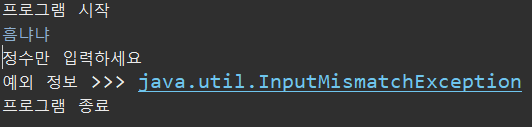
printStackTrace( ) 란?
: 에러 메세지의 발생 근원을 찾아서 단계별로 에러를 출력해 주는 메서드
=============================코드=============================
void exception1() {

		String str1 = "java";
		String str2 = null;

		try {
			System.out.println("str1 문자열 길이 >>> " + str1.length());
			System.out.println("str2 문자열 길이 >>> " + str2.length());

		}catch(Exception e) {
			e.printStackTrace();

		}

		/*
		 * printStackTrace()
		 * - 에러 메세지의 발생 근원을 찾아서
		 *   단계별로 에러를 출력해 주는 메서드
		 */
	}

	void exception2() {
		int num1 = 15, num2 = 0, result = 0;

		try {
			result = num1 / num2;

		}catch(Exception e) {
			e.printStackTrace();
		}
	}


	public static void main(String[] args) {

		Exception_08 exception = new Exception_08();

		exception.exception1();
		exception.exception2();

	}
=============================실행=============================

**어려웠던 점
-InputMismatchException 과 NullPointerException을 포함하는 예외처리가 Exception 이라는 것을 기억하자!!