Business Objects vs Crystal Reports Comparison for Analytics
Introduction
Organizations seeking to modernize their reporting and analytics capabilities often evaluate established enterprise tools before making strategic technology investments. Among the most frequently compared solutions are SAP BusinessObjects and SAP Crystal Reports. The debate around business objects vs crystal reports continues to surface as companies reassess their reporting architecture, scalability needs, and long-term analytics strategy.
Understanding the distinctions in the business objects vs crystal reports discussion is critical for decision makers who want to move beyond static reporting toward comprehensive business analytics. While both tools originate from the SAP ecosystem, their capabilities, architecture, and ideal use cases differ significantly. Evaluating the business objects vs crystal reports landscape requires careful consideration of data integration, dashboard functionality, scalability, and enterprise readiness.
Understanding the Core Purpose
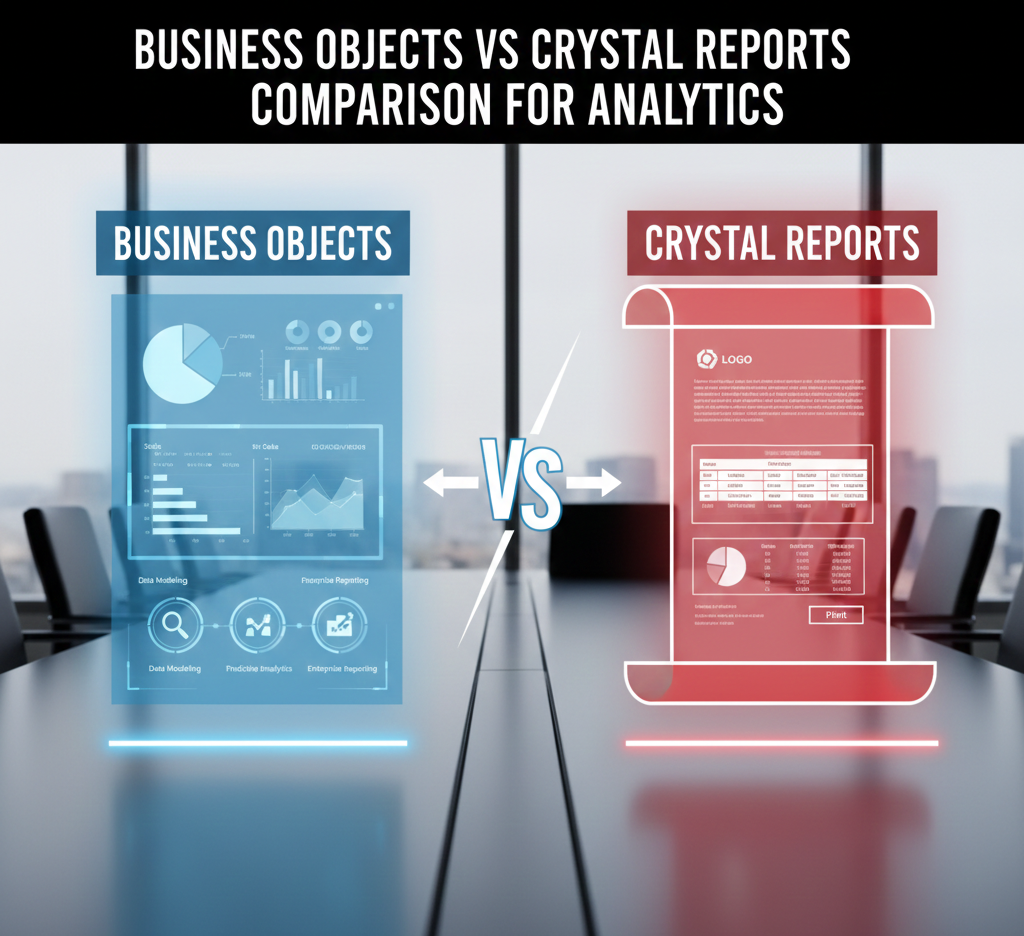
At a high level, Crystal Reports has historically focused on pixel perfect, formatted reporting. It is widely used for generating operational reports, invoices, and structured documents that require precise formatting. In contrast, SAP BusinessObjects offers a broader suite of business intelligence tools, including dashboards, ad hoc reporting, and data visualization.
When analyzing business objects vs crystal reports, it becomes clear that the scope of functionality differs. Crystal Reports is optimized for detailed, static outputs, while BusinessObjects aims to deliver interactive analytics and enterprise level reporting frameworks. Organizations evaluating business objects vs crystal reports must determine whether their primary need is operational reporting or strategic analytics.
The distinction becomes more pronounced as businesses embrace data driven decision making. Static reports alone may not satisfy the demand for real time insights and cross departmental analysis.
Architecture and Scalability Considerations
Scalability plays a major role in the business objects vs crystal reports comparison. Crystal Reports typically operates as a report design tool embedded within applications or deployed in limited environments. It excels at producing consistent formatted reports but may require additional infrastructure for enterprise-wide distribution.
BusinessObjects, on the other hand, is designed for centralized deployment and broader enterprise use. In the business objects vs crystal reports evaluation, scalability often favors BusinessObjects for organizations requiring role-based access, large scale user management, and integrated dashboards.
As data volumes continue to grow, enterprises require solutions capable of handling complex queries and multiple concurrent users. The business objects vs crystal reports conversation increasingly includes considerations around performance optimization, cloud compatibility, and integration with modern analytics platforms.
Data Integration and Analytics Capability
Modern analytics depends on seamless integration across diverse data sources. The business objects vs crystal reports comparison highlights differences in how each tool connects to enterprise data environments.
Crystal Reports supports connectivity to various databases and structured data sources, making it suitable for generating detailed reports from transactional systems. However, in the broader business objects vs crystal reports context, BusinessObjects provides enhanced capabilities for combining data from multiple sources and delivering interactive analytics experiences.
Organizations moving toward self-service business intelligence often evaluate the business objects vs crystal reports landscape to determine which solution aligns with evolving analytics needs. Advanced analytics initiatives require dynamic dashboards, drill down capabilities, and flexible visualization tools that extend beyond static reporting.
User Experience and Reporting Flexibility
User experience is another key factor in the business objects vs crystal reports discussion. Crystal Reports is widely recognized for its strong formatting control, enabling designers to create highly customized report layouts. This makes it particularly effective for operational documents that demand precise presentation.
In contrast, BusinessObjects emphasizes user friendly interfaces and interactive dashboards. Within the business objects vs crystal reports debate, organizations often weigh the need for formatted reporting against the demand for collaborative analytics and visual exploration.
As enterprises pursue digital transformation, reporting flexibility becomes increasingly important. The business objects vs crystal reports comparison reveals that while both tools serve valuable functions, their strengths align with different reporting philosophies.
Enterprise Analytics and Modern Alternatives
The modern analytics landscape has evolved beyond traditional reporting tools. Cloud platforms, data integration frameworks, and advanced business intelligence solutions now offer greater agility and scalability. When evaluating business objects vs crystal reports, many organizations also explore alternative analytics platforms capable of unifying data integration and reporting within a single ecosystem.
Enterprise ready analytics platforms provide capabilities such as real time data processing, embedded analytics, and advanced visualization. In the broader business objects vs crystal reports conversation, decision makers must assess whether legacy tools align with long term digital strategy goals.
As organizations expand into hybrid and multi cloud environments, the limitations identified in the business objects vs crystal reports evaluation may prompt consideration of more flexible, modern analytics solutions.
Aligning Technology with Business Strategy
Choosing between reporting tools should not be purely a technical decision. The business objects vs crystal reports comparison must align with business objectives, scalability requirements, and future growth plans.
Companies that primarily require highly formatted operational reports may find value in Crystal Reports. However, enterprises seeking centralized analytics platforms and interactive dashboards may lean toward broader business intelligence suites. In the evolving business objects vs crystal reports landscape, integration with enterprise data management and analytics strategy is crucial.
A strategic evaluation of business objects vs crystal reports should also consider long term maintenance, total cost of ownership, and compatibility with modern data architectures. Organizations that anticipate rapid growth or digital expansion must ensure their reporting infrastructure can adapt accordingly.
Conclusion
The discussion around business objects vs crystal reports reflects a broader shift in enterprise reporting and analytics priorities. While both tools have established reputations within the SAP ecosystem, their strengths cater to different organizational needs.
Crystal Reports remains effective for structured, pixel perfect reporting, particularly in operational environments. BusinessObjects offers broader analytics capabilities and centralized management suited for enterprise scale deployments. However, the evolving demands of digital transformation encourage organizations to look beyond traditional reporting frameworks.
Ultimately, the business objects vs crystal reports decision depends on business goals, scalability requirements, and analytics maturity. Enterprises that carefully evaluate their reporting strategy in the context of modern data integration and business intelligence trends will be better positioned to select a solution that supports both current operations and future innovation.