How a Data Orchestration Platform Solves Modern Business Analytics Chaos
Introduction
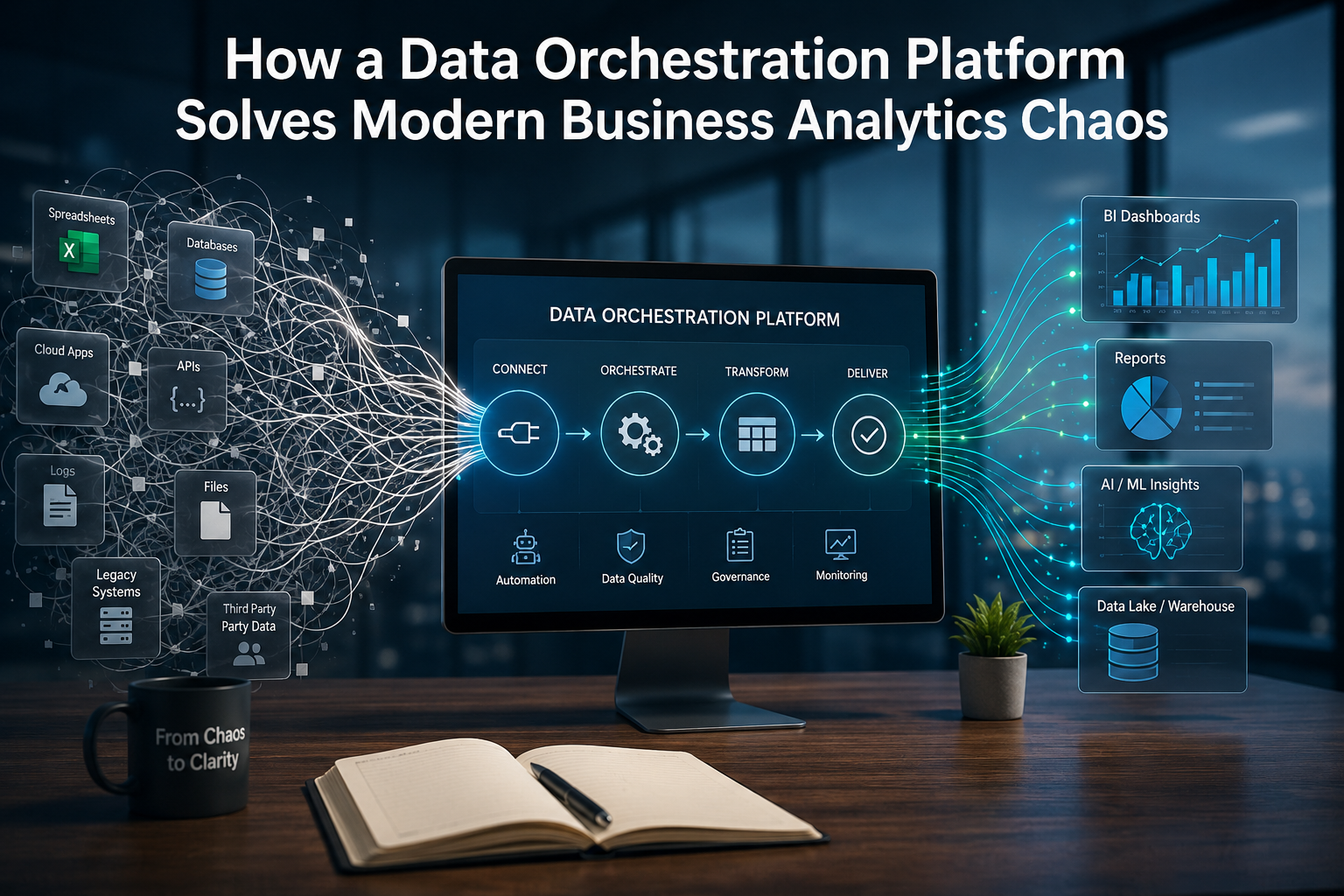
Modern enterprises run on information, but most of them are secretly drowning in it. Companies collect millions of data points every day from customer interactions, financial transactions, cloud applications, and marketing tools. The real challenge is not gathering this information, but moving it to the right place at the right time. When different departments use isolated software tools, information gets trapped in separate silos. Teams spend countless hours manually extracting files, fixing broken formatting, and trying to patch together disjointed reports. This chaotic environment is exactly why forward-thinking enterprises are shifting toward a centralized solutions architecture. Implementing a robust data orchestration platform has quickly evolved from a technical luxury into an absolute operational necessity for survival.
Understanding the Breakdown of Disconnected Systems
Without an overarching strategy, infrastructure naturally fragments over time. A marketing team might use one cloud service, while the finance department relies on a completely different legacy database. When leadership needs a unified report that combines information from both worlds, engineers have to build custom, fragile pipelines. These manual pipelines frequently break whenever an external software application updates its API or changes its data structure. The tech team ends up playing an endless game of whack-a-mole, fixing broken data streams instead of building new features.
A modern data orchestration platform elegantly solves this friction by acting as a universal translator and traffic controller for an entire digital ecosystem. Instead of relying on rigid, hard-coded connections, it coordinates the automated flow of information across entirely separate environments. It ensures that information is not just sitting passively in storage, but actively moving through its lifecycle in a clean, predictable, and fully visible manner.
The Operational Magic of Automated Data Workflows
When an organization deploys a data orchestration platform, the daily routine of data engineering teams changes completely. Instead of writing custom scripts to pull information every midnight, engineers can design visual, automated workflows that trigger based on specific events. For instance, the moment a customer completes a purchase on an e-commerce storefront, that transaction record instantly initiates a chain reaction. The automated system validates the entry, strips out sensitive personal details to maintain privacy compliance, and updates both the inventory log and the business intelligence dashboard in real time.
This level of automation means that business analysts no longer have to wait until the end of the month to review corporate performance. Because the data orchestration platform manages dependencies flawlessly, every step in the pipeline happens in the exact correct sequence. If a specific data source experiences a temporary network delay, the system does not just crash and corrupt the database. Instead, it intelligently pauses the pipeline, retries the connection, alerts the engineering team, and resumes the work safely without losing a single line of information.
Enhancing Data Quality and Governance Standards
Raw information is notoriously messy. It arrives with duplicate entries, missing fields, and inconsistent formatting that can completely ruin corporate analytics. If an organization makes major financial decisions based on corrupted analytics, the consequences can be disastrous. By routing all incoming pipelines through a unified data orchestration platform, a business establishes a strict, automated checkpoint for quality control. The system automatically screens incoming files, normalizes formatting discrepancies, and isolates anomalies for manual review before they ever reach the central warehouse.
Beyond basic cleanliness, corporate regulatory compliance demands absolute visibility into where data comes from and who alters it. A comprehensive data orchestration platform provides an immutable, transparent paper trail of the entire lifecycle. Compliance officers can look at any specific metric on a dashboard and trace it all the way back to its raw, original source. This level of granular visibility protects organizations from costly regulatory penalties while building deep, widespread internal trust in the numbers company leaders rely on every single day.
Future Proofing Your Architecture for Scale
As a business expands, its technological infrastructure must inevitably evolve alongside it. Companies frequently swap out old software tools, adopt new cloud providers, or purchase additional analytics engines. In a traditional environment, changing a single software component requires rebuilding dozens of custom pipelines from scratch. However, utilizing a flexible data orchestration platform decouples data logic from the underlying storage systems. It provides an abstraction layer that allows engineers to unplug an old database and connect a new cloud warehouse seamlessly without disrupting the end users.
This flexibility is particularly critical as organizations begin to embrace advanced machine learning models and artificial intelligence tools. These advanced systems require an immense, continuous stream of pristine, real-time data to remain accurate. A central data orchestration platform serves as the foundational engine that feeds these hungry AI models safely and reliably. It guarantees that data scientists spend their valuable time optimizing models rather than fighting with broken pipelines, accelerating the timeline from raw experimentation to actual production.
Conclusion
The true value of corporate information lies entirely in its mobility and accessibility. Leaving valuable assets trapped inside fragmented applications limits organizational agility and forces teams to make critical decisions based on outdated intuition. Embracing a unified data orchestration platform fundamentally remodels how an enterprise interacts with its digital assets. It transforms fragmented, manual pipelines into an elegant, automated highway system that delivers clean insights exactly when they matter most. Investing in this core foundational infrastructure eliminates operational friction, protects data integrity, and empowers a modern workforce to operate with absolute clarity and confidence in an increasingly competitive marketplace.