Modern ETL Pipelines That Power Reliable Data Workflows and Insights
Introduction
Companies depend on clean, timely data to make decisions, but raw sources are messy and inconsistent. Building robust ETL pipelines turns distributed, unreliable inputs into usable datasets that teams trust. This article walks through practical considerations for designing ETL pipelines that scale, remain maintainable, and deliver reliable outcomes for analytics and operational systems.
Why ETL Pipelines Matter
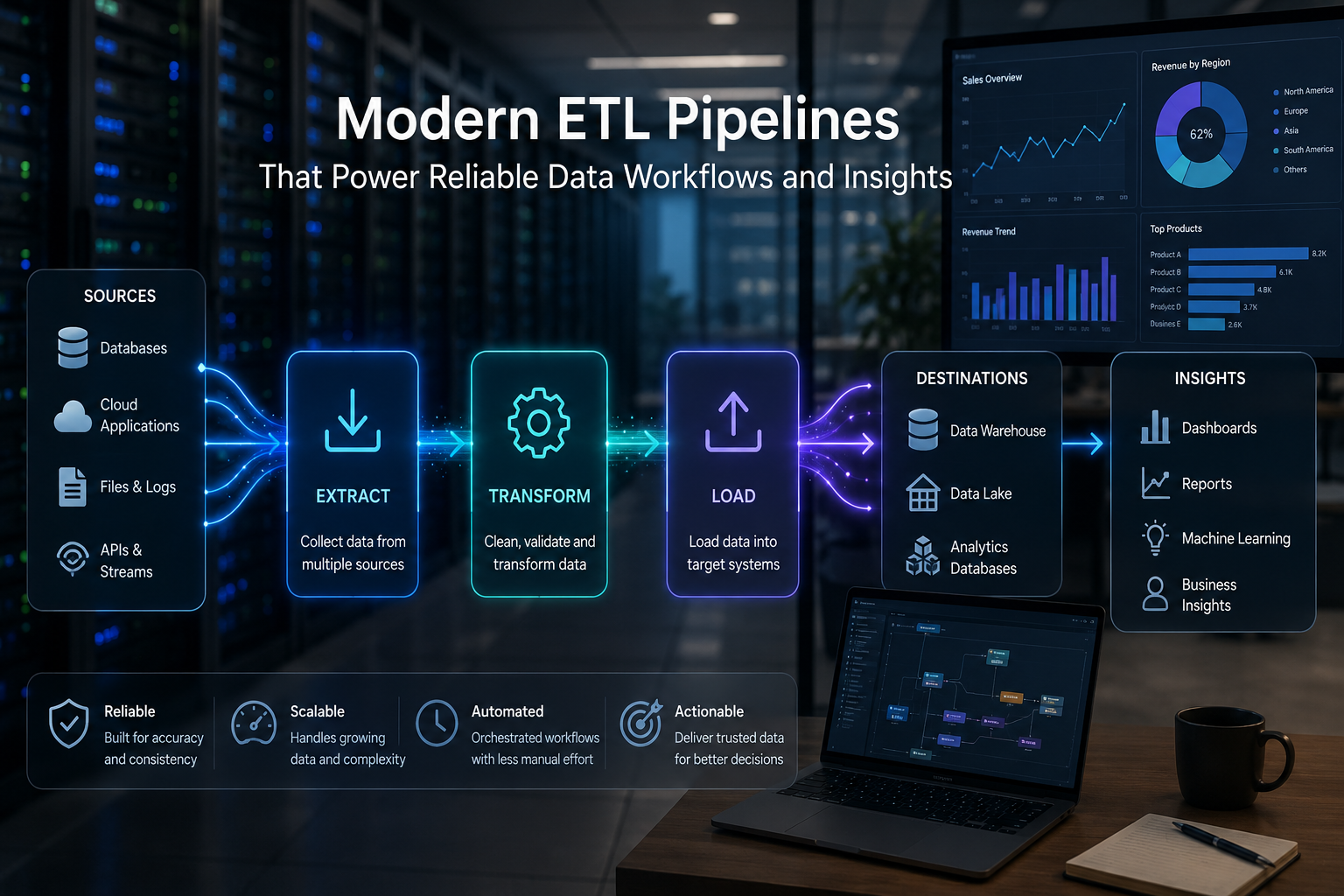
ETL pipelines are the backbone of data-driven organizations. They extract information from multiple sources, transform it to match business rules and schema expectations, and load it into storage optimized for querying and analysis. Without thoughtfully engineered ETL pipelines, organizations face duplicated work, conflicting metrics, and slow time-to-insight, which undermines confidence in decision-making. Well-designed pipelines centralize data logic, enable reproducible results, and reduce manual cleaning work across teams.
Design Principles for Durable Pipelines
Design starts with understanding the data lifecycle: how data is generated, how often it changes, and how it will be consumed. Adopt clear ownership for each data source and transformation. Keep transformations small and testable so debugging is faster when an issue appears. Implement schema evolution strategies that tolerate minor upstream changes without breaking downstream consumers. Observability must be baked in from day one—track schema drift, row counts, latency, and error rates so you can detect and act on anomalies before they affect reporting.
Handling Data Quality and Validation
Data validation reduces the propagation of errors. Create validation rules that run at extraction and prior to loading, checking for expected ranges, formats, and referential integrity. Where data quality issues are common, capture the original raw record alongside a normalized version to support audits and reprocessing. Use lightweight data contracts to set expectations between producers and consumers; automated tests that run in CI will enforce those contracts and reduce surprise failures in production.
Scaling and Performance Considerations
As data volume grows, ETL pipelines need to scale both compute and I/O efficiently. Prefer batch processing for high-volume, non-latency-sensitive workloads and streaming for time-critical updates. Optimize transformations by pushing computation closer to the data source when possible, using columnar file formats for analytical workloads, and batching writes to the destination to reduce overhead. Cost awareness matters: choose the right storage tiers and compute sizing, and use auto-scaling or serverless execution where it reduces operational complexity.
Operational Practices and Automation
Operationalizing ETL means treating pipelines as software products. Version control every transformation, test changes in isolated environments, and automate deployments. Schedule and orchestrate pipeline run with tools that provide dependency management, retries, and alerting. When failures occur, provide actionable error messages and convenient reprocessing pathways; operators should be able to resume from checkpoints rather than rerun entire jobs. Regularly audit performance and cost metrics to spot inefficiencies before they escalate.
Security and Compliance
ETL pipelines often move sensitive data. Encrypt data in transit and at rest, apply least-privilege access to storage and compute resources, and mask or redact personally identifiable information where necessary. Maintain an audit trail of who accessed or modified data and when. If regulatory constraints apply, implement retention policies and data subject request handling as part of the pipeline design.
Choosing Tools and Technologies
There is no one-size-fits-all stack for ETL pipelines. For smaller teams, managed services and low-code platforms accelerate time to value. Larger organizations may favor modular frameworks that support custom logic and complex orchestration. Evaluate solutions on criteria such as testing support, monitoring integrations, scalability, cost predictability, and community adoption. Also consider interoperability with data catalogs and governance tools to keep lineage and metadata visible to stakeholders.
Case Example: Improving Time-to-Insight
A mid-sized analytics team struggled with inconsistent metrics across reports. They restructured their ETL pipelines to centralize transformation logic into a shared layer, introduced automated tests that validated key metrics, and added observability dashboards that showed row counts and freshness. Within weeks, report discrepancies dropped and the team reduced manual reconciliation work. The investment in pipeline hygiene translated directly into faster, more confident business decisions.
Conclusion
Investing in well-architected ETL pipelines pays off in data reliability, reduced operational overhead, and faster insights. Focus on modular transformations, strong validation, observability, and automation, and select tooling that matches your team’s scale and skills. With these practices, ETL pipelines become predictable, auditable, and a true foundation for data-driven work.