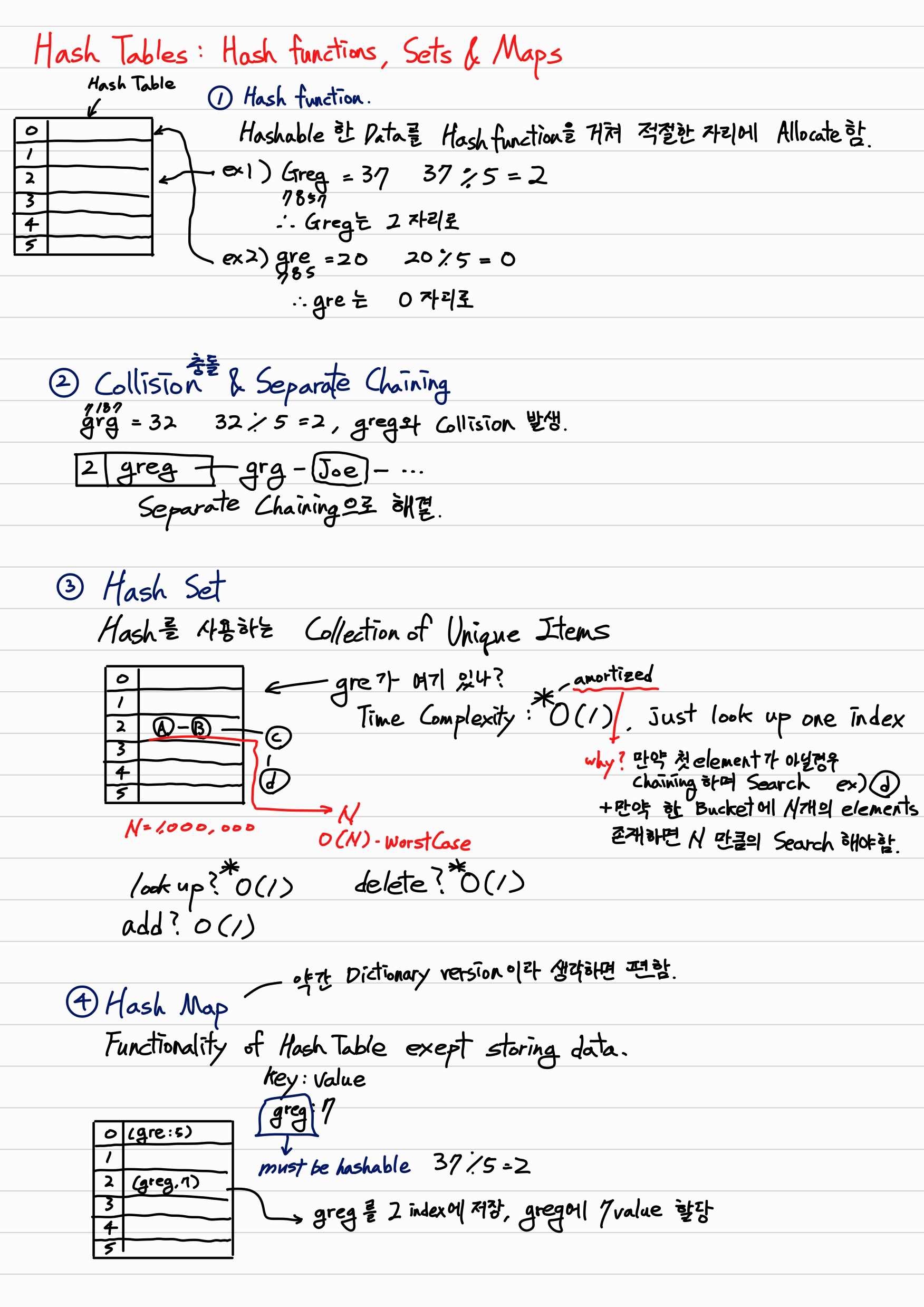
필기
1페이지
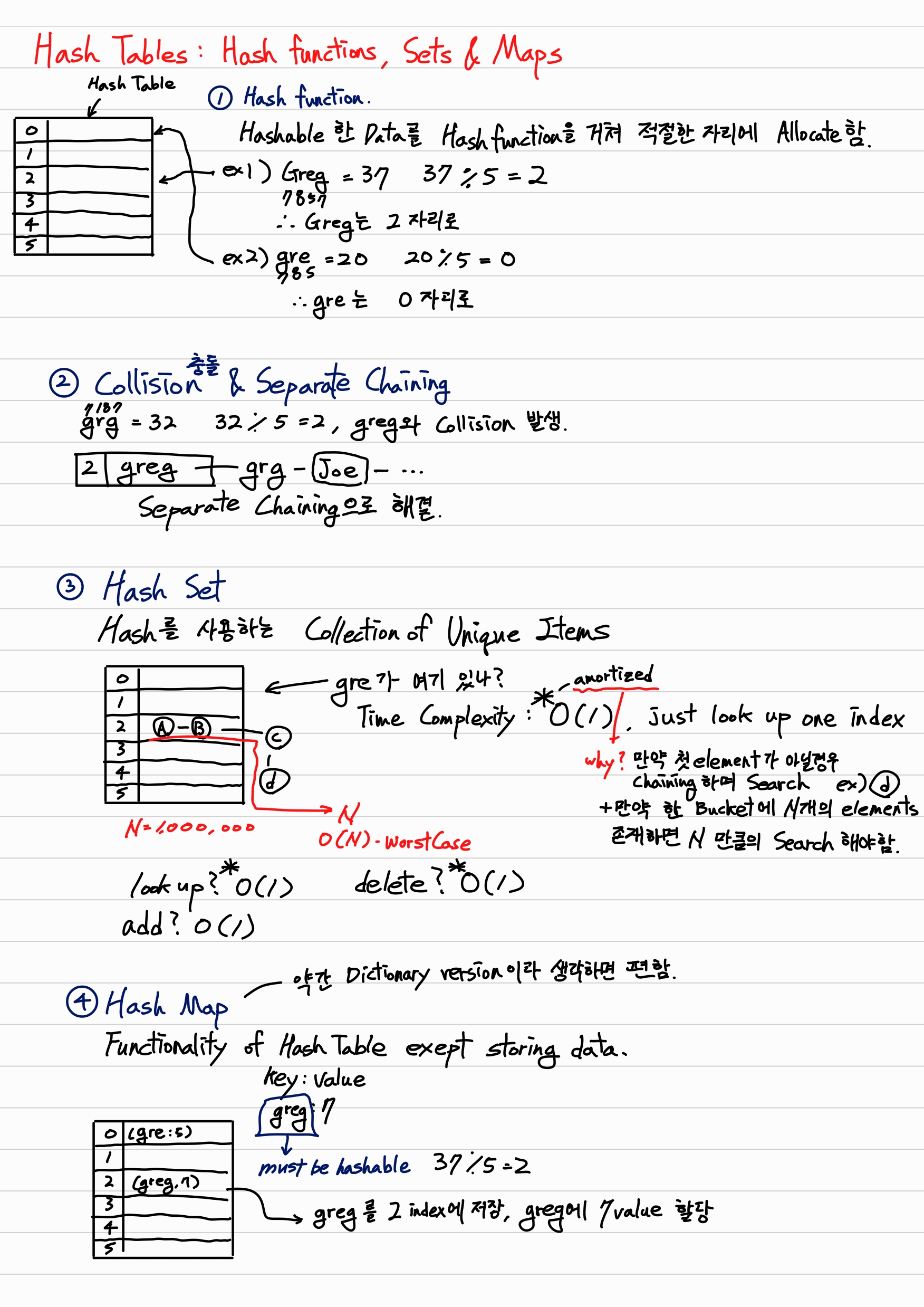
2페이지
실제 예시
# Hashsets
s = set()
print(s)
Add
# Add item into Set > O(1)
s.add(1)
s.add(2)
s.add(3)

print(s)
{1, 2, 3}
Look up
# Lookup if item in set > *O(1)
if 1 in s:
	print(True)
Remove
# Remove Item > O(1)
s.remove(3)

print(s)
{1, 2}
중복된 string
string = "aaaabbbbbbbbbbbbbcccccccceeeeaa"
sett = set(string) #Set construction O(S)

print(sett)
{'a', 'b', 'c', 'e'}
이러면 sett에서 unique한 것만 남음
# Hash mpas - Dictionaries
d = {
	'm' : 1,
    's' : 2,
    'r' : 3}
{'m' : 1,'s' : 2, 'r' : 3}
# Look up 할 수 있음
if 'm' not in d:
	print(False)

print(d['m']) #이건 'm'이 dictionary 안에 있다고 가정함
Loop over dictionary items!
# Loop over the key:val pairs of the dictionary: O(n)
for key, val in d.items():
	print[f'key {key}:val {val}']
Default dict
from collections import defaultdict

default = defaultdict(int)
default[2]
0
기본 정수, 0을 채운 default dictionary를 생성함. 그래서 key가 없는 지 찾아볼 필요 없이 0을 반환함
from collections import defaultdict

default = defaultdict(list)
default[2]
[]
[] 리스트로 채워진 dictionary 생성
Counter
from collections import Counter

string # 'aaaaabbbbccccceeeeee'
counter = Counter(string)

print(counter)
Counter({'a' : 5, 'b' : 4, 'c': 5, 'e' : 6})
요소의 갯수를 세는 dictionary 반환!

안녕하세요! 강민수입니다.