605. Can Place Flowers
You have a long flowerbed in which some of the plots are planted, and some are not.
However, flowers cannot be planted in adjacent plots.
Given an integer array flowerbed containing 0's and 1's, where 0 means empty and 1 means not empty, and an integer n, return true if n new flowers can be planted in the flowerbed without violating the no-adjacent-flowers rule and false otherwise.
✨ Example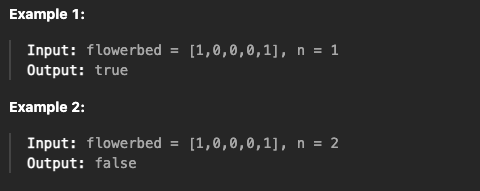
🚨 Constraints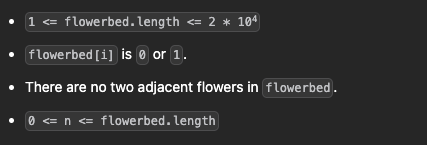
▶︎ 풀이
- 현재 인덱스가
i이고 값이 0일때, 인접한 인덱스i-1(left),i+1(right)의 값이 둘 다0이면 심을 수 있음
→ 이 때, i가0(left가 없음),length-1(right 가 없음)에 주의 flowerbed[i]의 값을1로 변경, 심을 때count증가
→ count : 심을 수 있는 꽃의 수count가n보다 크거나 같으면n개의 꽃을 모두 심을 수 있음
⏰ 제한시간 초과하여 답안 코드 및 풀이 확인
🚨 제약조건(Contraints) 확인
▶︎ 기존코드
class Solution {
    public boolean canPlaceFlowers(int[] flowerbed, int n) {
       int count = 0;
        for (int i = 0; i < flowerbed.length; i++) {
            if (flowerbed[i] == 0) {
                boolean emptyLeftPlot = (i == 0) || (flowerbed[i - 1] == 0);
                boolean emptyRightPlot = (i == flowerbed.length - 1) || (flowerbed[i + 1] == 0);
                if (emptyLeftPlot && emptyRightPlot) {
                    flowerbed[i] = 1;
                    count++;
                }
            }
        }
        return count >= n;
    }
}
▶︎ 개선사항
✨ 실행 속도 최적화
- for문 수정
증감식 :flowerbed[i]의 값이 1이면 다음 칸은 심을 수 없음 →i+2(그 다음 칸)을 확인 - 제약조건 간략화
flowerbed[i]의 값이 0이고flowerbed[i+1]이 1이면flowerbed[i+2]에 심을 수 없음
⇒ i++ 다음 증감식(i+=2) :i+3번째 칸부터 다시 확인 - 변수 선언
별도의count변수를 선언하지 않고n활용
▶︎ 수정코드
class Solution {
    public boolean canPlaceFlowers(int[] flowerbed, int n) {
         for(int i=0;i<flowerbed.length;i=i+2){
            if(flowerbed[i]==0){
                if(i==flowerbed.length-1 || flowerbed[i] == flowerbed[i+1] ){
                    n--;
                } else{
                    i++;
                }
            }
        }
        return n<=0;
    }
}
안녕하세요 :)