
segregate - first_fit
/*
 * mm-naive.c - The fastest, least memory-efficient malloc package.
 *
 * In this naive approach, a block is allocated by simply incrementing
 * the brk pointer.  A block is pure payload. There are no headers or
 * footers.  Blocks are never coalesced or reused. Realloc is
 * implemented directly using mm_malloc and mm_free.
 *
 * NOTE TO STUDENTS: Replace this header comment with your own header
 * comment that gives a high level description of your solution.
 */
#include <stdio.h>
#include <stdlib.h>
#include <assert.h>
#include <unistd.h>
#include <string.h>

#include "mm.h"

#include <limits.h>

#include "memlib.h"

/*********************************************************
 * NOTE TO STUDENTS: Before you do anything else, please
 * provide your team information in the following struct.
 ********************************************************/
team_t team = {
    /* Team name */
    "ateam",
    /* First member's full name */
    "Harry Bovik",
    /* First member's email address */
    "bovik@cs.cmu.edu",
    /* Second member's full name (leave blank if none) */
    "",
    /* Second member's email address (leave blank if none) */
    ""
};

/* single word (4) or double word (8) alignment */
#define ALIGNMENT 8

/* rounds up to the nearest multiple of ALIGNMENT */
#define ALIGN(size) (((size) + (ALIGNMENT-1)) & ~0x7)


#define SIZE_T_SIZE (ALIGN(sizeof(size_t)))

/* Basic constants and macros */
#define WSIZE       4       /* Word and header/footer size (bytes) */
#define DSIZE       8       /* Double word size (bytes) */
#define CHUNKSIZE   (1<<12) /* Extend heap by this amount (bytes) */

#define MAX(x, y) ((x) > (y)? (x) : (y))

/* Pack a size and allocated bit into a word */
#define PACK(size, alloc) ((size) | (alloc))

/* Read and write a word at address p */
#define GET(p)      (*(unsigned int *)(p))
#define PUT(p, val) (*(unsigned int *)(p) = (val))

/* Read the size and allocated fields from address p */
#define GET_SIZE(p) (GET(p) & ~0x7)
#define GET_ALLOC(p) (GET(p) & 0x1)

/* Given block ptr bp, compute address of its header and footer */
#define HDRP(bp)    ((char *)(bp) - WSIZE)
#define FTRP(bp)    ((char *)(bp) + GET_SIZE(HDRP(bp)) - DSIZE)

/* Given block ptr bp, compute address of next and previous blocks */
#define NEXT_BLKP(bp) ((char *)(bp) + GET_SIZE(((char *)(bp) - WSIZE)))
#define PREV_BLKP(bp) ((char *)(bp) - GET_SIZE(((char *)(bp) - DSIZE)))

/* Pointers to predecessor and successor in free list */
#define PREDP(bp) (*(void **)(bp))
#define SUCCP(bp) (*(void **)(bp + WSIZE))

/* --- Segregated List Defines --- */
#define NUM_CLASSES 20  /* Number of size classes */

typedef void * (*fit_policy_t)(size_t asize);

/* --- Global Variables --- */
static char *free_lists[NUM_CLASSES]; /* Array of segregated list heads */
static char *heap_listp;              /* Pointer to prologue block */

/* --- Function Prototypes --- */
static void *coalesce(void *bp);
static void *extend_heap(size_t words);
static void *find_fit(size_t asize, fit_policy_t fit_policy);
static void *segregated_first_fit(size_t asize);
static void place(void *bp, size_t asize);
static void list_add(void *bp);
static void list_remove(void *bp);
static int get_list_index(size_t size);

/*
 * mm_init - initialize the malloc package.
 */
int mm_init(void) {
    if ((heap_listp = mem_sbrk(4 * WSIZE)) == (void *) -1)
        return -1;

    PUT(heap_listp, 0);                         /* Alignment padding */
    PUT(heap_listp + (1*WSIZE), PACK(DSIZE, 1)); /* Prologue header */
    PUT(heap_listp + (2*WSIZE), PACK(DSIZE, 1)); /* Prologue footer */
    PUT(heap_listp + (3*WSIZE), PACK(0, 1));     /* Epilogue header */
    heap_listp += (2 * WSIZE);

    /* Initialize all segregated list heads to NULL */
    for (int i = 0; i < NUM_CLASSES; i++) {
        free_lists[i] = NULL;
    }

    if (extend_heap(CHUNKSIZE / WSIZE) == NULL)
        return -1;
    return 0;
}

/*
 * mm_malloc - Allocate a block.
 */
void *mm_malloc(size_t size) {
    size_t asize; /* Adjusted block size */
    size_t extendsize; /* Amount to extend heap if no fit */
    char *bp;

    /* Ignore spurious requests */
    if (size == 0)
        return NULL;

    /* Adjust block size to include overhead and alignment reqs. */
    if (size <= DSIZE)
        asize = 2 * DSIZE;
    else
        asize = DSIZE * ((size + (DSIZE) + (DSIZE - 1)) / DSIZE);

    /* Search the free list for a fit */
    if ((bp = find_fit(asize, segregated_first_fit)) != NULL) {
        place(bp, asize);
        return bp;
    }

    /* No fit found. Get more memory and place the block */
    extendsize = MAX(asize, CHUNKSIZE);
    if ((bp = extend_heap(extendsize / WSIZE)) == NULL)
        return NULL;
    place(bp, asize);
    return bp;
}

/*
 * mm_free - Freeing a block.
 */
void mm_free(void *bp) {
    size_t size = GET_SIZE(HDRP(bp));

    PUT(HDRP(bp), PACK(size, 0));
    PUT(FTRP(bp), PACK(size, 0));
    coalesce(bp);
}

/*
 * mm_realloc - Implemented simply in terms of mm_malloc and mm_free
 */
 void *mm_realloc(void *ptr, size_t size) {
     void *oldptr = ptr;
     void *newptr;

     if (size == 0) {
         mm_free(ptr);
         return NULL;
     }

     if (ptr == NULL) {
         return mm_malloc(size);
     }

     newptr = mm_malloc(size);
     if (newptr == NULL)
         return NULL;

     size_t copysize = GET_SIZE(HDRP(ptr)) - DSIZE;
     if (size < copysize) {
         copysize = size;
     }
     memcpy(newptr, oldptr, copysize);
     mm_free(oldptr);
     return newptr;
}

/*
 * extend_heap - Extends the heap with a new free block.
 */
static void *extend_heap(size_t words) {
    char *bp;
    size_t size;

    /* Allocate an even number of words to maintain alignment */
    size = (words % 2) ? (words + 1) * WSIZE : words * WSIZE;
    if ((long) (bp = mem_sbrk(size)) == -1)
        return NULL;

    /* Initialize free block header/footer and the epilogue header */
    PUT(HDRP(bp), PACK(size, 0)); /* Free block header */
    PUT(FTRP(bp), PACK(size, 0)); /* Free block footer */
    PUT(HDRP(NEXT_BLKP(bp)), PACK(0, 1)); /* New epilogue header */

    /* Coalesce if the previous block was free */
    return coalesce(bp);
}

/*
 * list_add - Add a free block to the appropriate size class list.
 * Uses LIFO (Last-In, First-Out) insertion.
 */
static void list_add(void *bp) {
    size_t size = GET_SIZE(HDRP(bp));
    int index = get_list_index(size);

    void *list_head = free_lists[index];

    PREDP(bp) = NULL;
    SUCCP(bp) = list_head;
    if (list_head != NULL) {
        PREDP(list_head) = bp;
    }

    free_lists[index] = bp;
}

/*
 * list_remove - Remove a block from its size class list.
 */
static void list_remove(void *bp) {
    size_t size = GET_SIZE(HDRP(bp));
    int index = get_list_index(size);

    void *pred_bp = PREDP(bp);
    void *succ_bp = SUCCP(bp);

    if (pred_bp == NULL && succ_bp == NULL) {
        /* Only block in list */
        free_lists[index] = NULL;
    } else if (pred_bp == NULL) {
        /* Head of list */
        PREDP(succ_bp) = NULL;
        free_lists[index] = succ_bp;
    } else if (succ_bp == NULL) {
        /* Tail of list */
        SUCCP(pred_bp) = NULL;
    } else {
        /* Middle of list */
        SUCCP(pred_bp) = succ_bp;
        PREDP(succ_bp) = pred_bp;
    }
}

/*
 * coalesce - Merge adjacent free blocks.
 */
static void *coalesce(void *bp) {
    size_t prev_alloc = GET_ALLOC(FTRP(PREV_BLKP(bp)));
    size_t next_alloc = GET_ALLOC(HDRP(NEXT_BLKP(bp)));
    size_t size = GET_SIZE(HDRP(bp));

    if (prev_alloc && next_alloc) {
        /* Case 1: Both allocated. No merge. */
    } else if (prev_alloc && !next_alloc) {
        /* Case 2: Next block is free. */
        list_remove(NEXT_BLKP(bp));
        size += GET_SIZE(HDRP(NEXT_BLKP(bp)));
        PUT(HDRP(bp), PACK(size, 0));
        PUT(FTRP(bp), PACK(size, 0));
    } else if (!prev_alloc && next_alloc) {
        /* Case 3: Previous block is free. */
        list_remove(PREV_BLKP(bp));
        size += GET_SIZE(HDRP(PREV_BLKP(bp)));
        PUT(FTRP(bp), PACK(size, 0));
        PUT(HDRP(PREV_BLKP(bp)), PACK(size, 0));
        bp = PREV_BLKP(bp);
    } else {
        /* Case 4: Both previous and next are free. */
        list_remove(PREV_BLKP(bp));
        list_remove(NEXT_BLKP(bp));
        size += GET_SIZE(HDRP(PREV_BLKP(bp))) +
                GET_SIZE(FTRP(NEXT_BLKP(bp)));
        PUT(HDRP(PREV_BLKP(bp)), PACK(size, 0));
        PUT(FTRP(NEXT_BLKP(bp)), PACK(size, 0));
        bp = PREV_BLKP(bp);
    }

    /* Add the (potentially new, larger) block to the correct list */
    list_add(bp);
    return bp;
}

/*
 * segregated_first_fit - Find a fit in the segregated lists.
 * Searches from the block's size class up to larger classes.
 */
static void *segregated_first_fit(size_t asize) {
    int index = get_list_index(asize);
    void *bp;

    /* Search from the correct size class upwards */
    for (int i = index; i < NUM_CLASSES; i++) {
        for (bp = free_lists[i]; bp != NULL; bp = SUCCP(bp)){
            if (asize <= GET_SIZE(HDRP(bp))) {
                return bp;
            }
        }
    }

    return NULL; /* No fit found */
}

/*
 * find_fit - Wrapper for the chosen fit policy.
 */
static void *find_fit(size_t asize, fit_policy_t fit_policy) {
    return fit_policy(asize);
}

/*
 * place - Place block in heap, splitting if large enough.
 */
static void place(void *bp, size_t asize) {
    size_t csize = GET_SIZE(HDRP(bp));
    list_remove(bp); /* Remove this block from its free list */

    if ((csize - asize) >= (2 * DSIZE)) {
        /* Split the block */
        PUT(HDRP(bp), PACK(asize, 1));
        PUT(FTRP(bp), PACK(asize, 1));
        bp = NEXT_BLKP(bp);
        /* Add the remaining fragment back to the free list */
        PUT(HDRP(bp), PACK(csize-asize, 0));
        PUT(FTRP(bp), PACK(csize-asize, 0));
        list_add(bp);
    } else {
        /* Do not split */
        PUT(HDRP(bp), PACK(csize, 1));
        PUT(FTRP(bp), PACK(csize, 1));
    }
}

/*
 * get_list_index - Given a block size, return the correct
 * size class list index.
 */
static int get_list_index(size_t size) {
    /* * Simple power-of-2 size classes.
     * 0: [1, 32]
     * 1: [33, 64]
     * 2: [65, 128]
     * ...
     * 19: [2^20+1, infinity]
     */
    if (size <= 32) return 0;
    if (size <= 64) return 1;
    if (size <= 128) return 2;
    if (size <= 256) return 3;
    if (size <= 512) return 4;
    if (size <= 1024) return 5;
    if (size <= 2048) return 6;
    if (size <= 4096) return 7;
    if (size <= 8192) return 8;
    if (size <= 16384) return 9;
    if (size <= 32768) return 10;
    if (size <= 65536) return 11;
    if (size <= 131072) return 12;
    if (size <= 262144) return 13;
    if (size <= 524288) return 14;
    if (size <= 1048576) return 15;
    if (size <= 2097152) return 16;
    if (size <= 4194304) return 17;
    if (size <= 8388608) return 18;

    /* All larger blocks go in the last list */
    return 19;
}
CSAPP 8.6 ~ 8.8
8.6 비지역 점프 (Nonlocal Jumps)
C 언어는 비지역 점프(nonlocal jump)라는 사용자 수준의 예외적 제어 흐름(ECF)을 제공합니다. 이는 일반적인 함수 호출/반환 순서를 무시하고, 한 함수에서 스택 상의 다른 (현재 실행 중인) 함수로 제어권을 직접 이전시키는 기능입니다. 이 기능은 setjmp와 longjmp 함수를 통해 제공됩니다.
1. setjmp와 longjmp의 동작 원리
setjmp / sigsetjmp
#include <setjmp.h>

int setjmp(jmp_buf env);
int sigsetjmp(sigjmp_buf env, int savesigs);- 역할: 현재 호출 환경(프로그램 카운터, 스택 포인터, 레지스터 등)을
env버퍼에 저장합니다. - 반환 (특이점):
setjmp는 여러 번 반환될 수 있습니다.- 최초 호출 시: 0을 반환합니다.
longjmp를 통해 복귀 시:longjmp가 전달한 0이 아닌 값(retval)을 반환합니다.
- 주의:
setjmp의 반환 값은rc = setjmp(env);처럼 변수에 할당해서는 안 되며,switch나if조건문에서만 안전하게 사용할 수 있습니다.
longjmp / siglongjmp
#include <setjmp.h>

void longjmp(jmp_buf env, int retval);
void siglongjmp(sigjmp_buf env, int retval);- 역할:
env버퍼에 저장된 환경을 복원하고, 가장 최근에env를 저장했던setjmp호출 지점으로 즉시 점프합니다. - 반환 (특이점):
longjmp는longjmp를 호출한 위치로 절대 반환하지 않습니다(Never returns).
2. 활용 1: 깊은 중첩에서의 에러 처리 (Fig 8.43)
longjmp의 가장 중요한 용도는, 깊게 중첩된 함수(main foo bar)에서 에러가 발생했을 때, 스택을 일일이 return으로 거슬러 올라가지 않고 에러 핸들러로 즉시 탈출하는 것입니다.
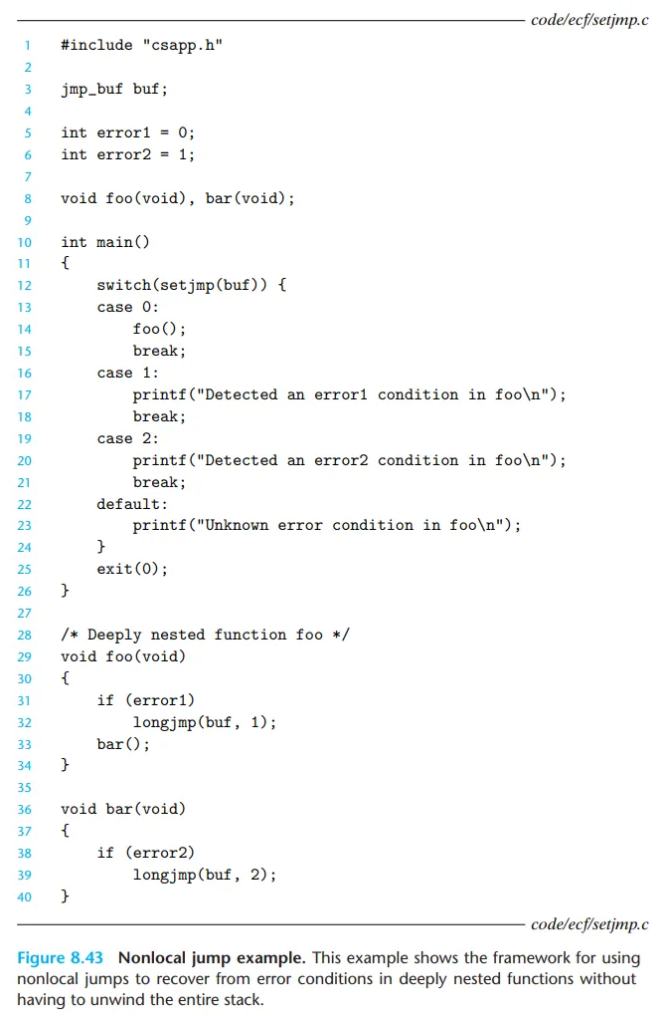
- 예시 (Fig 8.43):
main이setjmp(buf)를 호출하여 복귀 지점(case 0)을 설정합니다.main이foo()를 호출하고,foo()가bar()를 호출합니다.bar()에서error2가 감지되면,longjmp(buf, 2)를 호출합니다.- 제어권은
foo()를 건너뛰고main의setjmp위치로 즉시 점프합니다. setjmp는longjmp가 보낸2를 반환하고,switch문이case 2를 실행하여 에러를 처리합니다.
- ⚠️ 경고: 메모리 누수 longjmp는 foo 같은 중간 함수를 강제로 건너뜁니다. 만약 foo 함수가 malloc으로 메모리를 할당하고 함수 마지막에 free를 하도록 설계되었다면, 이 free 코드가 실행되지 않아 메모리 누수가 발생할 수 있습니다.
3. 활용 2: 시그널 핸들러에서 분기 (Fig 8.44)
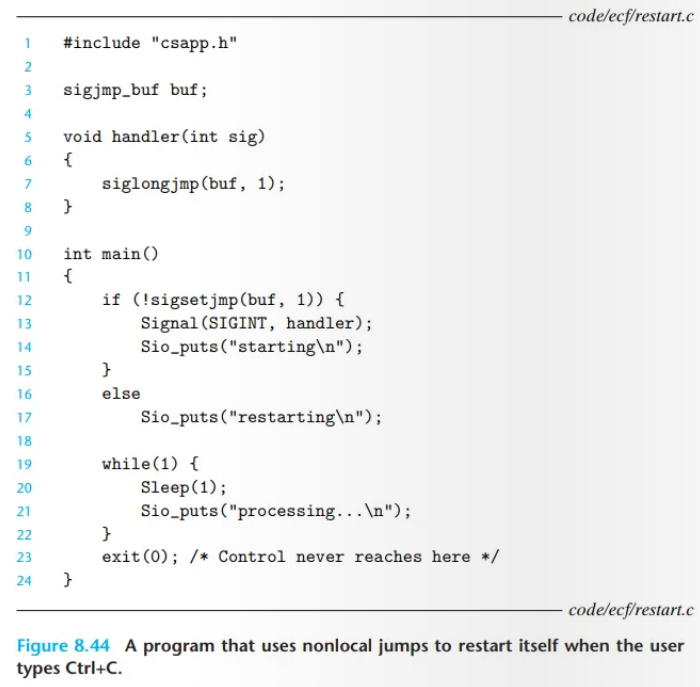
longjmp는 시그널 핸들러가 중단된 코드로 복귀하는 대신, 프로그램의 특정 지점(예: 시작점)으로 분기할 수 있게 합니다. (예: Ctrl+C로 프로그램 재시작)
- sigsetjmp / siglongjmp: 시그널 핸들러에서 안전하게 사용하기 위한 특별한 버전입니다. setjmp/longjmp의 기능에 더해 시그널 컨텍스트(예: 시그널 차단 벡터)까지 저장하고 복원합니다.
- 예시:
main이sigsetjmp로 재시작 지점을 저장합니다. Ctrl+C (SIGINT) 시그널이 발생하면, 핸들러가siglongjmp를 호출하여main의 시작 지점으로 제어를 되돌려 프로그램을 "재시작"합니다.
4. siglongjmp 사용 시 중요 주의사항
-
경합 상태 (Race Condition):
반드시 sigsetjmp를 먼저 호출하여 복귀 지점을 설정한 후에, Signal로 핸들러를 설치해야 합니다. (그렇지 않으면 핸들러가 sigsetjmp보다 먼저 실행될 수 있음)
-
비동기-시그널-안전 (Async-Signal-Unsafe):
siglongjmp는 시그널-안전 함수가 아닙니다. 따라서 siglongjmp가 되돌아간 지점(즉, sigsetjmp가 0이 아닌 값을 반환한 직후)부터는 sio_puts나 sleep처럼 시그널-안전이 보장된 함수들만 호출해야 합니다.
8.7 프로세스 조작을 위한 도구들
리눅스 시스템은 프로세스를 모니터링하고 조작하기 위한 여러 유용한 도구들을 제공합니다.
strace:- 실행 중인 프로그램과 그 자식들(children)이 호출하는 모든 시스템 콜(system call)을 추적하여 출력합니다.
- 호기심 많은 학생에게 아주 흥미로운(fascinating) 도구입니다.
- (공유 라이브러리 관련 잡다한 출력 없이) 더 깔끔한 추적 결과를 얻으려면, 프로그램을
static플래그와 함께 컴파일하는 것이 좋습니다.
ps:- 현재 시스템에 있는 프로세스들(좀비 프로세스 포함)의 목록을 보여줍니다.
top:- 현재 프로세스들의 리소스 사용량에 대한 정보를 출력합니다.
pmap:- 프로세스의 메모리 맵을 표시합니다.
/proc:- 수많은 커널(kernel) 자료 구조의 내용을 ASCII 텍스트 형태로 내보내는(export) 가상 파일 시스템(virtual filesystem)입니다.
- 사용자 프로그램은 이 텍스트 파일들을 읽을 수 있습니다.
- 예시: 터미널에
cat /proc/loadavg를 입력하면, 리눅스 시스템의 현재 "로드 애버리지(load average)"를 볼 수 있습니다.
8.8 요약 (Summary)
- 예외적 제어 흐름(ECF)은 컴퓨터 시스템의 모든 수준에서 발생하며, 시스템에 동시성(concurrency)을 제공하는 기본 메커니즘입니다.
- 하드웨어 수준:
- 예외(Exception)는 프로세서 내부 이벤트에 의해 트리거되는 제어 흐름의 갑작스러운 변경입니다.
- 제어 흐름은 소프트웨어 핸들러로 전달되며, 핸들러는 일부 처리를 수행한 뒤 중단된 제어 흐름으로 제어를 반환합니다.
- 4가지 예외 유형:
- 인터럽트 (Interrupts):
- 타이머 칩이나 디스크 컨트롤러 같은 외부 I/O 장치가 프로세서의 인터럽트 핀을 설정할 때 비동기적으로 발생합니다.
- 제어는 장애를 일으킨 명령어(faulting instruction) 다음의 명령어로 돌아갑니다.
- 폴트 (Faults)와 중단 (Aborts):
- 명령어 실행의 결과로 동기적으로 발생합니다.
- 폴트 핸들러는 장애를 일으킨 명령어를 재시작시킵니다.
- 중단 핸들러는 중단된 흐름으로 제어를 절대 반환하지 않습니다.
- 트랩 (Traps):
- 시스템 콜(System Call)을 구현하는 데 사용되는 함수 호출과 유사하며, 애플리케이션이 OS 코드로 진입하는 제어된 통로를 제공합니다.
- 인터럽트 (Interrupts):
- 운영체제(OS) 수준:
- 커널은 ECF를 사용하여 프로세스(process)라는 기본 개념을 제공합니다.
- 프로세스는 애플리케이션에 두 가지 중요한 추상화(abstraction)를 제공합니다.
- 논리적 제어 흐름: 각 프로그램이 프로세서를 독점적으로 사용하는 듯한 환상을 줍니다.
- 사적 주소 공간: 각 프로그램이 주 메모리를 독점적으로 사용하는 듯한 환상을 줍니다.
- OS와 애플리케이션 인터페이스:
- 애플리케이션은 자식 프로세스를 생성하고, 자식 프로세스가 멈추거나 종료되기를 기다리고(wait), 새 프로그램을 실행하며, 다른 프로세스로부터 시그널(signal)을 받을 수 있습니다.
- 시그널 처리의 의미는 미묘하며 시스템마다 다를 수 있지만, Posix 호환 시스템에는 예상되는 시그널 처리 의미를 명확히 지정하는 메커니즘이 존재합니다.
- 애플리케이션 수준:
- C 프로그램은 비지역 점프(nonlocal jump) (
setjmp,longjmp)를 사용하여 일반적인 호출/반환 스택 규율을 우회하고 한 함수에서 다른 함수로 직접 분기(branch)할 수 있습니다.
- C 프로그램은 비지역 점프(nonlocal jump) (

멈추지 않기