Mastering the Bass Guitar Fretboard: A Complete Guide for Players
The bass guitar is often described as the bridge between rhythm and melody. While drummers lock in the pulse and guitarists paint the harmonic landscape, the bass player holds everything together. But for many aspiring bassists, one element remains frustratingly elusive: the bass guitar fretboard. Unlike the guitar, where chords and shapes often steal the spotlight, the bass requires a deeper, more intentional relationship with the neck. Understanding where every note lives, how intervals connect, and how to move fluidly across the strings is what separates a casual player from a confident musician.
Why Most Bassists Struggle With Note Recognition
Walk into any rehearsal space, and you will find bass players who can slap, pop, and lock into a groove effortlessly. Ask them to name the note on the seventh fret of the A string, and suddenly the room goes quiet. This gap between technical ability and fretboard knowledge is surprisingly common. The reason is simple: many beginner methods prioritize patterns and tablature over true note literacy. Patterns like the pentatonic scale or the blues box can get you playing quickly, but they also allow you to avoid learning the actual geography of the bass guitar fretboard. Over time, this reliance on shapes becomes a ceiling rather than a floor.
The good news is that the bass is actually easier to navigate than most instruments. Unlike piano, where each octave repeats the same twelve notes but with a different visual layout, the bass repeats patterns consistently across strings and frets. The challenge is not the complexity of the system—it is the player’s willingness to stop relying on position shifts and start seeing the neck as a connected map of sound.
Understanding the Layout of the Bass Neck
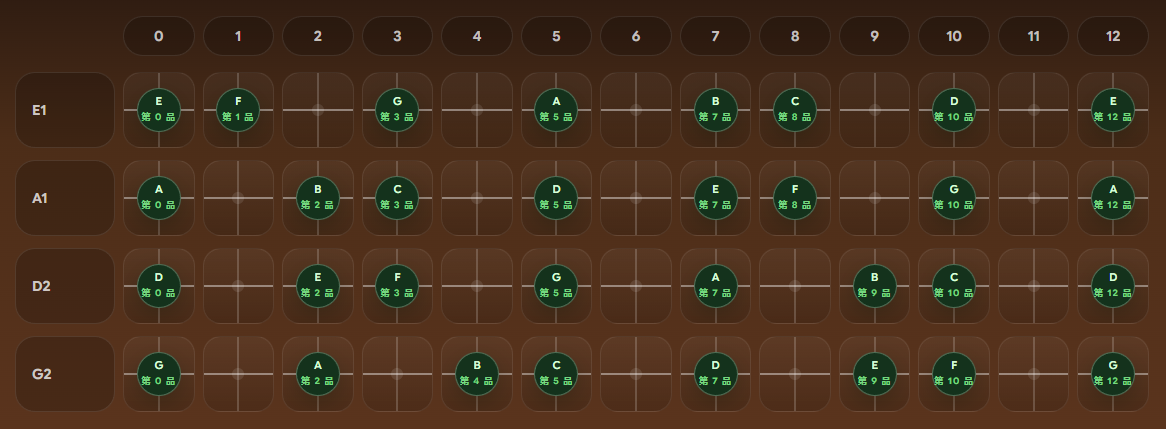
Before diving into exercises and strategies, let us establish a clear picture of what you are looking at when you glance down at your bass. A standard four-string bass is tuned E-A-D-G, from the thickest string to the thinnest. Each fret raises the pitch by one half-step. That means the open E string is E, the first fret is F, the second fret is F#, and so on up to the twelfth fret, where the pattern repeats.
The single most important insight about the bass guitar fretboard is its symmetry. The fifth fret of any string is the same pitch as the open string above it. The fifth fret on the E string is A, which matches the open A string. The fifth fret on the A string is D, matching the open D string. This simple relationship allows you to navigate the entire neck once you know the open strings and the chromatic scale.
Another landmark: the twelfth fret. At the twelfth fret, every string doubles its open pitch. The twelfth fret on the E string is E again, but one octave higher. The twelfth fret on the A string is A, and so on. These anchor points—the open strings, the fifth fret, and the twelfth fret—act as reference markers. If you can memorize these, you can calculate any other note by moving up or down in half-steps.
The Chromatic Scale as Your Fretboard Compass
The chromatic scale is simply all twelve notes of Western music: A, A#, B, C, C#, D, D#, E, F, F#, G, G#. Notice that there is no sharp between B and C, or between E and F. These are natural half-steps. If you understand that moving one fret equals moving one half-step, then the entire bass guitar fretboard becomes a linear sequence of notes wrapped across four strings.
For example, start on the open E string. First fret: F. Second fret: F#. Third fret: G. Fourth fret: G#. Fifth fret: A. This is the same logic that applies on every string, with one small adjustment: when you move from the G string to the B string on a five-string bass, the interval changes. But on a standard four-string, the pattern holds firm.
A practical exercise: Say the name of every note aloud as you play it, one fret at a time, from the open E string up to the twelfth fret. Then move to the A string and do the same. Do not rush. The goal is not speed but association between your finger position, the sound, and the note name. Within a week of five minutes daily on this exercise, most players report that the neck starts to feel familiar rather than foreign.
Visualizing Patterns Without Losing Individual Notes
Patterns are not the enemy. The real problem is using patterns to avoid note knowledge. The minor pentatonic box, for instance, is a fantastic tool for improvising. But if you only know the shape, you cannot transpose it smoothly to a different key unless you know where the root notes are. That is why learning the bass guitar fretboard note-by-note actually makes your patterns stronger, not weaker.
Try this hybrid approach. Take a simple two-octave major scale. Start on the third fret of the E string (G). Play G, A, B, C, D, E, F#, G. Now instead of just memorizing the finger pattern, name each note as you play it. Then ask yourself: where is the fifth? The seventh? The third? By connecting interval names to specific fret locations, you build two mental maps at once—one for notes and one for distances between them.
Another powerful method is to practice the same scale starting on different strings. Play a C major scale starting on the A string (third fret). Then play it starting on the D string (tenth fret). Each time, you will have to adjust your fingering. This forces you to stop relying on muscle memory and start relying on actual knowledge of the bass guitar fretboard.
Common Traps and How to Avoid Them
One of the biggest mistakes self-taught players make is staying in first position. First position means your hand hovers around the first four frets. It is comfortable, but it hides huge sections of the neck from your awareness. Force yourself to play simple lines in higher positions. Play a root-octave pattern starting at the tenth fret. Play a walking bass line at the seventh fret. The more you displace your hand, the more the fretboard reveals itself.
Another trap is looking at your fretting hand constantly. While beginners need visual feedback, relying on your eyes creates a crutch. Try practicing in low light or with your eyes closed. Feel the position markers on the side of the neck. Listen to the intervals. Your ears and your hands can learn the bass guitar fretboard better than your eyes if you give them the chance.
Tablature is the third trap. Reading tab is fine for learning songs quickly, but tab does not teach you note names. Rewrite a simple bass line from tab into standard notation or just into a list of note names. The act of translating forces your brain to process the fretboard actively instead of passively.
Daily Drills That Actually Work
Consistency beats intensity. Fifteen minutes a day of focused fretboard work will outperform three hours once a week. Here are drills that target the bass guitar fretboard directly.
The random note drill: pick a note anywhere on the neck. Name it instantly. Then find the same note on the next string. Then find it one octave higher. Do this for five minutes. Use a random note generator app or just have a friend call out notes.
The interval search drill: pick a root note, say D on the A string (fifth fret). Without looking, find the major third above it. The perfect fifth. The minor seventh. Play each interval and name the note you landed on. This connects fretboard geography to practical music theory.
The one-string scale drill: play a full two-octave scale on a single string. This is physically awkward but mentally brilliant. On the E string, play E, F#, G#, A, B, C#, D#, E. You will have to shift positions dramatically. This breaks the habit of thinking in boxes and forces you to see the bass guitar fretboard as a continuous line.
Moving Beyond the Basics
Once you can name any note without hesitation and find intervals quickly, you have achieved what most bass players never do: genuine fretboard freedom. From here, improvisation becomes about musical choice rather than physical guessing. Composing bass lines becomes faster because you can see multiple pathways between chords. Reading chord charts becomes intuitive because you know where every root, third, fifth, and seventh lives.
The bass guitar fretboard is not a mystery to be solved with a single trick or a secret shape. It is a landscape that rewards patient exploration. Every time you practice with intention—naming notes, finding intervals, breaking out of comfortable positions—you are not just memorizing a diagram. You are building a mental model of sound that will serve you for as long as you play. And that is the real goal: not just moving your fingers, but knowing exactly where you are going before you even get there.