Requirement:
system calls
- int clone(void(fcn)(void , void ), void arg1, void arg2, void stack).
This call creates a new kernel thread which shares the calling process's address space.
File descriptors are copied as in fork().
The new process uses stack as its user stack, which is passed two arguments (arg1 and arg2) and uses a fake return PC (0xffffffff); a proper thread will simply call exit() when it is done (and not return).
The stack should be one page in size and page-aligned.
The new thread starts executing at the address specified by fcn.
Return value: as with fork(), the PID of the new thread is returned to the parent (for simplicity, threads each have their own process ID).
- int join(void **stack).
This call waits for a child thread that shares the address space with the calling process to exit.
Return value: the PID of waited-for child or -1 if none. The location of the child's user stack is copied into the argument stack (which can then be freed).
thread library
- int thread_create(void (start_routine)(void , void ), void arg1, void *arg2)
This routine should call malloc() to create a new user stack, use clone() to create the child thread and get it running.
Return value: the newly created PID to the parent and 0 to the child (if successful), -1 otherwise.
- int thread_join()
calls the underlying join() system call, frees the user stack, and then returns.
Return value:the waited-for PID (when successful), -1 otherwise.
- void lock_acquire(lock_t ) & void lock_release(lock_t )
TODO:
- study fork() system call to implement clone() system call
- study wait() system call to implement join() system call
clone() systemcall:
Track the fork() system call:
It creates a new process copying p as the parent.
It sets up stack to return as if from system call.
Caller must set state of returned proc to RUNNABLE.
sysproc.c
 10 int
 11 sys_fork(void)
 12 {
 13   return fork();
 14 }
where is the fork()?
proc.c
180 int
181 fork(void)
182 {
183   int i, pid;
184   struct proc *np;
185   struct proc *curproc = myproc();
186
187   // Allocate process.
188   if((np = allocproc()) == 0){
189     return -1;
190   }
...
what does allocproc() actually do?
Look in the process table for an UNUSED proc.
If found, change state to EMBRYO and initialize state required to run in the kernel. Otherwise return 0.
Let's track down the function allocproc().
It is defined in
proc.c
 73 static struct proc*
 74 allocproc(void)
 75 {
 76   struct proc *p;
 77   char *sp;
 78
 79   acquire(&ptable.lock);
 80
 81   for(p = ptable.proc; p < &ptable.proc[NPROC]; p++) //what is process table?
 82     if(p->state == UNUSED)
 83       goto found;
 84
....
then, where is the process table initialized?
proc.c
10 struct {
 11   struct spinlock lock;
 12   struct proc proc[NPROC]; //NRPOC is defined as 64 in param.h
 13 } ptable;
struct proc is defined in proc.h
38 struct proc {
 39   uint sz;                     // Size of process memory (bytes)
 40   pde_t* pgdir;                // Page table
 41   char *kstack;                // Bottom of kernel stack for this process
 42   enum procstate state;        // Process state
 43   int pid;                     // Process ID
 44   struct proc *parent;         // Parent process
 45   struct trapframe *tf;        // Trap frame for current syscall
 46   struct context *context;     // swtch() here to run process
 47   void *chan;                  // If non-zero, sleeping on chan
 48   int killed;                  // If non-zero, have been killed
 49   struct file *ofile[NOFILE];  // Open files
 50   struct inode *cwd;           // Current directory
 51   char name[16];               // Process name (debugging)
 52 };
we now know that struct ptable initializes 64 struct proc and each initial states are UNUSED.
As defined in the proc.h,
35 enum procstate { UNUSED, EMBRYO, SLEEPING, RUNNABLE, RUNNING, ZOMBIE };In C programming, the default value of an enumeration type E is the value produced by expression (E)0, even if zero doesn't have the corresponding enum member -> Default value of the procstate is UNUSED.
go back to allocproc():
...
 94   // Allocate kernel stack.
 95   if((p->kstack = kalloc()) == 0){
 96     p->state = UNUSED;
 97     return 0;
 98   }
 99   sp = p->kstack + KSTACKSIZE;
100
101   // Leave room for trap frame.
102   sp -= sizeof *p->tf;
103   p->tf = (struct trapframe*)sp;
105   // Set up new context to start executing at forkret,
106   // which returns to trapret.
107   sp -= 4;
108   *(uint*)sp = (uint)trapret;
109
110   sp -= sizeof *p->context;
111   p->context = (struct context*)sp;
112   memset(p->context, 0, sizeof *p->context);
113   p->context->eip = (uint)forkret;
114
115   return p;
116 }


 ...
Kernel Stack?
Each process has two stacks: a user stack and a kernel stack (p->kstack). When the process is executing user instructions, only its user stack is in use, and its kernel stack is empty.
When the process enters the kernel (for a system call or interrupt), the kernel code executes on the process’s kernel stack; while a process is in the kernel, its user stack still contains saved data, but isn’t actively used.
On xv6, for example, the processor will push the program counter, flags, and a few other registers onto a per-process trap-frame in kernel stack; the return-fromtrap will pop these values off the stack and resume execution of the usermode program.
Context? trapret? forkret?
context structure is the kernel context of the running process for context switching. (context switching is done in kernel mode)
The user mode context is saved into the trapframe structure.
context의 eip레지스터(extension instruction pointer; 실행할 함수 주소로 이해하자)를 forkret() 함수 주소로 저장함으로써 생성된 프로세스가 스케쥴링되면 forkret() 함수가 실행된다. 또 eip 레지스터 다음에 trapret 함수의 주소를 저장함으로써 forkret() 함수가 return된 후 바로 trapret() 함수가 실행될 수 있도록 구성한다.
forkret()과 trapret() 함수에 대해서 간단히 설명하면 forkret()은 fork return의 약자로 fork(새로운 프로세스를 생성하는 함수)하여 새로운 프로세스가 생성하는 작업이 끝났으니 ptable lock을 해제한다. trapret()은 trap retrun의 약자로 trap을 통해 kernel에 진입하여 작업을 완료했으니 다시 user mode로 전화하기 위해 kernel stack의 trapframe에 저장되어있던 user mode에서의 register를 복구시킴으로써 user mode로 전환하는 함수이다.
go back to fork():
...
192   // Copy process state from proc.
193   if((np->pgdir = copyuvm(curproc->pgdir, curproc->sz)) == 0){
194     kfree(np->kstack);
195     np->kstack = 0;
196     np->state = UNUSED;
197     return -1;
198   }
199   np->sz = curproc->sz;
200   np->parent = curproc;
201   *np->tf = *curproc->tf;
202
203   // Clear %eax so that fork returns 0 in the child.
204   np->tf->eax = 0;
206   for(i = 0; i < NOFILE; i++)
207     if(curproc->ofile[i])
208       np->ofile[i] = filedup(curproc->ofile[i]);
209   np->cwd = idup(curproc->cwd);
210
211   safestrcpy(np->name, curproc->name, sizeof(curproc->name));
212
213   pid = np->pid;
214
215   acquire(&ptable.lock);
216
217   np->state = RUNNABLE;
218
219   release(&ptable.lock);
220
221   return pid;
222 }

...
Copying page table of the parent process, size, trap-frame, open files state, current working directory, name, and pid.
%eax is return register for the each processes. we set that value 0 for child process to return value 0.
Summary of fork():
-
The allocproc function creates a new process data structure, and allocates a new kernel stack.On the kernel stack of a new process, it pushes a trap frame and a context structure. The fork function copies the parent’s trap frame onto the child’s trap frame. As a result, both child and the parent return to the same point in the program, right after the fork system call.
The only difference is that the fork function zeroes out the EAX register in the child’s trap frame, which is the return value from fork, causing the child to return with the value 0. On the other hand, the parent returns with the pid of the child. -
In addition to the trap frame, the child’s kernel stack also has the context data structure. Normally, processes have this context data structure pushed onto the kernel stack when they are being switched out, so that this data structure can be used to restore context when the process has to resume again. For a new process, this context structure is pushed onto the stack by allocproc, so that the scheduler can start scheduling this new process like any other process. The instruction pointer in this (somewhat artificially created) context data structure is set to point to a piece of code called forkret, which is where this process starts executing when the scheduler swaps it in. The function forkret mainly calls trapret (and does a few other things we’ll see later). So, when the child process resumes, it also starts executing the code corresponding to the return from a trap, much like its parent. This is the reason why the child process returns to exactly same instruction after the fork system call, much like the parent, with only a different return value.
Actual implementation of clone() systemcall:
before start:
the trap frame stores context before handling a trap.
the context structure stores context during a context switch.
x86 registers:
1. EAX, EBX, ECX, EDX, ESI, and EDI are general purpose registers used to store variables during computations.
2. The general purpose registers EBP and ESP store the base and top of the current stack frame.
3. The program counter (PC) is also referred to as EIP (instruction pointer).
The ESP register should be pointing to the old stack as before, and EIP should contain the return address from where the process resumes execution.
The EAX register is used to pass and return values.
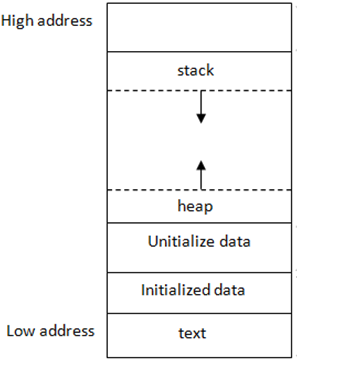
Pop the arguments from stack by incrementing esp register,
Push the arguments to stack by decrementing esp register.
user stack is single page sized, thus esp should point to stack + PGSIZE.
->because malloc()ed pointer points to lowest address of its allocated memory.
536 int
537 clone(void(*fcn)(void*, void*), void* arg1, void* arg2, void* stack)
538 {
539   int i, pid;
540   struct proc *np;
541   struct proc *curproc = myproc();
542
543   //share address space with parent process
544   np->pgdir = curproc->pgdir;
545
546   np->sz = curproc->sz;
547   np->parent = curproc;
548   *np->tf = *curproc->tf;
549
550   np->tf->eip = (uint)fcn; //instruction pointer, where the kernel should return after trap
551
552   char *sp; //stack pointer; char = 1 byte
553   sp = stack + PGSIZE;
554
555   sp -= 4;
556   *(uint*)sp = *(uint*)arg2; //unsigned int = 4 byte
557   sp -= 4;
558   *(uint*)sp = *(uint*)arg1;
559   np->tf->esp = (uint)sp;
sysproc.c
93 int
 94 sys_clone(void)
 95 {
 96   void *fcn, *arg1, *arg2, *stack;
 97   if(argptr(0, (char**)(&fcn), sizeof(void(*)(void*, void*))) < 0 ||
 98      argptr(1, (char**)(&arg1), sizeof(void*)) < 0 ||
 99      argptr(2, (char**)(&arg2), sizeof(void*)) < 0 ||
100     argptr(3, (char**)(&stack), sizeof(PGSIZE)) < 0) {
101     return -1;
102   }
103   return clone((void(*)(void*, void*))fcn, arg1, arg2, stack);
104 }
이부분 해결하기: uses a fake return PC (0xffffffff); a proper thread will simply call exit() when it is done (and not return)..? - 일단 보류
join() systemcall:
Track the wait() system call:
272 int
273 wait(void)
274 {
275   struct proc *p;
276   int havekids, pid;
277   struct proc *curproc = myproc();
278
279   acquire(&ptable.lock);
280   for(;;){
281     // Scan through table looking for exited children.
282     havekids = 0;
283     for(p = ptable.proc; p < &ptable.proc[NPROC]; p++){
284       if(p->parent != curproc)
285         continue;
286       havekids = 1;
287       if(p->state == ZOMBIE){
288         // Found one.
289         pid = p->pid;
290         kfree(p->kstack);
291         p->kstack = 0;
292         freevm(p->pgdir);
293         p->pid = 0;
294         p->parent = 0;
295         p->name[0] = 0;
296         p->killed = 0;
297         p->state = UNUSED;
298         release(&ptable.lock);
299         return pid;
300       }
301     }
302
303     // No point waiting if we don't have any children.
304     if(!havekids || curproc->killed){
305       release(&ptable.lock);
306       return -1;
307     }
308
309     // Wait for children to exit.  (See wakeup1 call in proc_exit.)
310     sleep(curproc, &ptable.lock);  //DOC: wait-sleep
311   }
312 }
ZOMBIE State = final state where it has exited but has not yet been cleaned up (in UNIX-based systems, this is called the zombie state)
by calling wait(), cleaning the zombie state.
287: if parent process find a ZOMBIE child process, it cleans up the child process and return.
310: but if not found, parent process goes to sleep and waiting for child process to wake parent up by exit()ing(exit() function calls wakeup1() func).
Actual implementation of join() system call:
588 int
589 join(void)
590 {
591   struct proc *p;
592   int havekids, pid;
593   struct proc *curproc = myproc();
594
595   acquire(&ptable.lock);
596   for(;;){
597     // Scan through table looking for exited children.
598     havekids = 0;
599     for(p = ptable.proc; p < &ptable.proc[NPROC]; p++){
600       if(p->parent != curproc)
601         continue;
602       havekids = 1;
603       if(p->state == ZOMBIE){
604         // Found one.
605         pid = p->pid;
606         kfree(p->kstack);
607         p->kstack = 0;
608         //freevm(p->pgdir); //it will free the parent pgdir as well.
609         p->pid = 0;
610         p->parent = 0;
611         p->name[0] = 0;
612         p->killed = 0;
613         p->state = UNUSED;
614         release(&ptable.lock);
615         return pid;
616       }
617     }
618
619     // No point waiting if we don't have any children.
620     if(!havekids || curproc->killed){
621       release(&ptable.lock);
622       return -1;
623     }
624
625     // Wait for children to exit.  (See wakeup1 call in proc_exit.)
626     sleep(curproc, &ptable.lock);  //DOC: wait-sleep
627   }
628 }
608: freeing vm of child zombie thread will leads to freeing vm of parent process.
syscall.c will be written after thread library code.
thread library:
thread_create():
ulib.c
109 int thread_create(void (*start_routine)(void*, void*), void *arg1, void *arg2) {
110   void *stack =  malloc(4096); //single PGSIZE stack
111   return clone(start_routine, arg1, arg2, stack);
112 }
thread_join():
It should free the user stack.
-> initial user stack pointer(malloc()ed pointer) should be known to free() the allocated user stack memory
proc.h
 38 struct proc {
 52   void *usp;                    //user stack pointer
 53 };
proc.c
536 int
537 clone(void(*fcn)(void*, void*), void* arg1, void* arg2, void* stack)
557   np->usp = stack;
now, we are able to know user stack pointer by looking a usp member.
589 int
590 join(void** stack)
591 {
604       if(p->state == ZOMBIE){
607         *stack = p->usp;;
615         p->usp = 0;
...
ulib.c
115 int thread_join(void) {
116   void *stack;
117   int r = join(&stack);
118   return r;
119 }
sysproc.c
106 int
107 sys_join(void)
108 {
109   void* stack;
110   if(argptr(0, (char**)(&stack), sizeof(void*) < 0)
111       return -1;
112   return join(&stack);
113 }
you have to link ulib.o and umalloc.o otherwise you cannnot use malloc & free function in ulib.c.
Makefile
153 _forktest: forktest.o $(ULIB)
154         # forktest has less library code linked in - needs to be small
155         # in order to be able to max out the proc table.
156         $(LD) $(LDFLAGS) -N -e main -Ttext 0x1000 -o _forktest forktest.o ulib.o usys.o u
    malloc.o
확인:
 1 #include "types.h"
  2 #include "user.h"
  3
  4
  5 void thread_func(void* arg1, void* arg2) {
  6
  7   int pid = getpid();
  8 printf(1,"child thread pid is %d\n", pid);
  9 printf(1,"arg1 = %d, arg2 = %d\n", (int*)arg1, (int*)arg2);
 10 exit();
 11 }
 12
 13 int main(void) {
 14   int arg1 = 11;
 15   int arg2 = 22;
 16   thread_create((void(*)(void*,void*))&thread_func, &arg1, &arg2);
 17   thread_join();
 18   int pid = getpid();
 19   printf(1,"parent pid is %d\n", pid);
 20 }