Context scheduling:
outline of the context scheduling
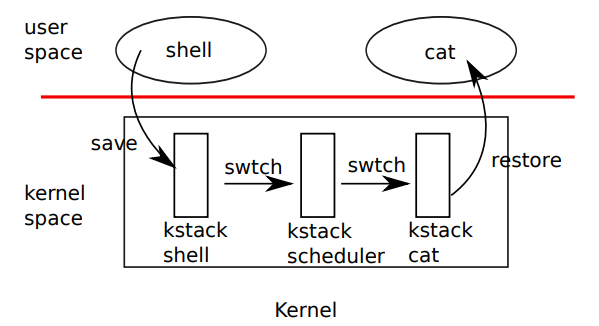
xv6 uses timer interrupt to implement time-sharing of the CPU.
timer interrupt handler calls yield() to yield the CPU to other process.
trap.c
105   if(myproc() && myproc()->state == RUNNING &&
106      tf->trapno == T_IRQ0+IRQ_TIMER)
107     yield();
yield() first acquires the ptable lock and calls sched().
385 void
386 yield(void)
387 {
388   acquire(&ptable.lock);  //DOC: yieldlock
389   myproc()->state = RUNNABLE;
390   sched();
391   release(&ptable.lock);
392 }
sched() double checks the lock and calls swtch() to store the context of the current process and switch to the scheduler context.
It returns not to sched but to scheduler, and its stack pointer points at the current CPU’s scheduler stack.
This is possible because that scheduler context had been saved by scheduler’s call to swtch and ret instruction in swtch.S assume that the topmost stack -which is saved as scheduler stack- %eip and continues.
proc.c
365 void
366 sched(void)
367 {
368   int intena;
369   struct proc *p = myproc();
370
371   if(!holding(&ptable.lock))
372     panic("sched ptable.lock");
373   if(mycpu()->ncli != 1)
374     panic("sched locks"); //double checks if it holds the ptable lock
375   if(p->state == RUNNING)
376     panic("sched running");
377   if(readeflags()&FL_IF)
378     panic("sched interruptible");
379   intena = mycpu()->intena;
380   swtch(&p->context, mycpu()->scheduler);
381   mycpu()->intena = intena;
382 }
swtch() starts by copying its arguments from the stack to caller-saved register %eax and %edx.
Then creating a context structure on the stack by pushing the current callee-saved register.
swtch.S
 9 .globl swtch
 10 swtch:
 11   movl 4(%esp), %eax
 12   movl 8(%esp), %edx
 13
 14   # Save old callee-saved registers
 15   pushl %ebp
 16   pushl %ebx
 17   pushl %esi
 18   pushl %edi
 19
 20   # Switch stacks
 21   movl %esp, (%eax)
 22   movl %edx, %esp
 23
 24   # Load new callee-saved registers
 25   popl %edi
 26   popl %esi
 27   popl %ebx
 28   popl %ebp
 29   ret #ret assume the top-most stack variable is %eip
after swtch() returns to scheduler(), scheduler() continutes to find a runnable process and cycle repeats.
322 void
323 scheduler(void)
324 {
325   struct proc *p;
326   struct cpu *c = mycpu();
327   c->proc = 0;
328
329   for(;;){
330     // Enable interrupts on this processor.
331     sti();
332
333     // Loop over process table looking for process to run.
334     acquire(&ptable.lock);
335     for(p = ptable.proc; p < &ptable.proc[NPROC]; p++){
336       if(p->state != RUNNABLE)
337         continue;
338
339       // Switch to chosen process.  It is the process's job
340       // to release ptable.lock and then reacquire it
341       // before jumping back to us.
342       c->proc = p;
343       switchuvm(p);
344       p->state = RUNNING;
345
346       swtch(&(c->scheduler), p->context);
347       switchkvm();
348
349       // Process is done running for now.
350       // It should have changed its p->state before coming back.
351       c->proc = 0;
352     }
353     release(&ptable.lock);
354
355   }
356 }
Sleep and Wakeup
In common Producer/Consumer case, sometimes, you don't need to waste your CPU busy waiting by polling repeatedly for rare produce event.
It may be much more efficient to yield the CPU while waiting.
The pair of calls, Sleep and Wakeup exist. These method is called "sequence coordination" or "conditional synchronization" method.
Correct version of sleep/wakeup method applied example code:
acquiring and releasing lock are needed to protect code from the "lost-wakeup" deadlock.
also, when sleeping the lock must be released, otherwise sender will block forever waiting for the lock.
400 struct q {
401 struct spinlock lock;
402 void *ptr;
403 };
404
405 void*
406 send(struct q *q, void *p)
407 {
408 acquire(&q->lock);
409 while(q->ptr != 0)
410 ;
411 q->ptr = p;
412 wakeup(q);
413 release(&q->lock);
414 }
415
416 void*
417 recv(struct q *q)
418 {
419 void *p;
420
421 acquire(&q->lock);
422 while((p = q->ptr) == 0)
423 sleep(q, &q->lock); //releasing spinlock
424 q->ptr = 0;
425 release(&q->lock);
426 return p;
427 }
In sleep, Sleep holds one of sleep’s lock or ptable.lock at all times, so a wakeup cannot run in between sleep.
Since it changes the process state, it needs ptable.lock.
Then switching to other process.
proc.c
417 void
418 sleep(void *chan, struct spinlock *lk)
419 {
420   struct proc *p = myproc();
421
422   if(p == 0)
423     panic("sleep");
424
425   if(lk == 0)
426     panic("sleep without lk");
427
428   // Must acquire ptable.lock in order to
429   // change p->state and then call sched.
430   // Once we hold ptable.lock, we can be
431   // guaranteed that we won't miss any wakeup
432   // (wakeup runs with ptable.lock locked),
433   // so it's okay to release lk.
434   if(lk != &ptable.lock){  //DOC: sleeplock0
435     acquire(&ptable.lock);  //DOC: sleeplock1
436     release(lk);
437   }
438   // Go to sleep.
439   p->chan = chan;
440   p->state = SLEEPING;
441
442   sched(); //goes to scheduler context: 347 line of scheduler().
443
444   // Tidy up.
445   p->chan = 0;
446
447   // Reacquire original lock.
448   if(lk != &ptable.lock){  //DOC: sleeplock2
449     release(&ptable.lock);
450     acquire(lk);
451   }
452 }
Wait/Exit
When a parent calls wait(), it scans through the table looking for exited childrent. If there is no exited children, parent goes to sleep which later causes context switching.
proc.c
272 int
273 wait(void)
274 {
275   struct proc *p;
276   int havekids, pid;
277   struct proc *curproc = myproc();
278
279   acquire(&ptable.lock); //since it will change the process state
280   for(;;){
281     // Scan through table looking for exited children.
282     havekids = 0;
283     for(p = ptable.proc; p < &ptable.proc[NPROC]; p++){
284       if(p->parent != curproc || p->pgdir == curproc->pgdir)
285         continue;
286       havekids = 1;
287       if(p->state == ZOMBIE){
288         // Found one.
			...clear child memory and state...
298         release(&ptable.lock);
299         return pid;
300       }
301     }
302
303     // No point waiting if we don't have any children.
...
309     // Wait for children to exit.  (See wakeup1 call in proc_exit.)
310     sleep(curproc, &ptable.lock);  //DOC: wait-sleep, still hold ptable.lock
311   }
312 }
sleep will start from here at scheduler() and scheduler will loop to find next RUNNABLE process.
proc.c
347       switchkvm(); //scheduler context starts from here
348
349       // Process is done running for now.
350       // It should have changed its p->state before coming back.
351       c->proc = 0;
352     }
353     release(&ptable.lock);
354
355   }
356 }
after switching to child process, when child process calls exit(), it will acquire ptable.lock and calls wakeup1 to wake up the sleeping parent process.
It is possible to acquire the lock because that there is release call after the call to sched in yield, sleep, and exit. Otherwise, in case of the newly created process, forkret release the ptable.lock.
-> The switched process will first release the ptable.lock as it is likely to have been yielded before.
proc.c
250   acquire(&ptable.lock);
251
252   // Parent might be sleeping in wait().
253   wakeup1(curproc->parent);