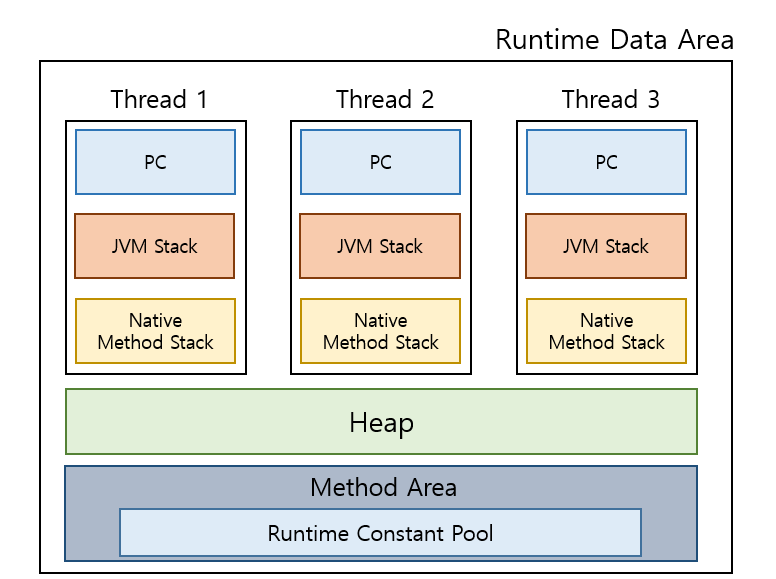
1편에서 JVM의 전체 동작 과정을 살펴봤다면, 이번 2편에서는 런타임 데이터 영역의 메모리 구조와 실전 성능 최적화 기법을 심도 있게 다뤄보겠습니다.
🧠 런타임 데이터 영역 (Runtime Data Area) 완전 분석
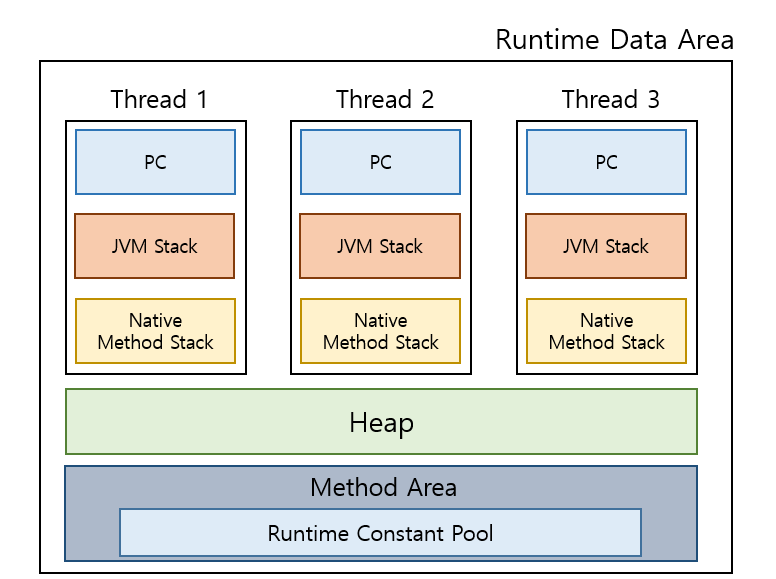
런타임 데이터 영역은 JVM이 프로그램을 실행하면서 사용하는 메모리 공간입니다. 각 영역의 특성과 역할을 정확히 이해하는 것이 성능 최적화의 핵심입니다.
메모리 영역 분류
📚 Method Area (메서드 영역)
메서드 영역은 클래스 레벨의 정보를 저장하는 공간으로, JVM 시작 시 생성되어 프로그램 종료까지 유지됩니다.
메서드 영역에 저장되는 정보
public class MethodAreaExample {
    // 1. 클래스 정보
    private static final String COMPANY_NAME = "TechCorp";  // static 변수
    private static int employeeCount = 0;                    // static 변수

    // 2. 메서드 정보 (바이트코드)
    public static void hireEmployee() {                     // static 메서드
        employeeCount++;
    }

    // 3. 상수 풀
    public String getWelcomeMessage() {
        return "안녕하세요, " + COMPANY_NAME + "입니다!";    // 문자열 리터럴
    }
}
메서드 영역의 구성 요소:
-
클래스 메타데이터
- 클래스명, 부모 클래스, 인터페이스 정보
- 접근 제어자, 클래스 타입 정보
-
런타임 상수 풀 (Runtime Constant Pool)
- 문자열 리터럴, 숫자 상수
- 클래스와 메서드 참조
-
메서드 바이트코드
- 메서드의 실행 가능한 코드
- 지역 변수 테이블, 피연산자 스택 정보
-
Static 변수
- 클래스 변수 저장 공간
Runtime Constant Pool 심화
public class ConstantPoolExample {
    public static void main(String[] args) {
        // 문자열 리터럴은 상수 풀에 저장됨
        String str1 = "Hello";
        String str2 = "Hello";
        String str3 = new String("Hello");

        System.out.println(str1 == str2);     // true (같은 상수 풀 참조)
        System.out.println(str1 == str3);     // false (str3는 힙에 새로 생성)
        System.out.println(str1.equals(str3)); // true (내용은 같음)

        // intern() 메서드로 상수 풀에 추가 가능
        String str4 = str3.intern();
        System.out.println(str1 == str4);     // true (상수 풀의 동일한 객체)
    }
}
🏠 Heap Area (힙 영역) 심화 분석
힙 영역은 객체 인스턴스와 배열이 저장되는 공간으로, 가비지 컬렉션의 주요 대상입니다.
힙 영역의 세대별 구조
Heap Memory
├─ Young Generation
│  ├─ Eden Space        (새로운 객체 생성)
│  ├─ Survivor 0 (S0)   (GC에서 살아남은 객체)
│  └─ Survivor 1 (S1)   (GC에서 살아남은 객체)
└─ Old Generation (Tenured)
   └─ Long-lived objects (오래 살아있는 객체)
객체 생성과 생명 주기
public class HeapLifecycleExample {
    public static void main(String[] args) {
        // 1. Eden 영역에 객체 생성
        List<String> shortLivedList = new ArrayList<>();
        shortLivedList.add("임시 데이터");
        // shortLivedList는 메서드 종료 시 참조 해제 → Young GC 대상

        // 2. 오래 살아있는 객체
        GlobalCache.getInstance().put("key", "오래 유지될 데이터");
        // 계속 참조되므로 Old Generation으로 이동
    }
}

class GlobalCache {
    private static GlobalCache instance = new GlobalCache();
    private Map<String, String> cache = new HashMap<>();

    public static GlobalCache getInstance() { return instance; }
    public void put(String key, String value) { cache.put(key, value); }
}
가비지 컬렉션 과정
Minor GC (Young Generation)
1. Eden 영역이 가득 참
2. 살아있는 객체를 Survivor 영역으로 이동
3. Eden 영역 정리
4. Survivor 영역 간 객체 이동 (age 증가)
5. age가 임계값에 도달하면 Old Generation으로 승격
Major GC (Old Generation)
1. Old Generation이 가득 참
2. 전체 힙에 대한 GC 수행
3. 더 오랜 시간 소요 (Stop-the-World)
public class GCExample {
private static List<byte[]> memoryConsumer = new ArrayList<>();
public static void main(String[] args) {
// Young Generation 압박 상황 시뮬레이션
for (int i = 0; i < 1000; i++) {
// 1MB 크기의 배열을 반복적으로 생성
byte[] data = new byte[1024 * 1024];
if (i % 10 == 0) {
// 10번에 한 번씩 장기 보관 (Old Generation으로 이동)
memoryConsumer.add(data);
}
// Minor GC가 발생하여 임시 객체들 정리
// -verbose:gc 옵션으로 GC 로그 확인 가능
}
}
}📚 Stack Area (스택 영역) 상세 분석
스택 영역은 메서드 호출과 지역 변수를 관리하는 스레드별 메모리 공간입니다.
스택 프레임 구조
public class StackFrameExample {
    public static void main(String[] args) {        // 메인 스택 프레임
        int mainVariable = 10;
        System.out.println("메인 메서드 시작");

        methodA(mainVariable);                       // methodA 스택 프레임 생성

        System.out.println("메인 메서드 종료");
    }                                               // 메인 스택 프레임 제거

    static void methodA(int param) {                // methodA 스택 프레임
        int localVar = param * 2;
        String message = "Method A";

        methodB(localVar);                          // methodB 스택 프레임 생성

        System.out.println(message);
    }                                               // methodA 스택 프레임 제거

    static void methodB(int value) {                // methodB 스택 프레임
        int result = value + 5;
        System.out.println("Result: " + result);
    }                                               // methodB 스택 프레임 제거
}
스택 프레임의 구성 요소
Stack Frame
├─ Local Variable Array    (지역 변수 저장)
├─ Operand Stack          (연산을 위한 스택)
├─ Frame Data             (메서드 정보)
│  ├─ Constant Pool Reference
│  ├─ Method Return Address
│  └─ Exception Table
기본 타입 vs 참조 타입의 저장 방식
public class MemoryStorageExample {
    public static void main(String[] args) {
        // 기본 타입: 스택에 실제 값 저장
        int number = 42;              // 스택: [42]
        double price = 19.99;         // 스택: [19.99]
        boolean flag = true;          // 스택: [true]

        // 참조 타입: 스택에 주소값, 힙에 실제 객체
        String name = "김개발자";      // 스택: [주소값] → 힙: ["김개발자"]
        List<String> skills = new ArrayList<>(); // 스택: [주소값] → 힙: [ArrayList 객체]

        // 메서드 매개변수 전달 방식
        modifyPrimitive(number);      // 값 복사 (Call by Value)
        modifyReference(skills);      // 주소값 복사 (Call by Reference)

        System.out.println(number);   // 42 (변경되지 않음)
        System.out.println(skills.size()); // 1 (변경됨)
    }

    static void modifyPrimitive(int value) {
        value = 100;  // 복사된 값만 변경
    }

    static void modifyReference(List<String> list) {
        list.add("Java");  // 힙의 실제 객체 변경
    }
}
🎯 PC Register와 Native Method Stack
PC Register (Program Counter Register)
- 현재 실행 중인 JVM 명령어의 주소를 저장
- 스레드별로 독립적으로 관리
public class PCRegisterExample {
    public static void main(String[] args) {
        int sum = 0;
        for (int i = 0; i < 5; i++) {    // PC Register가 루프의 현재 위치 추적
            sum += i;                     // 각 연산의 명령어 주소 저장
        }
        System.out.println(sum);         // PC Register가 다음 실행할 명령어 가리킴
    }
}
Native Method Stack
- JNI(Java Native Interface)를 통해 호출되는 C/C++ 코드를 위한 스택
- Java 외부 라이브러리 호출 시 사용
public class NativeMethodExample {
    // native 키워드로 선언된 메서드
    public native void nativeMethod();

    static {
        // 네이티브 라이브러리 로드
        System.loadLibrary("nativeLib");
    }

    public static void main(String[] args) {
        NativeMethodExample example = new NativeMethodExample();
        example.nativeMethod();  // Native Method Stack 사용
    }
}
🔧 실전 JVM 성능 최적화
1. 힙 메모리 튜닝
적절한 힙 크기 설정
# 기본 힙 설정
java -Xms2g -Xmx4g MyApplication

# Young Generation 크기 조정
java -Xms2g -Xmx4g -Xmn800m MyApplication

# New Ratio 설정 (Old:Young = 3:1)
java -Xms2g -Xmx4g -XX:NewRatio=3 MyApplication
힙 크기 결정 가이드라인
public class HeapSizingExample {
    public static void main(String[] args) {
        // 메모리 사용량 모니터링
        MemoryMXBean memoryBean = ManagementFactory.getMemoryMXBean();

        Runtime runtime = Runtime.getRuntime();
        long maxMemory = runtime.maxMemory();     // -Xmx 설정값
        long totalMemory = runtime.totalMemory(); // 현재 할당된 메모리
        long freeMemory = runtime.freeMemory();   // 사용 가능한 메모리

        System.out.println("최대 메모리: " + (maxMemory / 1024 / 1024) + "MB");
        System.out.println("할당된 메모리: " + (totalMemory / 1024 / 1024) + "MB");
        System.out.println("사용 가능 메모리: " + (freeMemory / 1024 / 1024) + "MB");

        // 힙 사용량 정보
        MemoryUsage heapUsage = memoryBean.getHeapMemoryUsage();
        System.out.println("힙 사용량: " + (heapUsage.getUsed() / 1024 / 1024) + "MB");
    }
}
2. 가비지 컬렉터 선택과 튜닝
다양한 GC 알고리즘
# Serial GC (단일 스레드, 소규모 애플리케이션)
java -XX:+UseSerialGC MyApp

# Parallel GC (멀티스레드, 처리량 중심)
java -XX:+UseParallelGC MyApp

# G1 GC (낮은 지연시간, 대용량 힙)
java -XX:+UseG1GC -XX:MaxGCPauseMillis=100 MyApp

# ZGC (매우 낮은 지연시간, Java 11+)
java -XX:+UseZGC MyApp

# Shenandoah GC (낮은 지연시간)
java -XX:+UseShenandoahGC MyApp
GC 모니터링과 분석
public class GCMonitoringExample {
    public static void main(String[] args) {
        // GC 정보 수집
        List<GarbageCollectorMXBean> gcBeans = ManagementFactory.getGarbageCollectorMXBeans();

        for (GarbageCollectorMXBean gcBean : gcBeans) {
            System.out.println("GC 이름: " + gcBean.getName());
            System.out.println("GC 횟수: " + gcBean.getCollectionCount());
            System.out.println("GC 소요 시간: " + gcBean.getCollectionTime() + "ms");
        }

        // 메모리 풀 정보
        List<MemoryPoolMXBean> poolBeans = ManagementFactory.getMemoryPoolMXBeans();
        for (MemoryPoolMXBean poolBean : poolBeans) {
            MemoryUsage usage = poolBean.getUsage();
            System.out.println("풀 이름: " + poolBean.getName());
            System.out.println("사용률: " + (usage.getUsed() * 100.0 / usage.getMax()) + "%");
        }
    }
}
3. 메모리 누수 방지
일반적인 메모리 누수 패턴과 해결책
public class MemoryLeakExamples {

    // ❌ 나쁜 예: Static 컬렉션에 계속 추가
    private static List<String> staticList = new ArrayList<>();

    public void badExample1() {
        staticList.add("계속 추가되는 데이터"); // 메모리 누수!
    }

    // ✅ 좋은 예: 적절한 크기 제한
    private static final int MAX_SIZE = 1000;
    private static List<String> limitedList = new ArrayList<>();

    public void goodExample1(String data) {
        if (limitedList.size() >= MAX_SIZE) {
            limitedList.remove(0); // 오래된 데이터 제거
        }
        limitedList.add(data);
    }

    // ❌ 나쁜 예: 리스너 등록 후 해제하지 않음
    public class BadListener {
        private SomeComponent component;

        public BadListener(SomeComponent component) {
            this.component = component;
            component.addListener(this::onEvent); // 등록 후 해제하지 않음
        }

        private void onEvent(Event event) {
            // 이벤트 처리
        }
    }

    // ✅ 좋은 예: 적절한 리스너 해제
    public class GoodListener implements AutoCloseable {
        private SomeComponent component;
        private EventListener listener;

        public GoodListener(SomeComponent component) {
            this.component = component;
            this.listener = this::onEvent;
            component.addListener(listener);
        }

        @Override
        public void close() {
            if (component != null && listener != null) {
                component.removeListener(listener); // 명시적 해제
            }
        }

        private void onEvent(Event event) {
            // 이벤트 처리
        }
    }

    // ❌ 나쁜 예: ThreadLocal 정리하지 않음
    private static ThreadLocal<ExpensiveObject> threadLocal = new ThreadLocal<>();

    public void badThreadLocalUsage() {
        threadLocal.set(new ExpensiveObject());
        // 정리하지 않으면 메모리 누수 발생
    }

    // ✅ 좋은 예: ThreadLocal 적절히 정리
    public void goodThreadLocalUsage() {
        try {
            threadLocal.set(new ExpensiveObject());
            // 작업 수행
        } finally {
            threadLocal.remove(); // 명시적 정리
        }
    }
}

class SomeComponent {
    private List<EventListener> listeners = new ArrayList<>();

    public void addListener(EventListener listener) {
        listeners.add(listener);
    }

    public void removeListener(EventListener listener) {
        listeners.remove(listener);
    }
}

interface EventListener {
    void onEvent(Event event);
}

class Event {}
class ExpensiveObject {}
4. JIT 컴파일러 최적화
메서드 인라이닝 최적화
public class JITOptimizationExample {

    // ✅ 인라이닝에 적합한 메서드
    private static final int THRESHOLD = 100;

    public final int simpleCalculation(int x) {  // final 키워드로 인라이닝 촉진
        return x * 2 + 1;
    }

    public int optimizableLoop(int[] array) {
        int sum = 0;
        for (int value : array) {
            sum += simpleCalculation(value);     // 인라이닝 대상
        }
        return sum;
    }

    // ❌ 인라이닝에 부적합한 메서드
    public int complexMethod(int x) {
        // 너무 복잡한 로직 (35바이트 이상)
        if (x > THRESHOLD) {
            return expensiveCalculation(x);
        } else {
            return anotherExpensiveCalculation(x);
        }
    }

    // JIT 컴파일러 정보 확인을 위한 플래그
    // -XX:+PrintCompilation -XX:+UnlockDiagnosticVMOptions -XX:+PrintInlining
}
컴파일 임계값 조정
# 컴파일 임계값 설정
java -XX:CompileThreshold=1000 MyApp      # 기본값: 10000 (Server VM)

# Tiered Compilation 설정
java -XX:+TieredCompilation \
     -XX:Tier3CompileThreshold=2000 \
     -XX:Tier4CompileThreshold=15000 MyApp
5. 스택 최적화
스택 오버플로우 방지
public class StackOptimizationExample {

    // ❌ 나쁜 예: 깊은 재귀 호출
    public int factorialRecursive(int n) {
        if (n <= 1) return 1;
        return n * factorialRecursive(n - 1);  // 스택 오버플로우 위험
    }

    // ✅ 좋은 예: 반복문으로 변환
    public int factorialIterative(int n) {
        int result = 1;
        for (int i = 2; i <= n; i++) {
            result *= i;
        }
        return result;
    }

    // ✅ 좋은 예: 꼬리 재귀 최적화 스타일
    public long factorialTailRecursive(int n) {
        return factorialHelper(n, 1);
    }

    private long factorialHelper(int n, long accumulator) {
        if (n <= 1) return accumulator;
        return factorialHelper(n - 1, n * accumulator);
    }
}
스택 크기 조정
# 스택 크기 설정
java -Xss512k MyApp    # 기본값: 1MB (64-bit), 512KB (32-bit)

# 큰 스택이 필요한 경우
java -Xss2m MyApp
📊 JVM 모니터링 도구와 실전 활용
1. 내장 모니터링 도구
jstat - GC 통계 정보
# GC 통계 5초마다 출력
jstat -gc <pid> 5s

# 힙 영역별 용량 정보
jstat -gccapacity <pid>

# 컴파일 통계
jstat -compiler <pid>
jmap - 힙 덤프 분석
# 힙 덤프 생성
jmap -dump:format=b,file=heap.hprof <pid>

# 힙 히스토그램 출력
jmap -histo <pid>

# 클래스별 인스턴스 수 확인
jmap -histo <pid> | head -20
jstack - 스레드 덤프 분석
# 스레드 덤프 생성
jstack <pid> > thread_dump.txt

# 데드락 감지
jstack -l <pid>
2. 애플리케이션 내 모니터링
@Component
@Slf4j
public class JVMMonitor {

    private final MemoryMXBean memoryMXBean;
    private final List<GarbageCollectorMXBean> gcMXBeans;
    private final ThreadMXBean threadMXBean;

    public JVMMonitor() {
        this.memoryMXBean = ManagementFactory.getMemoryMXBean();
        this.gcMXBeans = ManagementFactory.getGarbageCollectorMXBeans();
        this.threadMXBean = ManagementFactory.getThreadMXBean();
    }

    @Scheduled(fixedRate = 60000) // 1분마다 실행
    public void monitorJVM() {
        logMemoryUsage();
        logGCStatistics();
        logThreadInformation();
    }

    private void logMemoryUsage() {
        MemoryUsage heapUsage = memoryMXBean.getHeapMemoryUsage();
        MemoryUsage nonHeapUsage = memoryMXBean.getNonHeapMemoryUsage();

        double heapUsedPercentage = (double) heapUsage.getUsed() / heapUsage.getMax() * 100;

        log.info("힙 메모리 사용률: {:.2f}% ({}/{})",
            heapUsedPercentage,
            formatBytes(heapUsage.getUsed()),
            formatBytes(heapUsage.getMax()));

        log.info("Non-힙 메모리 사용량: {}", formatBytes(nonHeapUsage.getUsed()));

        // 메모리 사용률이 80% 이상이면 경고
        if (heapUsedPercentage > 80) {
            log.warn("⚠️ 힙 메모리 사용률이 높습니다: {:.2f}%", heapUsedPercentage);
        }
    }

    private void logGCStatistics() {
        for (GarbageCollectorMXBean gcBean : gcMXBeans) {
            long collections = gcBean.getCollectionCount();
            long time = gcBean.getCollectionTime();

            if (collections > 0) {
                log.info("GC [{}]: 횟수={}, 총 시간={}ms, 평균={}ms",
                    gcBean.getName(), collections, time, time / collections);
            }
        }
    }

    private void logThreadInformation() {
        int threadCount = threadMXBean.getThreadCount();
        int peakThreadCount = threadMXBean.getPeakThreadCount();

        log.info("스레드 정보: 현재={}, 최대={}", threadCount, peakThreadCount);

        // 데드락 감지
        long[] deadlockedThreads = threadMXBean.findDeadlockedThreads();
        if (deadlockedThreads != null) {
            log.error("🚨 데드락 감지됨! 스레드 수: {}", deadlockedThreads.length);
        }
    }

    private String formatBytes(long bytes) {
        String[] units = {"B", "KB", "MB", "GB"};
        int unitIndex = 0;
        double size = bytes;

        while (size >= 1024 && unitIndex < units.length - 1) {
            size /= 1024;
            unitIndex++;
        }

        return String.format("%.2f %s", size, units[unitIndex]);
    }
}
3. 성능 튜닝 체크리스트
메모리 최적화 체크리스트
public class PerformanceTuningChecklist {

    // ✅ 1. 적절한 컬렉션 선택
    private List<String> frequentRead = new ArrayList<>();        // 빈번한 읽기
    private Set<String> uniqueItems = new HashSet<>();           // 중복 제거
    private Map<String, String> fastLookup = new HashMap<>();    // 빠른 조회

    // ✅ 2. 초기 용량 설정
    private List<String> knownSizeList = new ArrayList<>(1000);
    private Map<String, String> knownSizeMap = new HashMap<>(256);

    // ✅ 3. StringBuilder 사용
    public String buildString(List<String> items) {
        StringBuilder sb = new StringBuilder(items.size() * 20); // 예상 크기 설정
        for (String item : items) {
            sb.append(item).append(", ");
        }
        return sb.toString();
    }

    // ✅ 4. 객체 풀 패턴 (필요한 경우)
    private final Queue<ExpensiveObject> objectPool = new ConcurrentLinkedQueue<>();

    public ExpensiveObject borrowObject() {
        ExpensiveObject obj = objectPool.poll();
        return obj != null ? obj : new ExpensiveObject();
    }

    public void returnObject(ExpensiveObject obj) {
        obj.reset(); // 상태 초기화
        objectPool.offer(obj);
    }

    // ✅ 5. 캐시 활용
    @Cacheable("expensiveOperations")
    public String expensiveOperation(String input) {
        // 비용이 많이 드는 연산
        return processHeavyCalculation(input);
    }

    private String processHeavyCalculation(String input) {
        // 실제 계산 로직
        return "result";
    }
}
🎯 실전 트러블슈팅 가이드
OutOfMemoryError 해결
// 1. 힙 공간 부족 (java.lang.OutOfMemoryError: Java heap space)
// 해결책: 힙 크기 증가, 메모리 누수 제거
java -Xmx4g -XX:+HeapDumpOnOutOfMemoryError MyApp

// 2. 메타스페이스 부족 (java.lang.OutOfMemoryError: Metaspace)
// 해결책: 메타스페이스 크기 증가
java -XX:MetaspaceSize=256m -XX:MaxMetaspaceSize=512m MyApp

// 3. 스택 오버플로우 (java.lang.StackOverflowError)
// 해결책: 스택 크기 증가, 재귀 로직 개선
java -Xss2m MyApp
GC 튜닝 실전 예제
# 처리량 중심 애플리케이션
java -XX:+UseParallelGC \
     -XX:ParallelGCThreads=8 \
     -XX:+UseParallelOldGC \
     -Xms4g -Xmx4g MyApp

# 응답 시간 중심 애플리케이션
java -XX:+UseG1GC \
     -XX:MaxGCPauseMillis=100 \
     -XX:G1HeapRegionSize=16m \
     -Xms4g -Xmx4g MyApp

# 매우 큰 힙 (32GB+)
java -XX:+UseZGC \
     -Xmx32g MyApp
💡 마무리
JVM의 메모리 구조를 이해하고 적절한 튜닝을 수행하면 애플리케이션의 성능을 크게 향상시킬 수 있습니다.
핵심 포인트 요약
- 메모리 영역별 특성 이해: Method Area, Heap, Stack 각각의 역할과 최적화 포인트
- GC 알고리즘 선택: 애플리케이션 특성에 맞는 가비지 컬렉터 선택
- 지속적인 모니터링: JVM 메트릭을 통한 성능 추이 관찰
- 메모리 누수 방지: 일반적인 메모리 누수 패턴 인지와 예방
- 실전 튜닝: 운영 환경에서의 체계적인 성능 튜닝 접근법
Java 개발자로서 JVM에 대한 깊은 이해는 단순히 이론적 지식이 아닌, 실제 문제 해결 능력을 크게 향상시키는 실용적인 기술입니다. 지속적인 모니터링과 개선을 통해 더 나은 애플리케이션을 만들어 나가시길 바랍니다!