
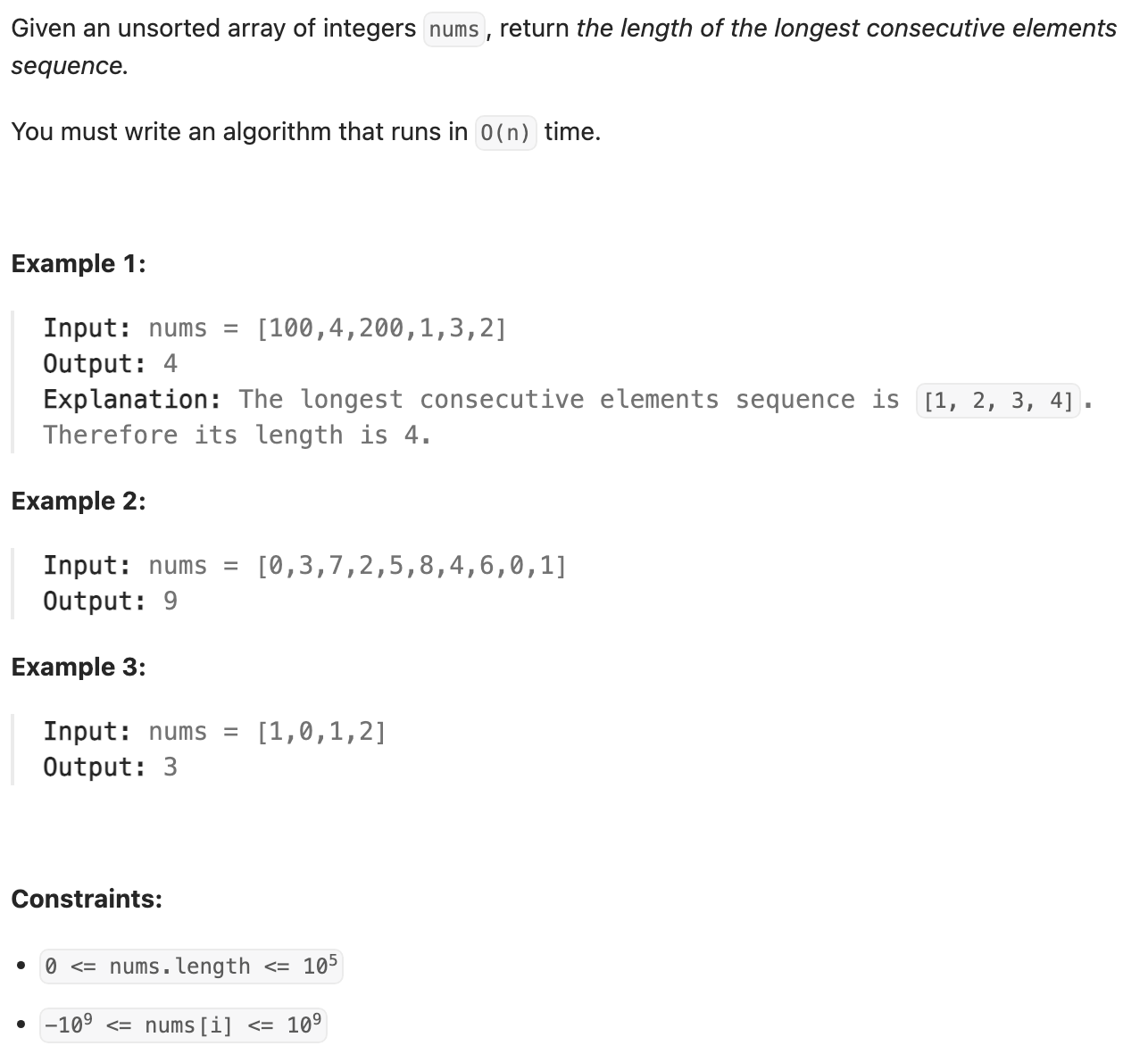
📌 Problem
[LeetCode] 128. Longest Consecutive Sequence
📌 Solution
Solution 1: Original Idea (Sort + Scan)
Idea
- Remove duplicates and sort the array.
- Traverse numbers from left to right.
- Keep a
start_idxthat marks the beginning of the current consecutive sequence. - While iterating:
- If the next number is not equal to current + 1, the sequence breaks.
- Compute the sequence length using the distance from
start_idxto the current index. - Update the local maximum
length. - Reset
start_idxto the next index.
- Handle the last element separately since it has no next index.
Code
class Solution:
    def longestConsecutive(self, nums: List[int]) -> int:
        num_set = sorted(set(nums))
        longest = 0
        length = 0
        start_idx = 0

        for i, curr in enumerate(num_set):
            if i >= len(num_set) - 1:
                length = i - start_idx + 1
            elif curr + 1 != num_set[i+1]:
                length = i - start_idx + 1
                start_idx = i+1
            longest = max(longest, length)

        return longest
Complexity
- Time Complexity:
- Space Complexity:
Solution 2: Upgraded Version (Still Sort + Scan)
Idea
- Keep the same sort + scan strategy.
- Instead of tracking indices (
start_idx), directly track the current sequence length. - While iterating:
- If the current number is consecutive (
prev + 1), incrementlength. - Otherwise, update
longestand resetlengthto 1.
- If the current number is consecutive (
- This simplifies logic and avoids index-based calculations.
Code
class Solution:
    def longestConsecutive(self, nums: List[int]) -> int:
        if not nums:
            return 0

        num_set = sorted(set(nums))  # unique + sort
        longest = 1
        length = 1

        for i in range(1, len(num_set)):
            if num_set[i] == num_set[i - 1] + 1:
                length += 1
            else:
                longest = max(longest, length)
                length = 1

        return max(longest, length)
Complexity
- Time Complexity:
- Space Complexity:
⭐️ Solution 3: Optimal Solution (HashSet, O(n))
Idea
- Insert all numbers into a hash set for lookup.
- Only start counting when the current number is the start of a sequence
(i.e.,num - 1does not exist in the set). - From the start, expand forward (
num + 1,num + 2, ...) to count the sequence length. - Each number is visited at most once during expansion.
Code
class Solution:
    def longestConsecutive(self, nums: List[int]) -> int:
        num_set = set(nums)
        longest = 0

        for num in num_set:
            # start of sequence
            if num - 1 not in num_set:
                length = 1
                curr = num

                while curr + 1 in num_set:
                    curr += 1
                    length += 1

                longest = max(longest, length)

        return longest
Complexity
- Time Complexity:
- Space Complexity:

Where there's a will, there's a way