
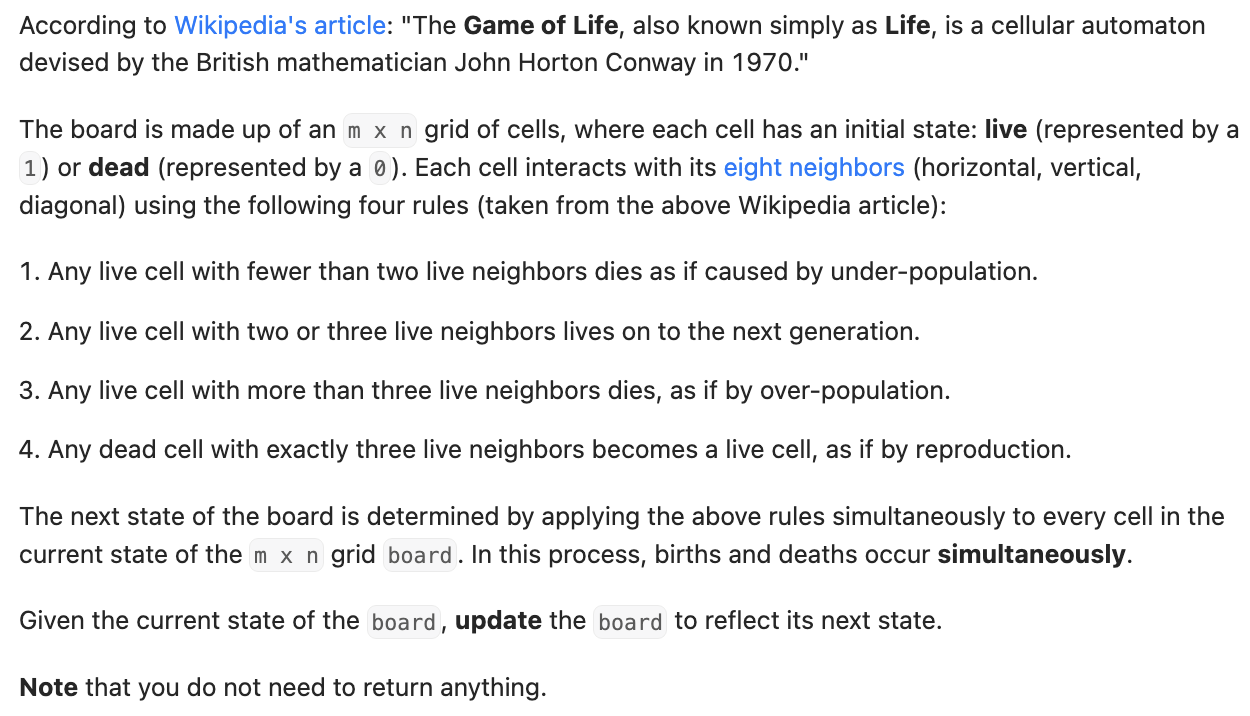
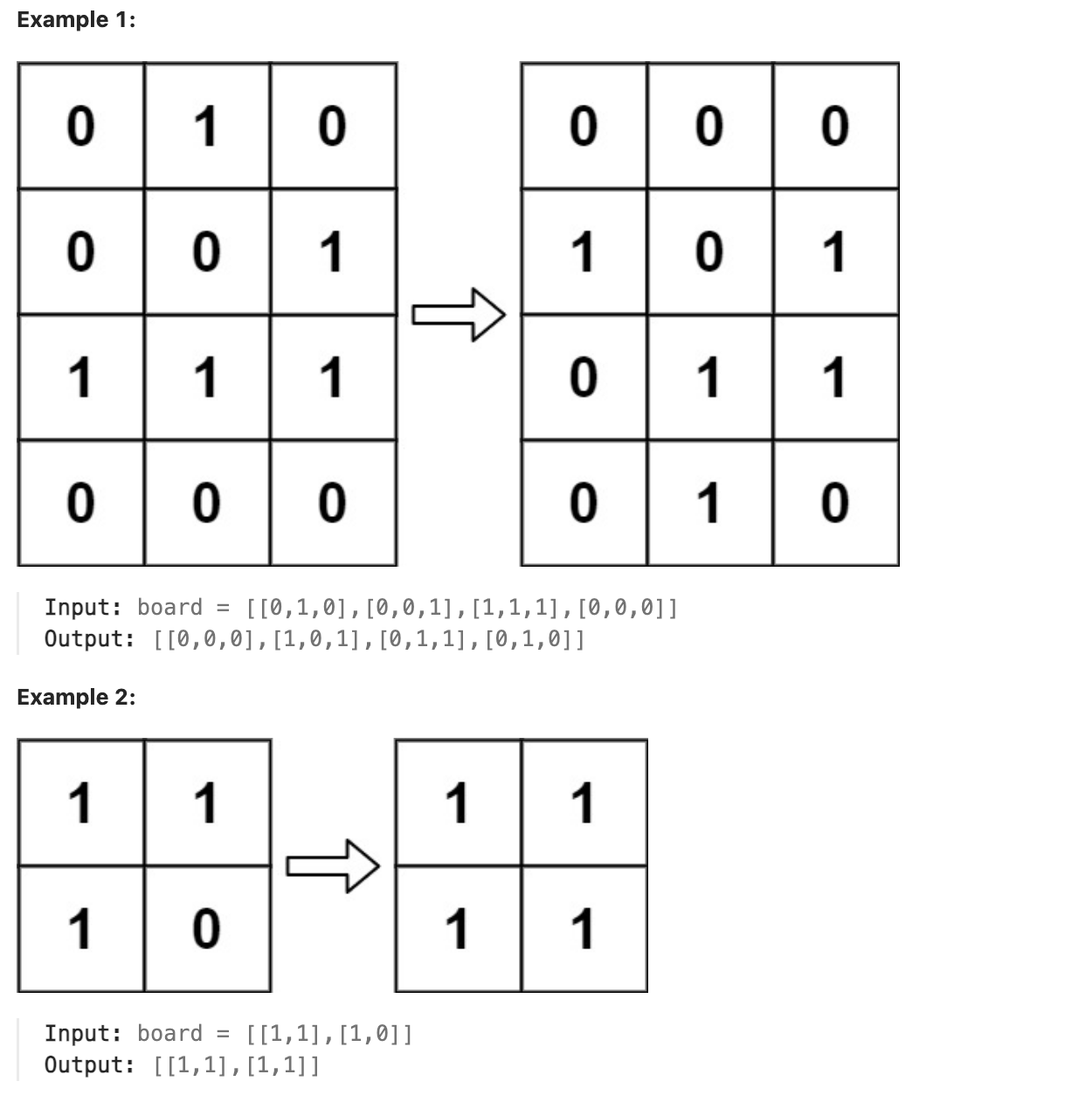
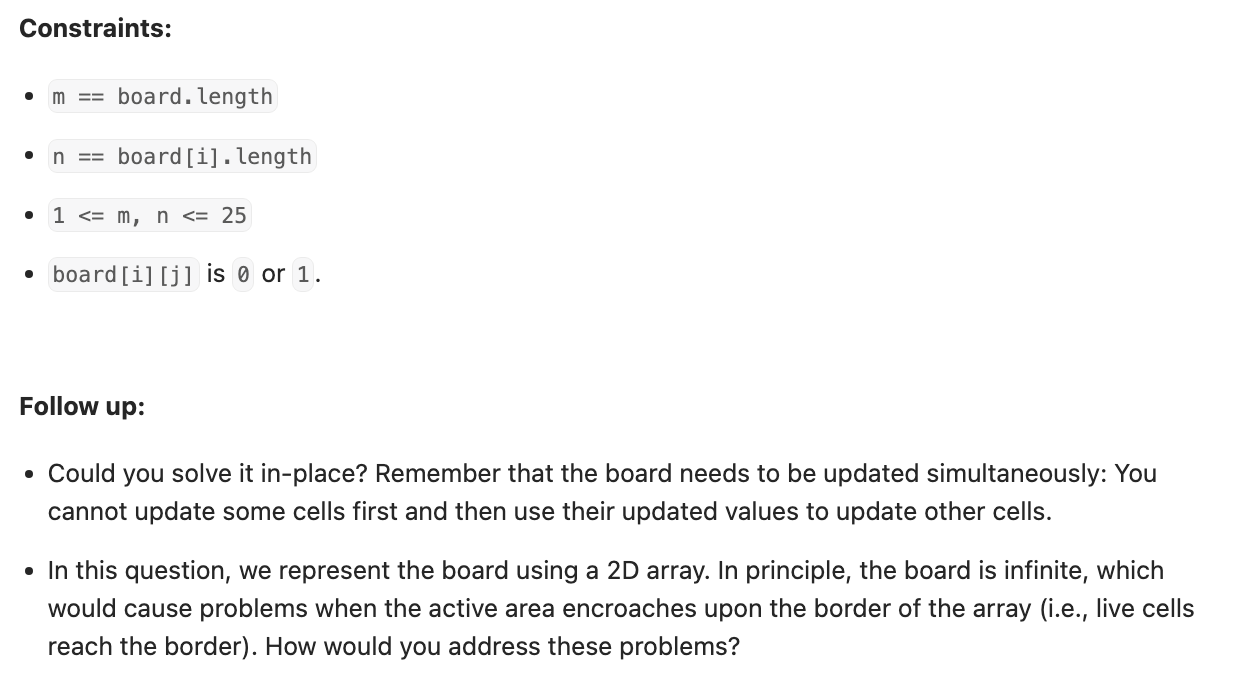
📌 Problem
📌 Solution
Idea
The main difficulty is that all cells must be updated simultaneously, while we are required to modify the board in-place.
To solve this, we encode both the original state and the next state in a single cell using temporary values.
State Encoding
| Value | Meaning |
|---|---|
0 | dead → dead |
1 | live → live |
2 | dead → live (birth) |
3 | live → dead (death) |
Key observation:
- When counting neighbors, we must check whether a cell was originally live
- Cells with value 1 or 3 were originally live
Steps
- Direction Vector
Use a fixed list of 8 directions to visit all neighbors.dirs = [(-1,-1), (-1,0), (-1,1), ( 0,-1), ( 0,1), ( 1,-1), ( 1,0), ( 1,1)] - First Pass — Count Neighbors & Encode State
For each cell(i, j):- Count the number of originally live neighbors
- Apply the Game of Life rules
- Encode the transition using values 0, 1, 2, 3
- Second Pass — Finalize Board
After the first pass, convert encoded values to final states:- 1, 2 → 1 (live)
- 0, 3 → 0 (dead)
Code
class Solution:
    def gameOfLife(self, board: List[List[int]]) -> None:
        """
        Do not return anything, modify board in-place instead.
        """
        if not board or not board[0]:
            return

        m, n = len(board), len(board[0])

        # 8 directions
        dirs = [(-1, -1), (-1, 0), (-1, 1),
                ( 0, -1),          ( 0, 1),
                ( 1, -1), ( 1, 0), ( 1, 1)]

        def was_live(x: int) -> bool:
            # originally live cells are 1 (live->live) or 3 (live->dead)
            return x == 1 or x == 3

        # 1) State encoding
        #    (0: 0->0, 1: 1->1, 2: 0->1, 3: 1->0)
        for i in range(m):
            for j in range(n):
                live_neighbors = 0
                for di, dj in dirs:
                    ni, nj = i + di, j + dj
                    if 0 <= ni < m and 0 <= nj < n and was_live(board[ni][nj]):
                        live_neighbors += 1

                if was_live(board[i][j]):  # originally live
                    if live_neighbors < 2 or live_neighbors > 3:
                        board[i][j] = 3  # live -> dead
                    else:
                        board[i][j] = 1  # live -> live
                else:  # originally dead
                    if live_neighbors == 3:
                        board[i][j] = 2  # dead -> live
                    else:
                        board[i][j] = 0  # dead -> dead

        # 2) State encoding -> Finalize to 0/1
        for i in range(m):
            for j in range(n):
                board[i][j] = 1 if board[i][j] in (1, 2) else 0
Complexity
- Time Complexity:
- Space Complexity: (in-place, constant extra space)
🚀 Key Takeaways
- In-place problems often require state encoding
- Always distinguish original state vs next state
- Two-pass strategy is common for simultaneous updates
- Similar pattern appears in:
- Game of Life
- Set Matrix Zeroes
- Board / grid simulation problems

Where there's a will, there's a way