해당 문제는 3 종류의 파이프를 나누어서 처리하는 문제이다.
- 문제 핵심
-
첫 파이프는 가로이며 0,0 과 0,1에 있다. 즉, 0,1 지점에서 시작된다.
-
파이프의 움직이는 방향은 가로, 세로, 대각선이므로 위로는 올라갈 수 없다. 즉, visit 배열을 쓰지 않아도 n-1, n-1 지점에 도달 할 수 있다.
(아래의 그림을 통해 이해할 수 있다.)
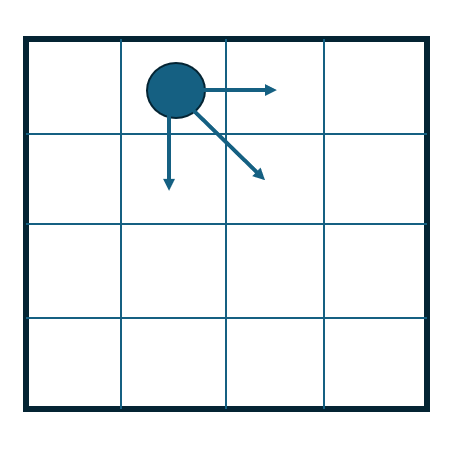
즉, 모든 경로를 탐색하는 bfs dfs를 선택할 수 있다. 또한, 해당 좌표에서의 모든 경우의 수를 더하는 dp도 선택 가능하다.
- bfs (시간초과)
bfs의 경우 que로 부터 인접 좌표를 먼저 탐색하므로 특정 좌표에 도달하는 문제에는 성능이 떨어진다.
from collections import deque
import sys

def cross_check(y, x):
    if lis[y+1][x] == 0 and lis[y][x+1] == 0 and lis[y+1][x+1] == 0:
        return True

    return False

def bfs(y,x,pipe):      # pipe = 0,1,2 -> 가로,세로,대각선
    global cnt
    que = deque()

    que.append((y,x,pipe))

    while que:
        ty, tx, tpipe = que.popleft()

        if ty == n-1 and tx == n-1:
            cnt += 1
            continue        # 모든 경우의 수를 찾아야하므로

        if tpipe == 0:
            if 0 <= tx+1 <= n-1 and lis[ty][tx+1] == 0:
                que.append((ty,tx+1,0))
            if 0 <= ty+1 <= n-1 and 0 <= tx+1 <= n-1:
                if cross_check(ty, tx):
                    que.append((ty+1,tx+1,2))

        elif tpipe == 1:
            if 0 <= ty+1 <= n-1 and lis[ty+1][tx] == 0:
                que.append((ty+1,tx,1))
            if 0 <= ty+1 <= n-1 and 0 <= tx+1 <= n-1:
                if cross_check(ty, tx):
                    que.append((ty+1,tx+1,2))

        elif tpipe == 2:
            if 0 <= tx+1 <= n-1 and lis[ty][tx+1] == 0:
                que.append((ty,tx+1,0))
            if 0 <= ty+1 <= n-1 and lis[ty+1][tx] == 0:
                que.append((ty+1,tx,1))
            if 0 <= ty+1 <= n-1 and 0 <= tx+1 <= n-1:
                if cross_check(ty, tx):
                    que.append((ty+1,tx+1,2))


input = sys.stdin.readline

n = int(input())
lis = []
cnt = 0

for _ in range(n):
    lis.append(list(map(int, input().split(" "))))

bfs(0,1,0)
print(cnt)
- dfs
dfs의 경우 특정 좌표에 도달할 때 까지 탐색하므로 이 문제에서는 bfs 보다 조금 더 적합하다. (문제에서의 시간제한이 빡빡하기 때문에)
# dfs
# 가로 = 가로, 대각선
# 세로 = 세로, 대각선
# 대각선 = 가, 세, 대각선

# visit는 필요 없음 -> n, n으로 가는 방법밖에 없기 때문

def dfs(y, x, pipe):        # pipe = 0,1,2 -> 가로, 세로, 대각선
    global cnt

    if y == n-1 and x == n-1:
        cnt += 1
        return

    if pipe == 0:
        if x+1 < n and lis[y][x+1] == 0:
            dfs(y, x+1, 0)
        if x+1 < n and y+1 < n and lis[y+1][x] == 0 and lis[y+1][x+1] == 0 and lis[y][x+1] == 0:
            dfs(y+1, x+1, 2)
    if pipe == 1:
        if y+1 < n and lis[y+1][x] == 0:
            dfs(y+1, x, 1)
        if x+1 < n and y+1 < n and lis[y+1][x] == 0 and lis[y+1][x+1] == 0 and lis[y][x+1] == 0:
            dfs(y+1, x+1, 2)
    if pipe == 2:
        if x+1 < n and lis[y][x+1] == 0:
            dfs(y, x+1, 0)
        if y+1 < n and lis[y+1][x] == 0:
            dfs(y+1, x, 1)
        if x+1 < n and y+1 < n and lis[y+1][x] == 0 and lis[y+1][x+1] == 0 and lis[y][x+1] == 0:
            dfs(y+1, x+1, 2)


import sys

input = sys.stdin.readline
n = int(input())
lis = []
cnt = 0

for _ in range(n):
    lis.append(list(map(int, input().split(" "))))

dfs(0,1,0)

print(cnt)
- dp
dp의 메모이제이션으로 인해 시간, 메모리 부분에서 가장 적합했다.
dp[y][x][pipe] 가 있다면, y,x 좌표에서의 특정 파이프에 대한 경우의 수이다. (pipe = 0,1,2를 가로,세로,대각선으로 가정했다.)
예를 들어, pipe = 0 = 가로라면 이전 좌표에서도 가로 or 대각선이었기에, dp[y][x][0] = dp[y][x-1][0] + dp[y][x-1][2] 가 된다.
# dp
# d[y][x][pipe] = y,x에서의 pipe일 때 경우의 수

n = int(input())
lis = []
dp = [[[0] * 3 for _ in range(n)] for _ in range(n)]

for _ in range(n):
    lis.append(list(map(int, input().split(" "))))

dp[0][1][0] = 1     # 초기 가로 파이프

for r in range(n):
    for c in range(2, n):
        if lis[r][c] == 1:
            continue

        if c-1 >= 0 and lis[r][c-1] == 0:
            dp[r][c][0] = dp[r][c-1][0] + dp[r][c-1][2]

        if r-1 >= 0 and lis[r-1][c] == 0:
            dp[r][c][1] = dp[r-1][c][1] + dp[r-1][c][2]

        if r-1 >= 0 and c-1 >= 0 and lis[r-1][c-1] == 0 and lis[r-1][c] == 0 and lis[r][c-1] == 0:
            dp[r][c][2] = dp[r-1][c-1][1] + dp[r-1][c-1][0] + dp[r-1][c-1][2]

print(dp[n-1][n-1][2] + dp[n-1][n-1][1] + dp[n-1][n-1][0])
아래는 시간, 메모리 제한 결과이다. (위부터 dp, dfs, bfs..)


주니어 백엔드 개발자