23.08.06 최초 작성
23.11.15 POSIX Message Queue, Semaphore 추가
- Inter Process Communication (IPC) : 프로세스 사이의 통신
주요 IPC 방법
- Message Queue
- Shared Memory
- Semaphore
1. IPC를 위한 절차
- IPC를 위한 Key 생성
- Identifier를 이용해 IPC 객체 생성
- 생성된 IPC 객체를 이용해 통신
- IPC 객체 삭제 후 종료
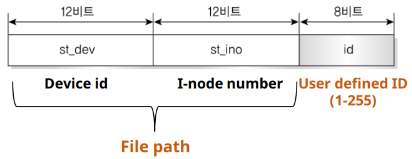
key : key_t형으로 32비트 정수형이다. 새로운 IPC 객체를 생성할 때 키를 지정하며 키가 다르면 다른 객체가 생성된다.
- 키의 구조
#include <sys/ipc.h>

key_t ftok(const char *path, int id);

///
path : 파일시스템에 존재하는 임의의 파일 경로
id : 키 값을 생성할 때 지정하는 임의의 번호

Return : key- IPC 구조체
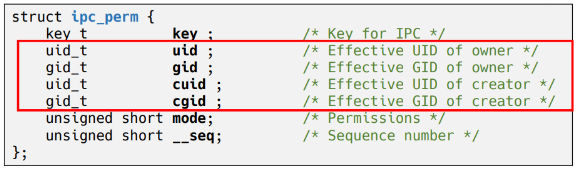
1.1 IPC 정보 검색
ipcs
-a : 모두 출력
-m : shared memory 정보
-q : message queue 정보
-s : semaphore 정보
1.2 IPC 정보 삭제
ipcrm 'object ID'2. Message Queue
- 메시지를 주고받는 Queue
#include <sys/types.h>
#include <sys/ipc.h>
#include <sys/msg.h>

int msgget(key_t key, int msgflg);

key : IPC의 key
msgflg : 생성 방법 및 접근 권한 지정

Return : 생성/연결된 Message Queue 객체의 identifier#include <sys/types.h>
#include <sys.ipc.h>
#include <sys/msg.h>
int msgsnd(int msqid, const void *msgp, size_t msgsz, int msgflg);
///
msqid : Message Queue ID
msgp : 메시지를 담고 있는 공간
msgsz : 메시지의 크기
msgflg : Message Queue가 가득 찬 경우 동작 지정
Return
(0 : Success, -1 : Error)2.1 메시지 수신
#include <sys/types.h>
#include <sys/ipc.h>
#include <sys/msg.h>

sszizt_t msgrcv(int msqid, void *msgp, size_t msgsz, long msgtyp, int msgflg);

///
msgflg : Message Queue가 비어있는 경우 동작 지정
msgtyp : 읽어올 메시지의 유형

Return : 실제 읽어 온 byte 수
(-1 : Error)
2.2 Message Queue Control
#include <sys/types.h>
#include <sys/ipc.h>
#include <sys/msg.h>

int msgctl(int msqid, iint cmd, struct msqid_ds *buf);

///
msqid : Message Queue ID
cmd : 수행할 제어 기능
buf : 제어기능에 사용되는 구조체

Return
(0 : Success, -1 : Fail)
ex) 예제
svmsg_file_server: ipc 키를 생성해 메시지를 주고 받는 코드
#include "svmsg_file.h"

static void             /* SIGCHLD handler */
grimReaper(int sig)
{
    int savedErrno;

    savedErrno = errno;                 /* waitpid() might change 'errno' */
    while (waitpid(-1, NULL, WNOHANG) > 0)
        continue;
    errno = savedErrno;
}

static void             /* Executed in child process: serve a single client */
serveRequest(const struct requestMsg *req)
{
    int fd;
    ssize_t numRead;
    struct responseMsg resp;

    fd = open(req->pathname, O_RDONLY);
    if (fd == -1) {                     /* Open failed: send error text */
        resp.mtype = RESP_MT_FAILURE;
        snprintf(resp.data, sizeof(resp.data), "%s", "Couldn't open");
        msgsnd(req->clientId, &resp, strlen(resp.data) + 1, 0);
        exit(EXIT_FAILURE);             /* and terminate */
    }

    /* Transmit file contents in messages with type RESP_MT_DATA. We don't
       diagnose read() and msgsnd() errors since we can't notify client. */

    resp.mtype = RESP_MT_DATA;
    while ((numRead = read(fd, resp.data, RESP_MSG_SIZE)) > 0)
        if (msgsnd(req->clientId, &resp, numRead, 0) == -1)
            break;

    /* Send a message of type RESP_MT_END to signify end-of-file */

    resp.mtype = RESP_MT_END;
    msgsnd(req->clientId, &resp, 0, 0);         /* Zero-length mtext */
}

int
main(int argc, char *argv[])
{
    struct requestMsg req;
    pid_t pid;
    ssize_t msgLen;
    int serverId;
    struct sigaction sa;

    /* Create server message queue */

    serverId = msgget(SERVER_KEY, IPC_CREAT | IPC_EXCL |
                            S_IRUSR | S_IWUSR | S_IWGRP);
    if (serverId == -1)
        errExit("msgget");

    /* Establish SIGCHLD handler to reap terminated children */

    sigemptyset(&sa.sa_mask);
    sa.sa_flags = SA_RESTART;
    sa.sa_handler = grimReaper;
    if (sigaction(SIGCHLD, &sa, NULL) == -1)
        errExit("sigaction");

    /* Read requests, handle each in a separate child process */

    for (;;) {
        msgLen = msgrcv(serverId, &req, REQ_MSG_SIZE, 0, 0);
        if (msgLen == -1) {
            if (errno == EINTR)         /* Interrupted by SIGCHLD handler? */
                continue;               /* ... then restart msgrcv() */
            errMsg("msgrcv");           /* Some other error */
            break;                      /* ... so terminate loop */
        }

        pid = fork();                   /* Create child process */
        if (pid == -1) {
            errMsg("fork");
            break;
        }

        if (pid == 0) {                 /* Child handles request */
            serveRequest(&req);
            _exit(EXIT_SUCCESS);
        }

        /* Parent loops to receive next client request */
    }

    /* If msgrcv() or fork() fails, remove server MQ and exit */

    if (msgctl(serverId, IPC_RMID, NULL) == -1)
        errExit("msgctl");
    exit(EXIT_SUCCESS);
}
2.3 POSIX Message Queue
mq_open: 메시지 큐 생성
#include <fcntl.h>           /* For O_* constants */
#include <sys/stat.h>        /* For mode constants */
#include <mqueue.h>

mqd_t mq_open(const char *name, int oflag, mode_t mode, struct mq_attr *attr);
///
name : 메시지 큐 이름을 지정
oflag : 메시지 큐 옵션
mode : 메시지 큐를 만들때 권한을 설정 (O_CREAT과 같이 사용)
attr : 메시지 큐의 속성을 지정 (최대 메시지수, 최대 메시지 사이즈(바이트))

Return
Success : 사용할 수 있는 mqd_t
Fail : -1
- oflag | O_RDONLY | O_WRONLY | O_RDWR | O_CLOEXEC |
|---|---|---|---|
| 읽기 전용 | 쓰기 전용 | 읽기, 쓰기 전용 | exec시 메시지큐를 닫음 |
| O_CREAT | O_EXCL | O_NONBLOCK |
|---|---|---|
| 메시지 큐가 존재하지 않을시 메시지큐 생성 (mode와 attr에 인자 필요) | O_CREAT과 같이 사용 이미 파일이 존재하면 EEXIST 에러 | 비블록 형식으로 메시지큐 open (메시지 없으면 대기하지 않음) |
- attr 구조 struct mq_attr {
long mq_flags; /* 앞서 설정한 oflag */
long mq_maxmsg; /* 메시지 큐의 최대 크기 */
long mq_msgsize; /* 메시지의 최대 크기 (bytes) */
long mq_curmsgs; /* 메시지 큐에 메시지가 몇개 있는지 */
};mq_send,mq_timedsend: 메시지를 보내는 함수
#include <mqueue.h>
#include <time.h>

int mq_send(mqd_t mqdes, const char *msg_ptr,nsize_t msg_len, unsigned int msg_prio);
int mq_timedsend(mqd_t mqdes, const char *msg_ptr, size_t msg_len, unsigned int msg_prio,
                     const struct timespec *abs_timeout);
///
mqdes : 메시지 큐의 mqd_t
msg_ptr : 메시지 내용
msg_len : 메시지의 크기
msg_prio : 메시지의 우선순위
abs_timeout : 큐가 꽉 찼을 경우 지정된 시간동안 메시지 전송을 보류  (NON_BLOCK 플래그가 없어야함, time.h 필요)

Return
0 : Success, -1 : Failmq_receive,mq_timedreceive: 메시지를 받는 함수
#include <mqueue.h>
#include <time.h>

ssize_t mq_receive(mqd_t mqdes, char *msg_ptr, size_t msg_len, unsigned int *msg_prio);

ssize_t mq_timedreceive(mqd_t mqdes, char *msg_ptr, size_t msg_len, unsigned int *msg_prio,
                          const struct timespec *abs_timeout);
///
mqdes : 메시지 큐의 mqd_t
msg_ptr : 메시지 내용 저장할 공간
msg_len : 메시지의 크기 (attr에서 설정한 최대 크기보다 작으면 안됨)
msg_prio : 메시지의 우선순위
abs_timeout : 큐가 비었을 경우 지정된 시간동안 메시지 수신을 보류  (NON_BLOCK 플래그가 없어야함, time.h 필요)


Return
받은 메시지의 byte 수
-1 : Failmq_close: 메시지 큐 종료
#include <mqueue.h>
int mq_close(mqd_t mqdes);
///
mqdes : 닫을 메시지 큐 지정

Return
0 : Success, -1 : Fail
ex) 예제 (POSIX)
pmsg_create:
// optind : argv에서 다음 요소의 인덱스

#include <mqueue.h>
#include <sys/stat.h>
#include <fcntl.h>
#include "tlpi_hdr.h"

static void
usageError(const char *progName)
{
    fprintf(stderr, "Usage: %s [-cx] [-m maxmsg] [-s msgsize] mq-name "
            "[octal-perms]\n", progName);
    fprintf(stderr, "    -c          Create queue (O_CREAT)\n");
    fprintf(stderr, "    -m maxmsg   Set maximum # of messages\n");
    fprintf(stderr, "    -s msgsize  Set maximum message size\n");
    fprintf(stderr, "    -x          Create exclusively (O_EXCL)\n");
    exit(EXIT_FAILURE);
}

int
main(int argc, char *argv[])
{
    int flags, opt;
    mode_t perms;
    mqd_t mqd;
    struct mq_attr attr, *attrp;

    attrp = NULL;
    attr.mq_maxmsg = 10;
    attr.mq_msgsize = 2048;
    flags = O_RDWR;

    /* Parse command-line options */

    while ((opt = getopt(argc, argv, "cm:s:x")) != -1) {
        switch (opt) {
        case 'c':
            flags |= O_CREAT;
            break;

        case 'm':
            attr.mq_maxmsg = atoi(optarg);
            attrp = &attr;
            break;

        case 's':
            attr.mq_msgsize = atoi(optarg);
            attrp = &attr;
            break;

        case 'x':
            flags |= O_EXCL;
            break;

        default:
            usageError(argv[0]);
        }
    }

    if (optind >= argc)
        usageError(argv[0]);

    perms = (argc <= optind + 1) ? (S_IRUSR | S_IWUSR) :
                getInt(argv[optind + 1], GN_BASE_8, "octal-perms");

    mqd = mq_open(argv[optind], flags, perms, attrp);
    if (mqd == (mqd_t) -1)
        errExit("mq_open");

    exit(EXIT_SUCCESS);
}pmsg_send: 파이프로 메시지를 보냄
#include <mqueue.h>
#include <fcntl.h>              /* For definition of O_NONBLOCK */
#include "tlpi_hdr.h"

static void
usageError(const char *progName)
{
    fprintf(stderr, "Usage: %s [-n] mq-name msg [prio]\n", progName);
    fprintf(stderr, "    -n           Use O_NONBLOCK flag\n");
    exit(EXIT_FAILURE);
}

int
main(int argc, char *argv[])
{
    int flags, opt;
    mqd_t mqd;
    unsigned int prio;

    flags = O_WRONLY;
    while ((opt = getopt(argc, argv, "n")) != -1) {
        switch (opt) {
        case 'n':   flags |= O_NONBLOCK;        break;
        default:    usageError(argv[0]);
        }
    }

    if (optind + 1 >= argc)
        usageError(argv[0]);

    mqd = mq_open(argv[optind], flags);
    if (mqd == (mqd_t) -1)
        errExit("mq_open");

    prio = (argc > optind + 2) ? atoi(argv[optind + 2]) : 0;

    if (mq_send(mqd, argv[optind + 1], strlen(argv[optind + 1]), prio) == -1)
        errExit("mq_send");
    exit(EXIT_SUCCESS);
}pmsg_receive: 파이프에서 메시지를 수신해 내용 출력
#include <mqueue.h>
#include <fcntl.h>              /* For definition of O_NONBLOCK */
#include "tlpi_hdr.h"

static void
usageError(const char *progName)
{
    fprintf(stderr, "Usage: %s [-n] mq-name\n", progName);
    fprintf(stderr, "    -n           Use O_NONBLOCK flag\n");
    exit(EXIT_FAILURE);
}

int
main(int argc, char *argv[])
{
    int flags, opt;
    mqd_t mqd;
    unsigned int prio;
    void *buffer;
    struct mq_attr attr;
    ssize_t numRead;

    flags = O_RDONLY;
    while ((opt = getopt(argc, argv, "n")) != -1) {
        switch (opt) {
        case 'n':   flags |= O_NONBLOCK;        break;
        default:    usageError(argv[0]);
        }
    }

    if (optind >= argc)
        usageError(argv[0]);

    mqd = mq_open(argv[optind], flags);
    if (mqd == (mqd_t) -1)
        errExit("mq_open");

    if (mq_getattr(mqd, &attr) == -1)
        errExit("mq_getattr");

    buffer = malloc(attr.mq_msgsize);
    if (buffer == NULL)
        errExit("malloc");

    numRead = mq_receive(mqd, buffer, attr.mq_msgsize, &prio);
    if (numRead == -1)
        errExit("mq_receive");

    printf("Read %ld bytes; priority = %u\n", (long) numRead, prio);
    if (write(STDOUT_FILENO, buffer, numRead) == -1)
        errExit("write");
    write(STDOUT_FILENO, "\n", 1);

    exit(EXIT_SUCCESS);
}
3. Shared Memory
같은 메모리 공간을 프로세스들이 공유하는 것. 동시에 읽기, 쓰기가 가능하며 동기화 해줘야 한다.
#include <sys/ipc.h>
#include <sys/shm.h>

int shmget(key_t key, size_t size, int shmflg);

///
key : IPC key (IPC_PRIVATE : private shared memory 생성)
size : 공유할 메모리 크기 (byte 단위)
shmflg : 생성 방법 및 접근 권한

Return : 생성된 shared memory 객체의 identifier#include <sys/types.h>
#include <sys/shm.h>
void *shmat(int shmid, const void *shmaddr, int shmflg); // 생성된 shared memory를 프로세스의 address space로 매핑
///
shmid : shared memory를 연결 할 주소
shmaddr : shared memory를 연결 할 주소 (NULL : 시스템이 적절한 주소 선택)
shmflg : shared memory에 대한 접근 권한
(0 : Read / Write, SHM_RDONLY : 읽기 권한)
Return : 매핑 된 주소
(-1 : Error)
---`
#include <sys/types.h>
#include <sys/shm.h>

int shmdt(const void *shmaddr); //주소 공간 매핑 해제

///
shmaddr : 연결을 해제할 메모리 주소
Return
(0 : Success, -1 : Error)#include <sys/ipc.h>
#include <sys/shm.h>
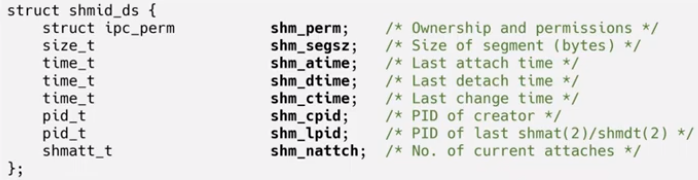
int shmctl(int shmid, int cmd, struct shmid_ds *buf);
///
shmid : shared memory segment ID
cmd : 수행할 제어기능
buf : 제어기능에 사용되는 구조체
Return
(0 : Success, -1 : Fail)
- Shared Memory에 대한 정보를 저장하는 구조체
4. Semaphore
4.1 Semaphore
#include <sys/types.h>
#include <sys/ipc.h>
#include <sys/sem.h>

int semget(key_t key, int nsems, int semflg);

///
nsems : 생성할 Semaphore 갯수
semflg : Semaphore 접근 옵션

Return : 생성된 Semaphore의 identifier#include <sys/types.h>
#include <sys/ipc.h>
#include <sys/sem.h>
int semop(int semid, struct sembuf *sops, size_t nsops);
///
semid : semget으로 생성한 Semaphore의 identifier
sops : 수행할 명령을 가지는 공간
nsops : sops가 가리키는 구조체의 수
Return
(0 : Success, -1 : Error)- sembuf 구조체

#include <sys/types.h>
#include <sys/ipc.h>
#include <sys/sem.h>

int semctl(int semid, int semnum, int cmd, ...);

///
semid : Semaphore의 identifier
semnum : 제어할 Semaphoer의 번호
cmd : 수행할 제어 기능

Return
(0 : Success, -1 : Fail)
ex) 예제
svsem_demo: 세마포어를 제어하는 코드
#include <sys/types.h>
#include <sys/sem.h>
#include <sys/stat.h>
#include "curr_time.h"                  /* Declaration of currTime() */
#include "semun.h"                      /* Definition of semun union */
#include "tlpi_hdr.h"

int
main(int argc, char *argv[])
{
    int semid;

    if (argc < 2 || argc > 3 || strcmp(argv[1], "--help") == 0)
        usageErr("%s init-value\n"
                 "   or: %s semid operation\n", argv[0], argv[0]);

    if (argc == 2) {            /* Create and initialize semaphore */
        union semun arg;

        semid = semget(IPC_PRIVATE, 1, S_IRUSR | S_IWUSR);
        if (semid == -1)
            errExit("semid");

        arg.val = getInt(argv[1], 0, "init-value");
        if (semctl(semid, /* semnum= */ 0, SETVAL, arg) == -1)
            errExit("semctl");

        printf("Semaphore ID = %d\n", semid);

    } else {                    /* Perform an operation on first semaphore */

        struct sembuf sop;              /* Structure defining operation */

        semid = getInt(argv[1], 0, "semid");

        sop.sem_num = 0;                /* Specifies first semaphore in set */
        sop.sem_op = getInt(argv[2], 0, "operation");
                                        /* Add, subtract, or wait for 0 */
        sop.sem_flg = 0;                /* No special options for operation */

        printf("%ld: about to semop at  %s\n", (long) getpid(), currTime("%T"));
        if (semop(semid, &sop, 1) == -1)
            errExit("semop");

        printf("%ld: semop completed at %s\n", (long) getpid(), currTime("%T"));
    }

    exit(EXIT_SUCCESS);
}binary_sem:
#include <sys/types.h>
#include <sys/sem.h>
#include "semun.h"                      /* Definition of semun union */
#include "binary_sems.h"

Boolean bsUseSemUndo = FALSE;
Boolean bsRetryOnEintr = TRUE;

int                     /* Initialize semaphore to 1 (i.e., "available") */
initSemAvailable(int semId, int semNum)
{
    union semun arg;

    arg.val = 1;
    return semctl(semId, semNum, SETVAL, arg);
}

int                     /* Initialize semaphore to 0 (i.e., "in use") */
initSemInUse(int semId, int semNum)
{
    union semun arg;

    arg.val = 0;
    return semctl(semId, semNum, SETVAL, arg);
}

/* Reserve semaphore (blocking), return 0 on success, or -1 with 'errno'
   set to EINTR if operation was interrupted by a signal handler */

int                     /* Reserve semaphore - decrement it by 1 */
reserveSem(int semId, int semNum)
{
    struct sembuf sops;

    sops.sem_num = semNum;
    sops.sem_op = -1;
    sops.sem_flg = bsUseSemUndo ? SEM_UNDO : 0;

    while (semop(semId, &sops, 1) == -1)
        if (errno != EINTR || !bsRetryOnEintr)
            return -1;

    return 0;
}

int                     /* Release semaphore - increment it by 1 */
releaseSem(int semId, int semNum)
{
    struct sembuf sops;

    sops.sem_num = semNum;
    sops.sem_op = 1;
    sops.sem_flg = bsUseSemUndo ? SEM_UNDO : 0;

    return semop(semId, &sops, 1);
}
4.2 POSIX Semaphore
POSIX API를 사용하는 방법은 두가지가 있다.
Unnamed Semaphore- 주로 shared memory 내의 메모리 영역을 이용한다.
Named Semaphore- ID를 갖는 별도의 객체를 생성한다.
- Shared memory 이외의 자원에 대한 동기화가 필요할 때 사용하기 좋다.
4.2.1 Unnamed Semaphore
sem_init: 세마포어 초기화 함수
#include <semaphore.h>

int sem_init(sem_t *sem, int pshared, unsigned int value);

///
sem: 초기화 할 semaphore 객체 위치
pshared
	‐ 0: process 내에서 thread 간 공유
	‐ 1: process 간 공유
value: semaphore 초기값

Return
(0 : Success, -1 : Fail)sem_destroy: 세마포어 리소스 반납하는 함수.
#include <semaphore.h>

int sem_destroy(sem_t *sem);
///
sem: 리소스를 반납할 semaphore 객체

Return
(0 : Success, -1 : Fail)
4.2.2 Named Semaphore
sem_open: name Semaphore 열기 / 생성
#include <fcntl.h>
#include <sys/stat.h>
#include <semaphore.h>

sem_t *sem_open(const char *name, int oflag);		//열기
sem_t *sem_open(const char *name, int oflag, mode_t, unsigned int value);
													//생성
///
name: 세마포어 ID
oflag: mask of O_CREAT, O_EXCL
mode: 권한
value: semaphore 초기값

Return
(0 : Success, -1 : Fail)sem_close: name semaphore 닫기sem_unlink: named semaphore 삭제, 모든 프로세스가 해당 세마포어를 닫으면 삭제함
#include <fcntl.h>
#include <sys/stat.h>
#include <semaphore.h>

int sem_close(sem_t *sem);
int sem_unlink(const char *name);

///
sem: 세마포어 객체
name: 세마포어 ID

Return
(0 : Success, -1 : Fail)
4.2.3 공통
sem_post: 갖고 있던 리소스 해제, 세마포어 값을 +1sem_wait: 리소스 획득 요청, 세마포어의 값을 -1, 세마포어의 값이 0보다 작아진다면 blocking 됨sem_trywait: 리소스 획득 시도sem_timedwait: 타임아웃을 설정하고 리소스 획득 요청
int sem_post(sem_t *sem);
int sem_wait(sem_t *sem);
int sem_trywait(sem_t *sem);
int sem_timedwait(sem_t *sem, const struct timespec *abs_timeout);

///
sem: 세마포어 객체
abs_timeout: timeout 설정값

Return
(0 : Success, -1 : Fail)
ex) 예제
psem_create: 세마포어 생성
#include <semaphore.h>
#include <sys/stat.h>
#include <fcntl.h>
#include "tlpi_hdr.h"

static void
usageError(const char *progName)
{
    fprintf(stderr, "Usage: %s [-cx] name [octal-perms [value]]\n", progName);
    fprintf(stderr, "    -c   Create semaphore (O_CREAT)\n");
    fprintf(stderr, "    -x   Create exclusively (O_EXCL)\n");
    exit(EXIT_FAILURE);
}

int
main(int argc, char *argv[])
{
    int flags, opt;
    mode_t perms;
    unsigned int value;
    sem_t *sem;

    flags = 0;
    while ((opt = getopt(argc, argv, "cx")) != -1) {
        switch (opt) {
        case 'c':   flags |= O_CREAT;           break;
        case 'x':   flags |= O_EXCL;            break;
        default:    usageError(argv[0]);
        }
    }

    if (optind >= argc)
        usageError(argv[0]);

    /* 기본 권한 rw-------; 기본 세마포어 값 0 */

    perms = (argc <= optind + 1) ? (S_IRUSR | S_IWUSR) :
                getInt(argv[optind + 1], GN_BASE_8, "octal-perms");
    value = (argc <= optind + 2) ? 0 : getInt(argv[optind + 2], 0, "value");

    sem = sem_open(argv[optind], flags, perms, value);
    if (sem == SEM_FAILED)
        errExit("sem_open");

    exit(EXIT_SUCCESS);
}psem_post: 세마포어 취득
#include <semaphore.h>
#include "tlpi_hdr.h"

int
main(int argc, char *argv[])
{
    sem_t *sem;

    if (argc != 2)
        usageErr("%s sem-name\n", argv[0]);

    sem = sem_open(argv[1], 0);
    if (sem == SEM_FAILED)
        errExit("sem_open");

    if (sem_post(sem) == -1)
        errExit("sem_post");
    exit(EXIT_SUCCESS);
}
psem_wait: 리소스 획득 요청
#include <semaphore.h>
#include "tlpi_hdr.h"

int
main(int argc, char *argv[])
{
    sem_t *sem;

    if (argc < 2 || strcmp(argv[1], "--help") == 0)
        usageErr("%s sem-name\n", argv[0]);

    sem = sem_open(argv[1], 0);
    if (sem == SEM_FAILED)
        errExit("sem_open");

    if (sem_wait(sem) == -1)
        errExit("sem_wait");

    printf("%ld sem_wait() succeeded\n", (long) getpid());
    exit(EXIT_SUCCESS);
}
pshm_create: 공유메모리 생성
#include <sys/stat.h>
#include <fcntl.h>
#include <sys/mman.h>
#include "tlpi_hdr.h"

static void
usageError(const char *progName)
{
    fprintf(stderr, "Usage: %s [-cx] shm-name size [octal-perms]\n", progName);
    fprintf(stderr, "    -c   Create shared memory (O_CREAT)\n");
    fprintf(stderr, "    -x   Create exclusively (O_EXCL)\n");
    exit(EXIT_FAILURE);
}

int
main(int argc, char *argv[])
{
    int flags, opt, fd;
    mode_t perms;
    size_t size;
    void *addr;

    flags = O_RDWR;
    while ((opt = getopt(argc, argv, "cx")) != -1) {
        switch (opt) {
        case 'c':   flags |= O_CREAT;           break;
        case 'x':   flags |= O_EXCL;            break;
        default:    usageError(argv[0]);
        }
    }

    if (optind + 1 >= argc)
        usageError(argv[0]);

    size = getLong(argv[optind + 1], GN_ANY_BASE, "size");
    perms = (argc <= optind + 2) ? (S_IRUSR | S_IWUSR) :
                getLong(argv[optind + 2], GN_BASE_8, "octal-perms");

    /* Create shared memory object and set its size */

    fd = shm_open(argv[optind], flags, perms);
    if (fd == -1)
        errExit("shm_open");

    if (ftruncate(fd, size) == -1)
        errExit("ftruncate");

    /* Map shared memory object */

    if (size > 0) {
        addr = mmap(NULL, size, PROT_READ | PROT_WRITE, MAP_SHARED, fd, 0);
        if (addr == MAP_FAILED)
            errExit("mmap");
    }

    exit(EXIT_SUCCESS);
}
