23.08.05 최초 작성
23.11.16 예제, mprotect, mlock 추가
23.12.11 내용 추가(madvise())
메모리의 영역을 파일에 매핑하는 것. 파일에 대한 접근을 메모리에 접근하는 것 처럼 처리할 수 있으며 다른 프로세스와 통신 할 수 있다.
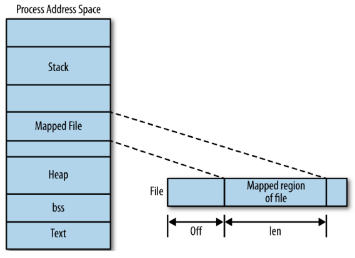
VMA (vm_area_struct)
- 리눅스에서 메모리 공간을 관리하는 단위
/proc/PID/maps에서 확인 가능
예외 처리
Segmetation Fault: 할당하지 않은 영역 접근Normal Page Fault:Demand PagingProtection Exception: 접근 권한 벗어남 (리눅스에선Segmetation Fault)
1. 메모리 매핑
#include <sys/mman.h>

void* mmap (void *addr, size_t length, int prot, int flags, int fd, off_t offset); // Page 단위로 이루어진다

///
addr : 매핑할 메모리 주소의 hint (일반적으로 NULL)
length : 매핑 할 길이
prot : Memory Protection Mode
(PROT_NONE : 접근할 수 없음, PROT_READ, WRITE, EXEC : 읽기, 쓰기, 실행 권한)
(file descriptor의 open mode와 다르면 안됨)
flags : 매핑 형태와 동작 방식 지정
(MAP_FIXED : 매핑 할 주소 지정
MAP_PRIVATE : 프로세스 간 변경 내용이 공유 및 반영되지 않음
MAP_SHARED : 프로세스 간 매핑 된 내용이 공유됨
fd : 매핑할 파일의 file descriptor
offset : 매핑 시작 지점을 지정 (Page Size의 배수)

Return : 할당된 메모리 주소
(MAP_FAILED : Fail)
1.2 매모리 매핑 제거
#include <sys/mman.h>

int munmap(void *addr, size_t length);

///
addr : 매핑 시작 주소
length : 매핑 길이

Return
(0 : Success, -1 : fail)
ex) 예제
memcat: 비공개 파일의 내용을 읽어서 출력하는 코드
#include <sys/mman.h>
#include <sys/stat.h>
#include <fcntl.h>
#include "tlpi_hdr.h"

int
main(int argc, char *argv[])
{
    char *addr;
    int fd;
    struct stat sb;

    if (argc != 2 || strcmp(argv[1], "--help") == 0)
        usageErr("%s file\n", argv[0]);

    fd = open(argv[1], O_RDONLY);
    if (fd == -1)
        errExit("open");

    /* Obtain the size of the file and use it to specify the size of
       the mapping and the size of the buffer to be written */

    if (fstat(fd, &sb) == -1)
        errExit("fstat");

    /* Handle zero-length file specially, since specifying a size of
       zero to mmap() will fail with the error EINVAL */

    if (sb.st_size == 0)
        exit(EXIT_SUCCESS);

    addr = mmap(NULL, sb.st_size, PROT_READ, MAP_PRIVATE, fd, 0);
    if (addr == MAP_FAILED)
        errExit("mmap");

    if (write(STDOUT_FILENO, addr, sb.st_size) != sb.st_size)
        fatal("partial/failed write");
    exit(EXIT_SUCCESS);
}
1.3 파일 동기화
#include <sys/mman.h>

int msync (void *addr, size_t length, int flags); //강제로 write-back 수행

///
flags
(MS_SYNC : write-back 끝날 때 까지 대기
MS_ASYNC : write-back 비동기적으로 수행
MS_INVALIDATE : 메모리에 변경 된 내용 무효화
1.4 파일 크기 변경
#include <unistd.h>
#include <sys/types.h>

int truncate(const char *path, off_t length);
int ftruncate(int fd, off_t length);

///
path / fd : 파일 경로 or file descriptor
lenght : 늘릴 공간의 크기 (0으로 채워짐)
1.5 메모리 보호모드 변경
mprotect: 메모리에 대한 접근을 제어하는 함수
#include <sys/mman.h>

int mprotect(void *addr, size_t length, int prot);

///
addr : 접근을 제어할 주소
length :주소 기준으로 관여할 길이
prot : 설정 값
	  PROT_NONE : 접근할 수 없다.
      PROT_READ : 읽기
      PROT_WRITE : 쓰기
      PROT_EXEC : 실행

Return
(0 : Success, -1 : fail)
ex) 예제
t_mprotect: 특정 영역의 메모리의 보호 설정을 확인하는 코드
#define _BSD_SOURCE         /* Get MAP_ANONYMOUS definition from <sys/mman.h> */
#include <sys/mman.h>
#include "tlpi_hdr.h"

#define LEN (1024 * 1024)

#define SHELL_FMT "cat /proc/%ld/maps | grep zero"
#define CMD_SIZE (sizeof(SHELL_FMT) + 20)
                            /* Allow extra space for integer string */

int
main(int argc, char *argv[])
{
    char cmd[CMD_SIZE];
    char *addr;

    /* Create an anonymous mapping with all access denied */

    addr = mmap(NULL, LEN, PROT_NONE, MAP_SHARED | MAP_ANONYMOUS, -1, 0);
    if (addr == MAP_FAILED)
        errExit("mmap");

    /* Display line from /proc/self/maps corresponding to mapping */

    printf("Before mprotect()\n");
    snprintf(cmd, CMD_SIZE, SHELL_FMT, (long) getpid());
    system(cmd);

    /* Change protection on memory to allow read and write access */

    if (mprotect(addr, LEN, PROT_READ | PROT_WRITE) == -1)
        errExit("mprotect");

    printf("After mprotect()\n");
    system(cmd);                /* Review protection via /proc/self/maps */

    exit(EXIT_SUCCESS);
}
1.6 메모리 잠금
mlock,munlock: 물리 메모리에 상주 보장 & 해제
#include <sys/mman.h>

int mlock(const void *addr, size_t len);
int munlock(const void *addr, size_t len);
1.7 메모리 영역에 대한 힌트 제공
madvise(): 해당 메모리 공간에 수행 할 명령에 대한 힌트 반환
#include <sys/types.h>
#include <sys/mman.h>

int madivse(void *addr, size_t length, int advice);

///
addr : 힌트를 얻을 주소
length : 힌트를 얻을 주소의 길이
advice : 앞으로 해당 메모리 공간에 수행할 명령

Return
(0 : Success, -1 : fail)advice값 정리
| MADV_NORMAL | MADV_RANDOM | MADV_SEQUENTIAL | MADV_WILLNEED | MADV_DONTNEED | MADV_SPACEAVAIL |
|---|---|---|---|---|---|
| 특별한 작업 없음 | 무작위 페이지 참조 | 순차 페이지 참조 | 해당 페이지 필요 예상 | 해당 페이지 필요 X 예상 | 해당 메모리 예약되었는지 확인 |
ex) 예제
#define _BSD_SOURCE             /* Get mincore() declaration and MAP_ANONYMOUS
                                   definition from <sys/mman.h> */
#include <sys/mman.h>
#include "tlpi_hdr.h"

/* Display residency of pages in range [addr .. (addr + length - 1)] */

static void
displayMincore(char *addr, size_t length)
{
    unsigned char *vec;
    long pageSize, numPages, j;

#ifndef _SC_PAGESIZE
    pageSize = getpagesize();   /* Some systems don't have _SC_PAGESIZE */
#else
    pageSize = sysconf(_SC_PAGESIZE);
#endif

    numPages = (length + pageSize - 1) / pageSize;
    vec = malloc(numPages);
    if (vec == NULL)
        errExit("malloc");

    if (mincore(addr, length, vec) == -1)
        errExit("mincore");

    for (j = 0; j < numPages; j++) {
        if (j % 64 == 0)
            printf("%s%10p: ", (j == 0) ? "" : "\n", addr + (j * pageSize));
        printf("%c", (vec[j] & 1) ? '*' : '.');
    }
    printf("\n");

    free(vec);
}

int
main(int argc, char *argv[])
{
    char *addr;
    size_t len, lockLen;
    long pageSize, stepSize, j;

    if (argc != 4 || strcmp(argv[1], "--help") == 0)
        usageErr("%s num-pages lock-page-step lock-page-len\n", argv[0]);

#ifndef _SC_PAGESIZE
    pageSize = getpagesize();
    if (pageSize == -1)
        errExit("getpagesize");
#else
    pageSize = sysconf(_SC_PAGESIZE);
    if (pageSize == -1)
        errExit("sysconf(_SC_PAGESIZE)");
#endif

    len =      getInt(argv[1], GN_GT_0, "num-pages") * pageSize;
    stepSize = getInt(argv[2], GN_GT_0, "lock-page-step") * pageSize;
    lockLen =  getInt(argv[3], GN_GT_0, "lock-page-len") * pageSize;

    addr = mmap(NULL, len, PROT_READ, MAP_SHARED | MAP_ANONYMOUS, -1, 0);
    if (addr == MAP_FAILED)
        errExit("mmap");

    printf("Allocated %ld (%#lx) bytes starting at %p\n",
            (long) len, (unsigned long) len, addr);

    printf("Before mlock:\n");
    displayMincore(addr, len);

    /* Lock pages specified by command-line arguments into memory */

    for (j = 0; j + lockLen <= len; j += stepSize)
        if (mlock(addr + j, lockLen) == -1)
            errExit("mlock");

    printf("After mlock:\n");
    displayMincore(addr, len);

    exit(EXIT_SUCCESS);
}
2. 매모리 매핑을 이용한 IPC
같은 메모리 매핑 영역을 공유해 프로세스들 사이의 통신이 가능하다.
Inter Process Communication 방법들
- Pipe
- Message Queue
- Shared Memory
- Semaphore
ex) 예제
t_mmap: 공유 메모리를 통해 IPC를 수행하는 코드
#include <sys/mman.h>
#include <fcntl.h>
#include "tlpi_hdr.h"

#define MEM_SIZE 10

int
main(int argc, char *argv[])
{
    char *addr;
    int fd;

    if (argc < 2 || strcmp(argv[1], "--help") == 0)
        usageErr("%s file [new-value]\n", argv[0]);

    fd = open(argv[1], O_RDWR);
    if (fd == -1)
        errExit("open");

    addr = mmap(NULL, MEM_SIZE, PROT_READ | PROT_WRITE, MAP_SHARED, fd, 0);
    if (addr == MAP_FAILED)
        errExit("mmap");

    if (close(fd) == -1)                /* No longer need 'fd' */
        errExit("close");

    printf("Current string=%.*s\n", MEM_SIZE, addr);
                        /* Secure practice: output at most MEM_SIZE bytes */

    if (argc > 2) {                     /* Update contents of region */
        if (strlen(argv[2]) >= MEM_SIZE)
            cmdLineErr("'new-value' too large\n");

        memset(addr, 0, MEM_SIZE);      /* Zero out region */
        strncpy(addr, argv[2], MEM_SIZE - 1);
        if (msync(addr, MEM_SIZE, MS_SYNC) == -1)
            errExit("msync");

        printf("Copied \"%s\" to shared memory\n", argv[2]);
    }

    exit(EXIT_SUCCESS);
}