PLC Gateway vs. Protocol Converter: What’s the Difference?
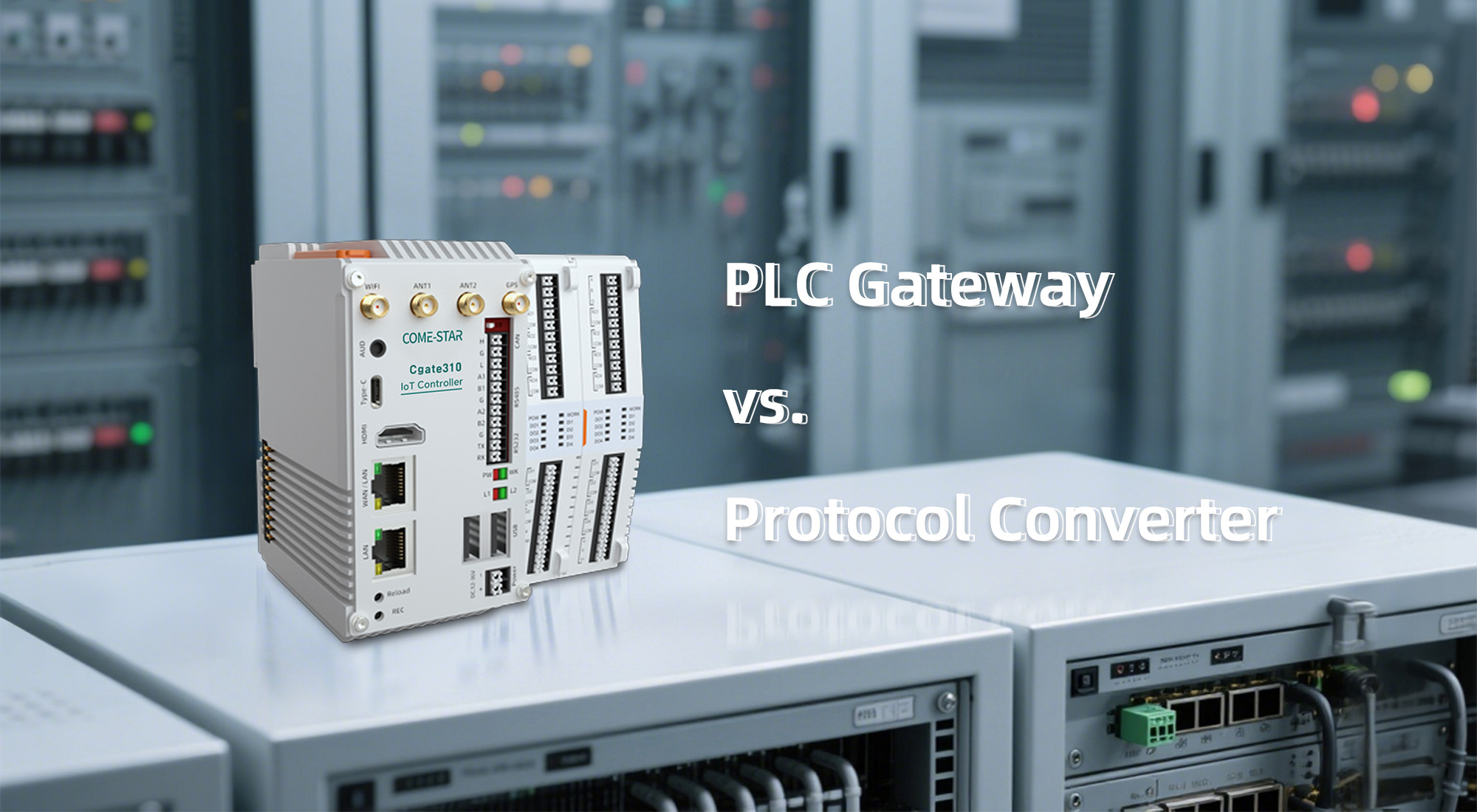
In industrial automation systems, as the types of equipment and the complexity of communication protocols continue to grow, achieving interoperability among different devices has become a critical task. Especially within a factory system, PLCs, sensors, actuators, and upper-level systems from different brands may use different communication protocols, making direct communication impossible. In such cases, bridge devices are needed to perform protocol conversion and data exchange functions. The two most common types of such devices are the Protocol Converter and the PLC Gateway.
Although these two devices are often used interchangeably or even confused in practical applications, they have significant differences in design philosophy, functional positioning, and application scenarios. This article will provide a detailed introduction to their definitions, functional characteristics, core differences, and typical application scenarios, helping users make more accurate choices for suitable communication solutions.
What is a protocol converter?
A protocol converter is a universal data protocol bridging device used to convert one communication protocol into another. Its primary function is to perform “protocol translation.” It can be applied not only between PLCs but also for communication bridging between various devices such as power equipment, instruments, and building systems. Its core function is to convert data of different formats, speeds, or encoding methods, enabling two originally incompatible systems to communicate.
Features of a protocol converter:
Wide conversion range: Supports not only industrial protocols but also protocols in fields such as building automation, transportation, and energy.
Simple structure: Compared to PLC gateways, protocol converters have a lighter structure and are generally used for point-to-point or one-to-many protocol interfaces.
High flexibility: Suitable for data integration with non-PLC devices such as sensors, instruments, and access control equipment.
Relatively low cost: Suitable for small-scale systems with relatively simple functional requirements.
What is a PLC gateway?
A PLC gateway is an industrial communication device specifically designed for communication between PLC systems. It is primarily used to connect multiple PLCs of different brands or protocols, enabling data sharing and interaction. It typically supports multiple industrial protocols and possesses robust data parsing and mapping capabilities, enabling accurate transmission of required control information between different PLCs. As a PLC IoT gateway, it can also serve as a bridge, connecting PLCs to the IoT ecosystem and supporting data exchange between industrial equipment and cloud platforms or other networked devices, thereby enabling remote monitoring, control, and data analysis.
Features of PLC gateways:
Multi-protocol support: Supports multiple industrial communication protocols such as Modbus TCP/RTU, PROFINET, EtherNet/IP, OPC UA, CANopen, and BACnet simultaneously.
High reliability: Designed for industrial environments, it supports wide temperature and voltage ranges and features anti-interference design, making it suitable for harsh conditions.
Strong data mapping capabilities: Accurate data matching and conversion can be performed based on the PLC address or variable name.
Supports remote management: Some PLC gateways come with a web management interface or supporting software for easy configuration, monitoring, and fault diagnosis. Some high-end models can also integrate cellular gateway functions to enable remote transmission of PLC data to cloud platforms via 4G/5G networks, meeting the needs of industrial IoT places.
Core Differences Between PLC Gateways and Protocol Converters
Different Application Scopes
PLC gateways focus on data communication between PLCs or between PLCs and systems within industrial control systems.
Protocol converters have a broader application scope and can be used for protocol bridging between any devices.
Different Design Complexity
PLC gateways support more complex data processing logic and feature complete variable mapping, diagnostics, caching, and other functions.
Protocol converters typically perform simple one-to-one protocol conversion and have relatively limited functionality.
Different target objects
PLC gateways are designed to integrate data for PLC systems, industrial control networks, or upper-level systems.
Protocol converters can connect any type of communication device, including meters, sensors, actuators, and instruments.
Differences in communication structures
PLC gateways are primarily used in “many-to-many” or “many-to-one” communication structures, suitable for centralized data collection or multi-protocol integration.
Protocol converters are generally used in “point-to-point” or “one-to-one” communication conversion structures.
Differences in applicable industries
PLC gateways are widely used in discrete manufacturing, process industries, and automated production lines.
Protocol converters are commonly found in building control, energy monitoring, and traffic management industries.
Choose the right equipment according to your needs
Whether to choose a PLC gateway or a protocol converter depends on your specific application requirements:
If you need to connect multiple PLCs from different manufacturers, support stable communication at the industrial field level, and may involve upper-level system integration or cloud platform uploads, we recommend using a PLC gateway, which covers the core requirements of an industrial gateway.
If you only need to read data from a specific device and convert it into a compatible protocol for system access, a protocol converter is more cost-effective and practical.
If you prioritize long-term scalability, security, and centralized management capabilities, you should prioritize a comprehensive, remotely configurable PLC gateway.
If the system is relatively simple and the protocol conversion task for a single device is clearly defined, a protocol converter is sufficient and offers cost-effectiveness advantages.
Conclusion
In short, a protocol converter is a “single-function translator,” while a PLC gateway is an “industrial data hub that integrates translation, processing, and transmission.” Although both PLC gateways and protocol converters can facilitate communication bridging between different types of devices, they target different audiences, offer varying levels of functionality depth, and have distinct application scopes. PLC gateways are more suitable for integrating complex industrial control systems, while protocol converters offer greater flexibility and cost advantages in lightweight communication scenarios.
