Dota 2 MMR in 2026: Why Solo Climbing Stalls and How to Break Through
Every Dota 2 player knows the feeling: hundreds of games played, and the same medal staring back. It is tempting to blame variance, teammates, or your own play but the truth is more structural. Solo climbing in Dota 2 stalls for specific, systemic reasons, and the 2026 ranked system is better than ever at finding your level and pinning you there. Here is what is actually holding you in place, and the levers that genuinely break the wall.
The Two Numbers Behind Every Game
Since the move to a Glicko-based system, your MMR is really two numbers: your Rank (the system's estimate of your skill) and your Rank Confidence (how sure it is about that estimate). A new wrinkle for 2026 makes this matter more than ever: matches no longer give a fixed MMR gain or loss. The amount now varies based on the ranks and confidence of everyone in the lobby, capped to avoid wild swings. The more confident the system is in your rank, the smaller and more stable your adjustments become which is the mechanical root of feeling "stuck." Your MMR is private; only your medal is public.
Where Everyone Is Stuck: The Distribution
To understand why climbing is hard, look at where the playerbase actually sits. These bands are community estimates from millions of tracked accounts, not official Valve numbers.
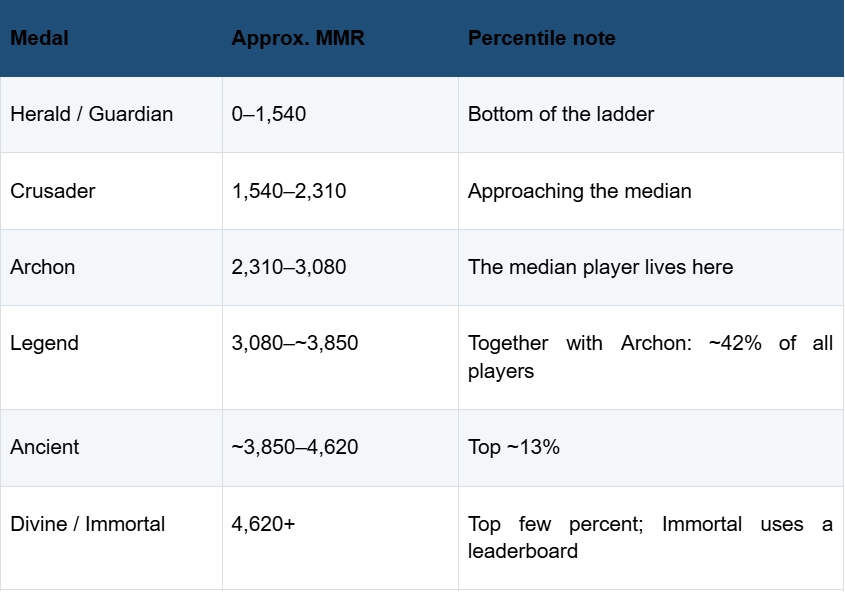
There is the wall, in one line: Archon and Legend together hold roughly 42% of the entire ranked population. The median player sits in Archon. This is the densest, stickiest stretch of the ladder --- the place where nearly everyone you queue with and against is around your level, so wins and losses tend to cancel out and progress feels glacial.
Why Solo Climbing Stalls
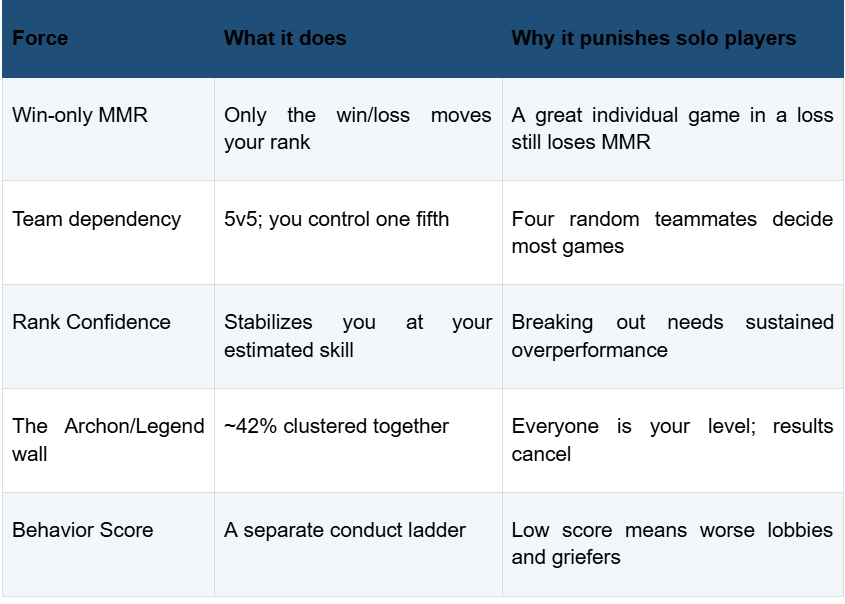
Several forces stack on top of that distribution, and they hit solo players hardest. The table lays them out.
The System Only Counts the Win
This is the fact that breaks the most hearts: Dota 2's MMR moves on the win, not on your performance. You can finish 34-and-3 with a Rampage and a triple-Aegis steal, and if your team loses, your MMR goes down exactly the same as if you had fed all game. The matchmaker does not grade your KDA, your last hits, or your highlight reel for rank purposes. In a five-player team game, that means you carry one fifth of the influence but absorb the full weight of every loss --- and as a solo player, the other four are strangers you cannot control. This is the single biggest reason solo climbing feels unfair: you are graded on an outcome that four other people co-author.

The Second Ladder: Behavior Score
Most rank guides stop at medals and miss the system that quietly decides your games. Behavior Score is a separate ladder that tracks your conduct, and it controls who you get matched with you can be a skilled player and still get dumped into miserable, griefer-filled lobbies because your score slipped. Grinding MMR does nothing for a broken Behavior Score, and a high score will not climb your MMR; they are two independent ladders. A huge number of stuck players are not actually stuck on skill they are stuck in a low-conduct pool that makes winning nearly impossible, and digging out by yourself can take dozens of clean games. If your matches suddenly feel cursed, check your Behavior Score before you blame your skill.
How to Break Through
The levers that actually move a stuck account are unglamorous but reliable. Fix your Behavior Score first if it is low --- nothing else works until your lobbies are healthy. Narrow your hero pool to two or three heroes per role and stop queue-filling all five positions; depth beats breadth at every bracket up through Divine. Play macro instead of chasing highlights: at Archon and Legend, games are decided by towers, Roshan, lane priority and vision far more than by mechanical flash. And manage your tilt the win-only system means a calm player who wins systematically will always out-climb a mechanically gifted one who throws after a bad start. The thread connecting all of these is that they raise your win rate, which is the only thing the system rewards.
When You've Done Everything and Still Stall
Sometimes you fix your conduct, tighten your pool, play clean macro and still grind in place, because the structural truth holds: solo, four strangers co-author every result. This is where outside help becomes rational, and the most effective forms work with the system rather than around it. The most account-safe option is duo queue, where a stronger, in-range player joins your own games on your account without ever sharing your login supplying the coordination and reliable second core that solo queue denies you. Coaching addresses the only thing that durably moves a confident MMR: real improvement in the macro decisions that decide games. A good Dota 2 boosting service is built around exactly these levers duo play, coaching, and conduct recovery rather than vague promises, and it is worth knowing that a core-role climb is more directly carry-able than a support one, simply because a carry shapes a game's tempo more directly. The honest framing is that help addresses the part of the wall you cannot fix alone the teammates and the coordination not your own hands.
So if you are stuck, start with the truth: the 2026 system is designed to hold you at your level, the Archon wall is where nearly everyone fights, and only the win moves your rank. Fix your Behavior Score, narrow your heroes, play macro over highlights, and keep your head and when the wall is genuinely the four randoms beside you rather than your own play, the coordination of a duo or the insight of a coach is what finally gets the boulder rolling uphill.
Frequently Asked Questions
Why can't I climb in Dota 2 solo?
Because the system only moves your MMR on the win, not your individual performance so in a 5v5 game you control one fifth of the outcome but absorb every loss, with four random teammates deciding most games. Add the Archon/Legend wall, where about 42% of players cluster at similar skill, and Rank Confidence stabilizing you at your estimated level, and solo progress naturally stalls.
Does individual performance affect Dota 2 MMR?
Not for rank. Your MMR moves on whether your team wins or loses, not your KDA, last hits, or highlights. You can go 34-and-3 with a Rampage and still lose MMR if your team loses the game. Performance metrics influence calibration placement, but within a season, only the win counts toward your rank.
How does Behavior Score affect climbing?
It's a separate ladder that controls your match quality. A low Behavior Score drops you into toxic, griefer-prone lobbies that are very hard to win in, so you stall regardless of skill. Grinding MMR won't fix it and a good score won't raise your MMR they're independent. If games suddenly feel cursed, check your Behavior Score first, since recovering it by yourself can take dozens of clean games.
What's the safest way to get help climbing in Dota 2?
Duo queue is the most account-safe form a stronger, in-range player joins your own games on your account without sharing your login, supplying the coordination solo queue lacks. Coaching is the other durable lever, since it improves the macro decisions that actually move a confident MMR. Both work with the system rather than around it, addressing the teammate-and-coordination part of the wall you can't fix alone.
