What Production Experience Adds That Side Projects Can’t
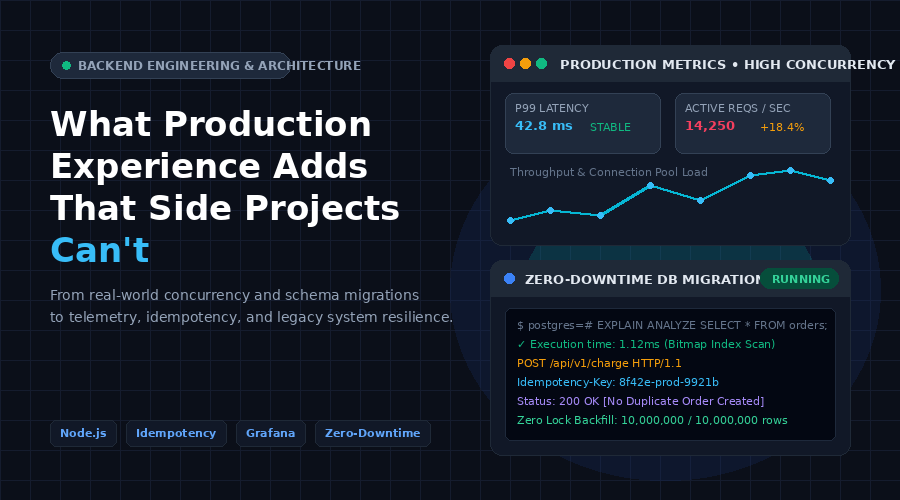
Side projects are a good way to learn software development. You can build an API, change a database schema, try a new framework, scrap an architecture that did not work, and start again. If you break something, usually no one else is affected.
That last part matters. In production, there are users, existing data, old integrations, release schedules, and code written years before you joined the project. Companies looking to hire proven backend talent therefore tend to care about more than knowledge of Node.js, Python, Java, or a particular framework. They need developers who have already worked with the constraints of live software.
Real Users Do Things You Didn't Test For
A personal app usually sees fairly predictable inputs. Even when you test invalid data, you are deciding which invalid data to try.
Once an application has real users, the range gets wider. Someone submits the same form twice. A mobile connection disappears during a request. A client retries after a timeout even though the server completed the original operation. Bots send requests at a rate no human user could produce.
Take an API endpoint that creates an order. During development, one request creates one order. In production, the client sends a request, waits, and times out. It tries again. The first request may already have reached the server, so now there is a risk of creating the order twice.
This is one reason payment APIs use idempotency mechanisms. Stripe, for example, lets clients send an idempotency key with supported requests. Retrying with the same key prevents the same operation from being performed again.
You can learn what idempotency means from documentation. It becomes much easier to appreciate once you have had to trace duplicate records back to a retry that looked harmless.
Code That Is Fast on Your Laptop May Not Stay Fast
A database query against a few thousand rows can look perfectly fine. The same query against a much larger table, while hundreds of other requests are competing for database resources, may be a different story.
Suppose a page needs to retrieve a customer's recent orders. Early in the product's life, the query takes a few milliseconds. As the orders table grows, response times start creeping up.
Adding an index might help, but that is not a decision to make automatically. PostgreSQL's EXPLAIN ANALYZE, for example, can show how the database executes the query and where it spends time. An additional index also takes storage and has to be updated when rows are inserted or changed.
Similar problems show up elsewhere in backend engineering. An application can run comfortably with a few concurrent requests and then start exhausting its database connection pool under heavier traffic. A third-party API may impose a rate limit that never appeared during development. Memory usage that looked insignificant per request becomes noticeable when thousands of requests overlap.
Debugging under load usually means looking at what the system was doing when the slowdown happened. Depending on the stack, that might involve Prometheus metrics, Grafana dashboards, OpenTelemetry traces, database statistics, as well as application logs. Running the same endpoint once on a development machine may reproduce nothing.
Database Migrations Get Awkward Once You Have Data to Protect
Changing a schema on a side project can take a few minutes. Update the model, run the migration, restart the application.
Now imagine adding a required column to a table with millions of existing rows while people are still using the product.
Existing records have no value for the new field. During a rolling deployment, old and new versions of the application may briefly run side by side. A large update can put additional pressure on the database, and some schema operations can interfere with normal queries if they hold locks for too long.
Teams often split this kind of change into several deployments. A new field might initially allow null values. Application code is updated to work during the transition. Existing records are backfilled separately, sometimes in batches. The stricter constraint comes later.
The exact procedure depends on the database, traffic, table size, deployment setup, and the change itself. A migration that is reasonable for a small PostgreSQL table may be a poor choice for a heavily used table with hundreds of millions of rows.
On a live product, the difficult part is often getting from one valid state to another without interrupting everything in between.
You Don't Get to Rewrite Every Piece of Bad Code
Tutorials and personal projects tend to start with an empty repository. Most professional codebases do not.
You may open a module written seven years ago and find minimal documentation, inconsistent naming, and also tests that cover only part of the behavior. There might be two different approaches to the same problem because the team's conventions changed halfway through the product's life.
Then there is the code that looks obviously unnecessary.
Removing it immediately can be a mistake. That odd condition may handle an old customer configuration or compensate for behavior in a third-party integration. Sometimes git blame leads to a commit from someone who left years ago, and the commit message says little more than "fix issue."
Working with legacy code involves a fair amount of investigation. Developers read nearby tests, follow dependencies, inspect commit history, check production behavior, and talk to people who know that part of the product.
Sometimes the suspicious code really should be deleted. Sometimes deleting it brings back a bug from 2019.
Code Review Is Different When the Reviewer Has to Maintain Your Work
When you work alone, you can accept code because you understand what you meant when you wrote it. A teammate does not have that context.
Code review practices expose this quickly. A reviewer might ask why an abstraction exists, what happens if an external call times out, or why a small feature touches 30 files. The implementation can be technically correct and still be difficult for the rest of the team to work with.
Reviewing other people's code is another skill in itself. There is little value in blocking a pull request because you would have named a variable differently. Formatting and many style issues can be handled by tools such as Prettier, ESLint, or CI checks.
Human review is more useful for questions that require context: Does the change match the requirement? Could it break an existing workflow? Are the tests checking meaningful behavior? Has the author introduced complexity that the feature does not need?
Senior developers are usually better at separating those questions from personal preference. That distinction saves time as well as arguments.
The Cleaner Solution Isn't Always the One That Ships
Imagine a team maintaining an old billing module. The code has become difficult to change, and everyone agrees that parts of it should be redesigned. Then a regulatory requirement arrives with a six-week deadline.
Rewriting the module might leave the codebase in better shape. It also expands the amount of code that has to be changed, tested, and released before the deadline.
The team may decide to make a smaller modification to the existing implementation.
That is not automatically good engineering. Quick fixes pile up, and "we'll clean it up later" has a habit of becoming permanent. But a rewrite is not automatically the responsible option either. It carries its own cost and failure risk.
Production work puts these decisions next to business deadlines, customer commitments, security requirements, available engineering time, and release risk. The technically nicest architecture does not get a separate calendar.
Incidents Make Observability Very Practical
Some production problems are ordinary bugs. Others happen because several otherwise reasonable parts of a system fail together.
A Redis instance becomes unavailable. A payment provider that normally responds in 300 milliseconds starts taking five seconds. Requests begin waiting, a connection pool fills, and an API that was healthy a few minutes earlier starts timing out.
At that point, the team needs evidence.
Which requests are slow? When did the change begin? Is the application itself consuming more resources, or is it waiting for something else? Did a deployment happen around the same time?
Prometheus, Grafana, Datadog, OpenTelemetry, and similar tools can provide pieces of that picture. They are useful only if the application records the right information. A dashboard containing CPU and memory graphs will not explain a checkout failure caused by a slow external service.
The gaps tend to become obvious during an incident. Maybe logs lack a request ID. Maybe nobody tracks latency for an important dependency. Maybe an alert fires so often that people have learned to ignore it.
Those are difficult problems to encounter on a project where an outage means restarting your own development server.
Security Looks Different When It Is Someone Else's Data
A personal project may contain a few test accounts and dummy records. That makes some shortcuts relatively harmless.
The same shortcuts do not travel well to production systems.
Logging complete request bodies, for example, can make debugging convenient. It can also put names, email addresses, tokens, or other sensitive information into logs that are accessible to more people than the production database itself.
Authorization creates similar traps. Confirming that a user is logged in answers one question. It does not establish whether that user should be able to retrieve a particular invoice, account, or administrative endpoint.
Then there are credentials, encryption, retention rules, audit requirements, and legal obligations. GDPR can affect products processing personal data relating to people in the EU, while particular industries and jurisdictions bring additional requirements.
Developers do not need to become lawyers or security specialists. They do need to notice when a routine implementation choice touches an area where guessing is expensive.
Side Projects Are Still Worth Building
There are things a side project can teach more easily than a production job.
You can replace PostgreSQL with MongoDB because you want to compare them. You can write the same API in Node.js and Go. You can try a queue you have never used before, change the deployment setup twice in a weekend, or abandon the whole experiment if it stops being useful.
Doing the same thing to a live product just to see what happens would be irresponsible.
Production experience covers the other side of software development: changing a database without losing existing data, tracing failures that appear only under traffic, understanding unfamiliar code before touching it, and also deciding whether a technically better solution is worth the disruption required to introduce it.
Side projects let you control the experiment. Production rarely does.
