이 문서는 https://asic-world.com/을 번역하여 정리한 글입니다.
Intro
베릴로그는 hardware descriptive language, HDL입니다. 즉 디지털 시스템(예를 들어 flipflop, microprocessor, memory..)을 설명하기 위한 언어입니다. 베릴로그는 Behavior level, register transfer (RTL)level, gate level, switch level에서 디지털 디자인을 가능하게 한다. 적어도 한 프로그래밍 언어를 알면 베릴로그를 배우는데는 일주일이면 충분하다고..한다..(나도 가능하겠지?)
Design Styles
Bottom-up Design
- 전통적인 디자인 방식
- 회로가 복잡해지면서 불가능해짐
Top-down Design
- 빠른 테스팅을 가능케 하는 장점이 있다.
- 그러나 어려운 방식
- 보통 두 방식을 섞어서 쓴다.
Behavioral level
RTL level
Gate level
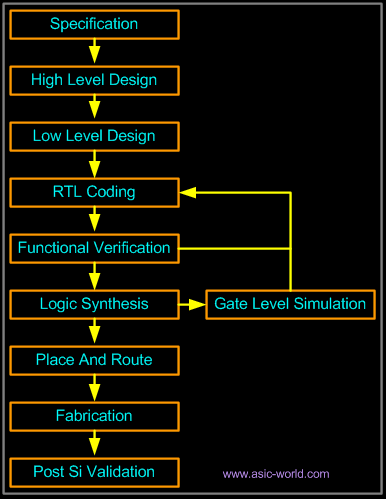
Verilog design cycle
- Specifications (specs)
- High level design
- Low level (micro) design
- RTL coding
- Verification
- Synthesis.
Module
Ports
input clock;
output s0;
inout[7:0] a0;
wire and reg
wire: 두 포인트를 연결하나 값 저장 x
reg: 값을 저장가능.
if-else
if (enable == 1'b1) begin
data = 10; // Decimal assigned
address = 16'hDEAD; // Hexadecimal
wr_enable = 1'b1; // Binary
end else begin
data = 32'b0;
wr_enable = 1'b0;
address = address + 1;
end
case
case(address)
0 : $display ("It is 11:40PM");
1 : $display ("I am feeling sleepy");
2 : $display ("Let me skip this tutorial");
default : $display ("Need to complete");
endcase
while
while (free_time) begin
$display ("Continue with webpage development");
end
for
for (i = 0; i < 16; i = i +1) begin
$display ("Current value of i is %d", i);
end
Repeat
repeat (16) begin
$display ("Current value of i is %d", i);
i = i + 1;
end
Initial blocks
initial begin
clk=0;
reset=0;
end
Always blocks
initial block과 다르게 한 번만 실행됨. @로 언제 실행할 지 알림. wire타입은 쓸 수 없다.
always @(a or b or sel) //sensitive list
begin
y=0;
if(sel==0) begin
y=a;
and else begin
y=b;
end
end
위 코드는 2:1 mux 코드이다. always block안의 코드들은 입력이 바뀔 때마다 실행되어야한다. 입력은 sensitive list 안의 변수들을 의미한다.
sensitive list에는 level sensitive와 edge sensitive가 있다
always @(posedge clk)
if(reset==0) begin
y<= 0;
end else if(sel==0) begin
y<= a;
end else begin
y<= b;
end
sequential block은 <=를 쓰고, comvinational block은 =을 쓴다.
Assign Statement
combinational logic에만 쓰인다
assign out= (enable)? data : 1'bz;
Function and Tasks
task는 delay를 가질 수 있고, function은 아니다.