
주요 학습내용
알고리즘 문제풀이(02)
1. 최댓값/최솟값 알고리즘
2. 최빈값 알고리즘
3. 근삿값 알고리즘
4. 평균 알고리즘
I. 최댓값/최솟값 알고리즘
1. 최댓값 알고리즘(개별)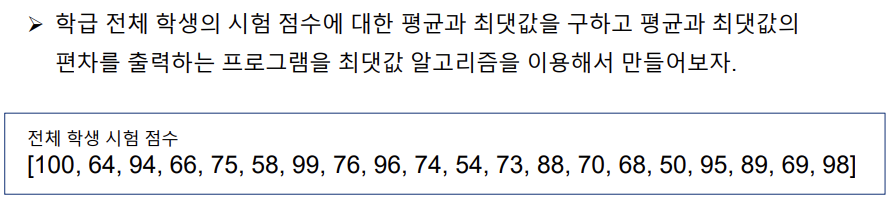
1) 모듈 생성(mod)
def getAvg(ns):

    total = 0
    for n in ns:
        total += n
    avg = round(total / len(ns), 2)
    return avg

# 2) 최댓값 get
def getMaxScore(ns):

    maxScore = ns[0]  # 첫번째 인덱스 값으로 초기화 해줌
    for n in ns:
        if maxScore < n:
            maxScore = n
    return maxScore

def getDeviation(n1, n2):

    # 방법 1) 강의 자료
    return round(abs(n1 - n2), 2)

# def getDeviation(ns):
    # 방법 2)
    # dev = round(getMaxScore(ns) - getAvg(ns), 2)
    # return dev
2) 문제풀이
import mod

scores = [100, 64, 94, 66, 75, 58, 99, 76, 96, 74,
          54, 73, 88, 70, 68, 50, 95, 89, 69, 98]

scores_avg = mod.getAvg(scores)
score_max = mod.getMaxScore(scores)
score_dev = mod.getDeviation(score_max, scores_avg)
print(f'scores_avg: {scores_avg}')
print(f'score_max: {score_max}')
print(f'score_dev: {score_dev}')
출력 결과 :

2. 최솟값 알고리즘(개별)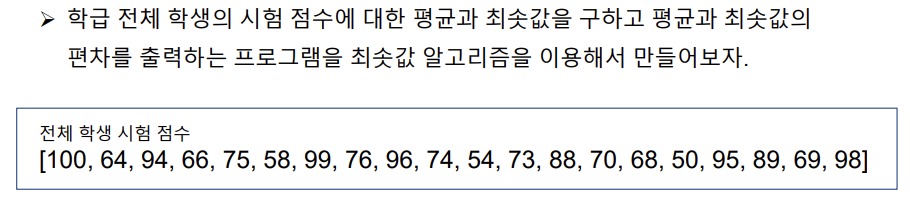
1) 모듈생성(minMod)
def getAvg(ns):

    total = 0
    for n in ns:
        total += n
    return round(total / len(ns), 2)

def getMinScore(ns):

    minScore = ns[0]  # 첫번째 인덱스 값으로 지정(순차적 비교)

    for n in ns:
        if minScore > n:
            minScore = n
    return minScore

def getDeviation(n1, n2):

    return round(abs(n1-n2), 2)
2) 문제풀이
import minMod
scores = [100, 64, 94, 66, 75, 58, 99, 76, 96, 74,
          54, 73, 88, 70, 68, 50, 95, 89, 69, 98]

# 방법 1) 개별 모듈
score_avg = minMod.getAvg(scores)
score_min = minMod.getMinScore(scores)
score_dev = minMod.getDeviation(score_avg, score_min)
print(f'score_avg: {score_avg}')
print(f'score_min: {score_min}')
print(f'score_dev: {score_dev}')
출력 결과 :

3. 클래스 생성(minMaxClass)
1) 클래스 생성
class ScoreManagement:

    def __init__(self, ss):
        self.scores = ss
        self.score_tot = 0
        self.score_avg = 0
        self.score_min = 0
        self.score_max = 0
        self.score_dev = 0

    def getMinScore(self):
        # 1)
        if self.scores == None or len(self.scores) == 0:  # if, 아직 초기화가 안된 경우
            return None

        self.score_min = self.scores[0]  # 0번째 인덱스를 기준으로 시작
        # self.scores가 있을 경우에만 사용할 수 있으므로, 위 첫번째(#1) 항목 넣어줌

        for n in self.scores:
            if self.score_min > n:
                self.score_min = n
        return self.score_min

    def getMaxScore(self):
        if self.scores == None or len(self.scores) == 0:  # if, 아직 초기화가 안된 경우
            return None

        self.score_max = self.scores[0]  # 0번째 인덱스를 기준으로 시작

        for n in self.scores:
            if self.score_max < n:
                self.score_max = n
        return self.score_max

    def getTotalScore(self):
        if self.scores == None or len(self.scores) == 0:  # if, 아직 초기화가 안된 경우
            return None

        self.score_tot = 0

        for n in self.scores:
            self.score_tot += n

        return self.score_tot

    def getAvgScore(self):
        if self.scores == None or len(self.scores) == 0:  # if, 아직 초기화가 안된 경우
            return None

        self.score_avg = round(self.getTotalScore() / len(self.scores), 2)
        return self.score_avg

    def getMaxDeviation(self):

        result = round(abs(self.getAvgScore()-self.getMaxScore()), 2)
        return result

    def getMinDeviation(self):

        result = round(abs(self.getAvgScore() - self.getMinScore()), 2)
        return result
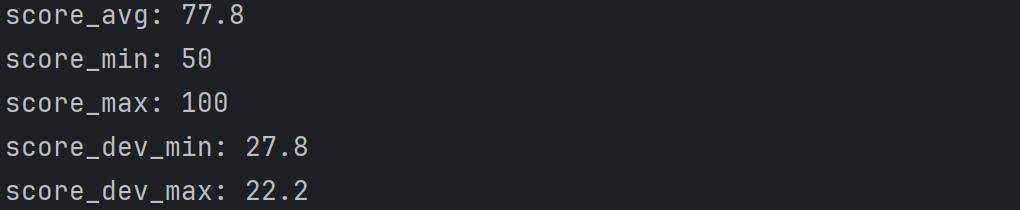
2) 문제풀이
import minMaxClass as mmc
scores = [100, 64, 94, 66, 75, 58, 99, 76, 96, 74,
          54, 73, 88, 70, 68, 50, 95, 89, 69, 98]

sm = mmc.ScoreManagement(scores)
score_avg = sm.getAvgScore()
score_min = sm.getMinScore()
score_dev_min = sm.getMinDeviation()
score_max = sm.getMaxScore()
score_dev_max = sm.getMaxDeviation()

print(f'score_avg: {score_avg}')
print(f'score_min: {score_min}')
print(f'score_max: {score_max}')
print(f'score_dev_min: {score_dev_min}')
print(f'score_dev_max: {score_dev_max}')
출력 결과 :
II. 최빈값 알고리즘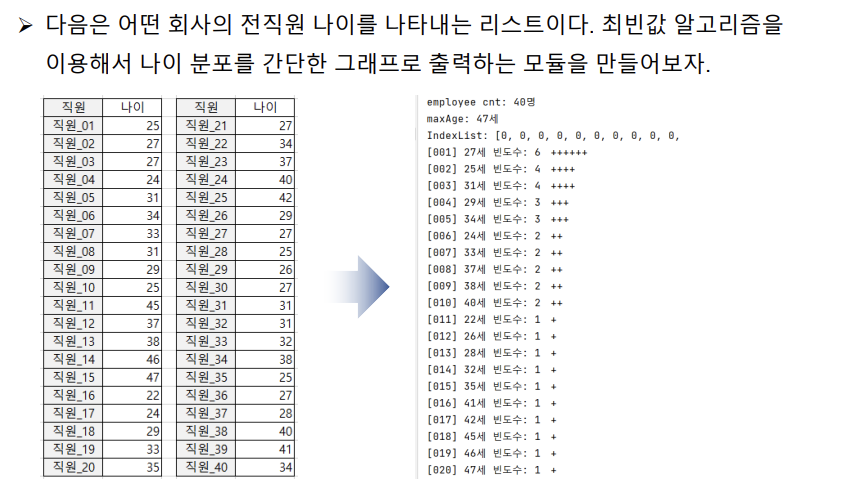
1) 클래스 생성(최댓값 구하기/maxMod)
class MaxAlgorithm:

    def __init__(self, ns):
        self.nums = ns
        self.maxNum = 0
        self.maxNumIdx = 0

    def setMaxIdxAndNum(self):

        self.maxNum = self.nums[0]  # 인덱스 0번째부터 순차적으로

        for idx, n in enumerate(self.nums):
            if self.maxNum < n:
                self.maxNum = n
                self.maxNumIdx = idx

    def getMaxNum(self):
        return self.maxNum

    def getMaxNumIdx(self):
        return self.maxNumIdx
2) 모듈 생성(modeMod)
import maxMod

class ModeAlgorithm:

    def __init__(self, ns, mn):
        self.nums = ns
        self.maxNum = mn
        self.indexes = []

    def setIndexList(self):

        self.indexes = [0 for i in range(self.maxNum + 1)]
        # +1안해도 47개인데 왜 +1?
        # 0세 x => 0부터 48번째까지

        for n in self.nums:
            self.indexes[n] += 1

    def getIndexList(self):
        # indexes가 초기화가 안된 경우를 대비하여 아래 구문 추가
        if sum(self.indexes) == 0:
            return None
        else:
            return self.indexes

    def printAges(self):

        n = 1
        while True:

            maxAlo = maxMod.MaxAlgorithm(self.indexes)
            # 인덱스리스트에서 가장 큰 값부터 출력
            maxAlo.setMaxIdxAndNum()
            maxNum = maxAlo.getMaxNum()
            maxNumIdx = maxAlo.getMaxNumIdx()  # self.indexes에서는 최빈값 n

            # 아직 초기화가 안됐을 경우,
            if maxNum == 0:
                break
                n += 1
            print(f'{n:0>3} {maxNumIdx}세 빈도수: {maxNum} \t', end='')
            # n:0>3 => 총 3자리로 맞추고, 오른쪽 정렬, 비어있는 자리 = 0
            print('+' * maxNum)
            self.indexes[maxNumIdx] = 0

            n += 1  # 무한루프에 빠지지 않기 위해 추가
3) 문제풀이
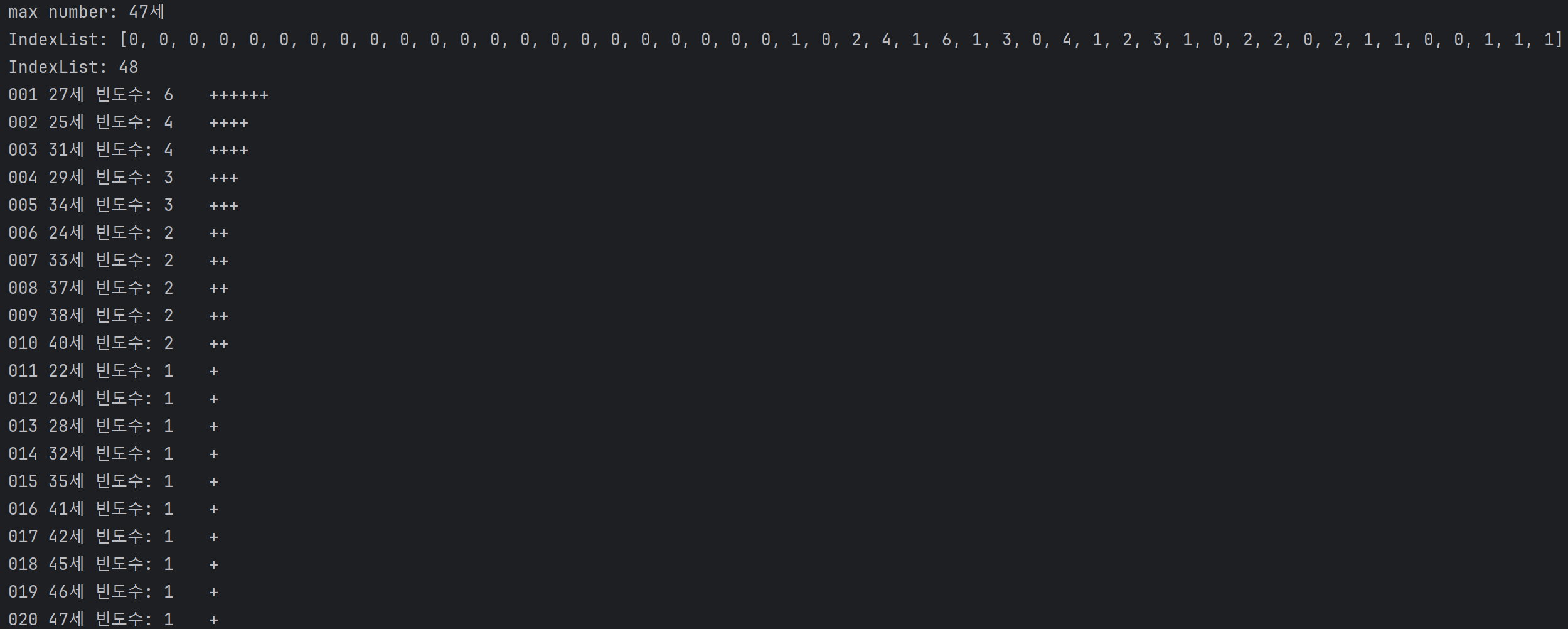
import modeMod
import maxMod
ages =[25, 27, 27, 24, 31, 34, 33, 31, 29, 25, 45,
       37, 38, 46, 47, 22, 24, 29, 33, 35, 27, 34,
       37, 40, 42, 29, 27, 25, 26, 27, 31, 31, 32,
       38, 25, 27, 28, 40, 41, 34]
print(f'employee cnt: {len(ages)}명')

# 최댓값 구하기
mm = maxMod.MaxAlgorithm(ages)
mm.setMaxIdxAndNum()
maxAge = mm.getMaxNum()
print(f'max number: {maxAge}세')

# 최빈값 구하기
modem = modeMod.ModeAlgorithm(ages, maxAge)
modem.setIndexList()
print(f'IndexList: {modem.getIndexList()}')
print(f'IndexList: {len(modem.getIndexList())}')

result = modem.printAges()
출력 결과 :
III. 근삿값 알고리즘
1) 클래스 생성(nearMod)
class BmiAlgorithm:

    def __init__(self, w, h):

        self.BMISection = {18.5: ['저체중', '정상'],
                           23: ['정상', '과체중'],
                           25: ['과체중', '비만']}
        self.weight = w
        self.height = h
        self.bmi = 0  # 몸무게 / 키^2
        self.condition = ''  # 최종적으로 결과 출력
        self.nearNum = 0
        self.minNum = 25  # 최댓값으로 우선 설정 후 비교해감

    def calculatorBMI(self):

        self.bmi = round(self.weight/(self.height*self.height), 2)
        print(f'self.userBMI: {self.bmi}')

    def printUserCondition(self):

        for n in self.BMISection.keys():
            absNum = abs(n - self.bmi)

            if self.minNum > absNum:
                self.minNum = absNum
                self.nearNum = n

        print(f'self.nearNum: {self.nearNum}')

        if self.bmi <= self.nearNum:
            self.condition = self.BMISection[self.nearNum][0]
        else:
            self.condition = self.BMISection[self.nearNum][1]

        print(f'self.user condition: {self.condition}')
2) 문제풀이
import nearMod

uWeight = float(input('input weight(kg): '))
uHeight = float(input('input height(m): '))

nr = nearMod.BmiAlgorithm(uWeight, uHeight)
nr.calculatorBMI()
nr.printUserCondition()
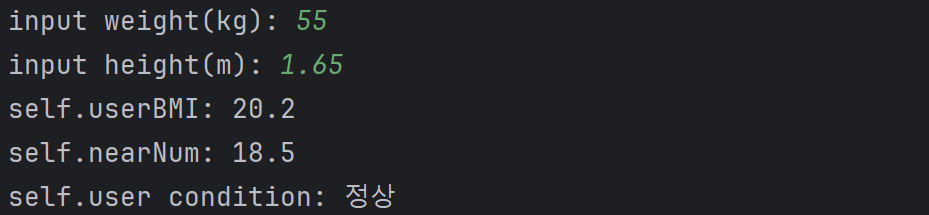
출력 결과 :
IV. 평균 알고리즘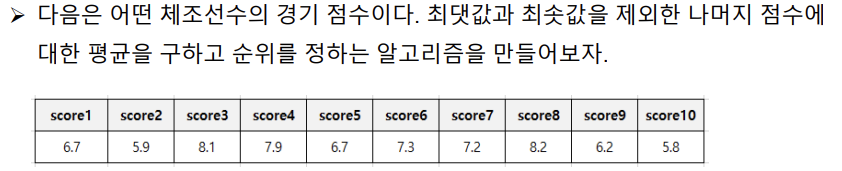
1) 클래스 생성①(maxAlgorithm)
class MaxAlgorithm:

    def __init__(self, ss):
        self.scores = ss
        self.maxScores = 0
        self.maxIdx = 0

    def removeMaxScore(self):

        self.maxScores = self.scores[0]  # 첫번째 인덱스 값으로 설정

        for idx, n in enumerate(self.scores):
            if self.maxScores < n:
                self.maxScores = n
                self.maxIdx = idx
        print(f'self.maxScores: {self.maxScores}')
        print(f'self.maxIdx: {self.maxIdx}')

        self.scores.pop(self.maxIdx)
        print(f'self.scores: {self.scores}')
2) 클래스 생성②(minAlgorithm)
class MinAlgorithm:

    def __init__(self, ss):
        self.scores = ss
        self.minScores = 0
        self.minIdx = 0

    def removeMinScore(self):

        self.minScores = self.scores[0]  # 첫번째 인덱스 값으로 설정

        for idx, n in enumerate(self.scores):
            if self.minScores > n:
                self.minScores = n
                self.minIdx = idx
        print(f'self.minScores: {self.minScores}')
        print(f'self.MinIdx: {self.minIdx}')

        self.scores.pop(self.minIdx)
        print(f'self.scores: {self.scores}')
3) 클래스 생성③(nearAlgorithm)
class Top5Players:

    def __init__(self, cts, ns):
        self.currentScores = cts
        self.newScore = ns

    def setAlignScore(self):  # 재정렬하는 함수 만들어줌
        nearIdx = 0
        minNum = 10.0  # 최고점으로 설정

        for idx, n in enumerate(self.currentScores):
            absNum = abs(self.newScore - n)
            if absNum < minNum:
                minNum = absNum
                nearIdx = idx

        # 왼/오 어느쪽으로 삽입할 지 check
        if self.newScore >= self.currentScores[nearIdx]:
            for i in range(len(self.currentScores)-1, nearIdx, -1):
                self.currentScores[i] = self.currentScores[i-1]
            self.currentScores[nearIdx] = self.newScore
        else:
            for i in range(len(self.currentScores)-1, nearIdx+1, -1):
                self.currentScores[i] = self.currentScores[i-1]
            self.currentScores[nearIdx+1] = self.newScore

    def getFinalTop5Score(self):
        return self.currentScores
4) 문제풀이
import maxAlgorithm as mx
import minAlgorithm as mn
import nearAlgorithm as nr
top5Scores = [9.12, 8.95, 8.12, 6.9, 6.18]
scores = [6.7, 5.9, 8.1, 7.9, 6.7, 7.3, 7.2, 8.2, 6.2, 5.8]

maxA = mx.MaxAlgorithm(scores)
maxA.removeMaxScore()
minA = mn.MinAlgorithm(scores)
minA.removeMinScore()

total = 0
avg = 0

for n in scores:
    total += n
total = round(total, 2)

avg = round(total / len(scores), 2)

print(f'total: {total}')
print(f'average: {avg}')

# 근사값 알고리즘 사용하여 가장 가까운 값 옆에 넣어주기
tp = nr.Top5Players(top5Scores, avg)
tp.setAlignScore()
top5Scores = tp.getFinalTop5Score()
print(f'top5Scores: {top5Scores}')
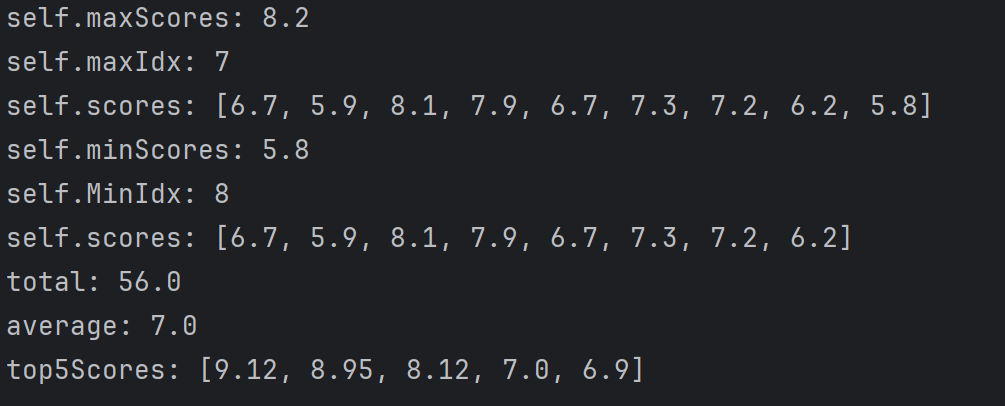
출력 결과 :

할 거면 제대로 하자