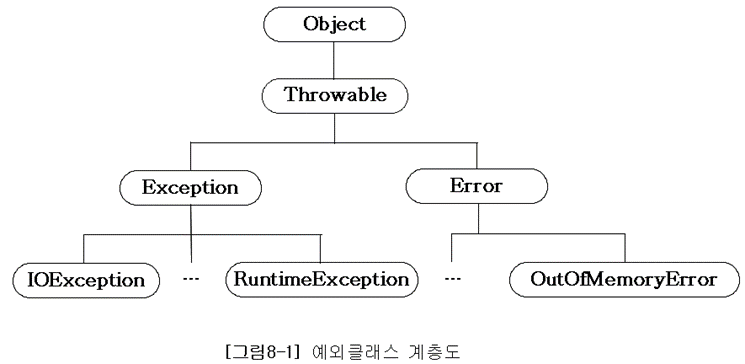
1. 자바 예외 클래스 계층 구조.
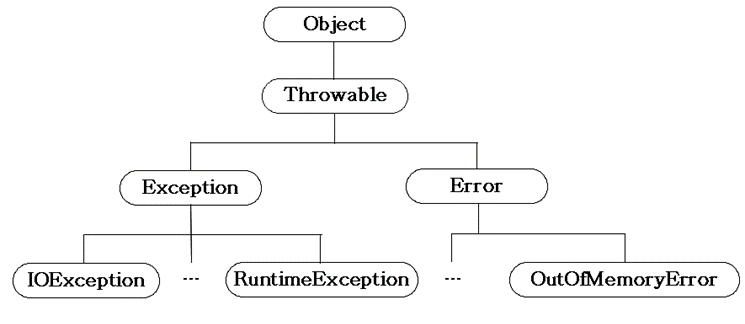
2. 매개변수가 1개인 생성자.
public class RuntimeException extends Exception {

			....


    /** Constructs a new runtime exception with the specified detail message.
     * The cause is not initialized, and may subsequently be initialized by a
     * call to {@link #initCause}.
     *
     * @param - message the detail message. The detail message is saved for
     * later retrieval by the {@link #getMessage()} method.
     */
    public RuntimeException(String message) {
        super(message);
    }


			...
}-
message만 매개변수로 받아서 부모 생성자를 호출하는
super()에 전달해줌. -
RuntimeException은
Exception을 상속 받고 있으므로 Exception의 생성자가 호출됨.
public class Exception extends Throwable {
			....


    public Exception(String message) {
        super(message);
    }

    		....
}- Exception의 생성자를 호출하는데 여기서도 마찬가지로 super()가 사용되고 있음.
- Exception은
Throwable을 상속 받고 있으므로 Throwable의 생성자가 호출됨.
public class Throwable implements Serializable {
    private transient Object backtrace;
    private String detailMessage;

    private static class SentinelHolder {
        public static final StackTraceElement STACK_TRACE_ELEMENT_SENTINEL =
            new StackTraceElement("", "", null, Integer.MIN_VALUE);
        public static final StackTraceElement[] STACK_TRACE_SENTINEL =
            new StackTraceElement[] {STACK_TRACE_ELEMENT_SENTINEL};
    }

    private static final StackTraceElement[] UNASSIGNED_STACK = new StackTraceElement[0];

    private Throwable cause = this;
    private StackTraceElement[] stackTrace = UNASSIGNED_STACK;

            ....

    public Throwable() {
        fillInStackTrace();
    }

    public Throwable(String message) {
        fillInStackTrace();
        detailMessage = message;
    }

    		....


    public String getMessage() {
        return detailMessage;
    }


    		....

}
- 결국 RuntimeException의 조상의 조상인 Throwable의 생성자를 호출한 꼴.
- 전달 받은 message는 Throwable의
detailMessage에 저장됨.
- 전달 받은 message는 Throwable의
2-1. Ex.
class MyCustomException extends RuntimeException {
    public MyCustomException(String message) {
        super(message);
}↑위와 같은 형식으로RuntimeException을 상속받아서 많이 사용함.
public class temp3 {
    public static void main(String[] args) {
        try {
            int[] numbers = {1, 2, 3};
            int value = numbers[5]; // ArrayIndexOutOfBoundsException
        } catch (ArrayIndexOutOfBoundsException e) {
            throw new MyCustomException("배열 인덱스 오류");
        }
    }
}
-- 실행 결과 --
Exception in thread "main" com.java.fm.alrorithm.MyCustomException: 배열 인덱스 오류
at com.java.fm.alrorithm.temp3.main(temp3.java:9)생성자중매개변수가 1개인걸 사용하게 되면 위처럼예외 메시지만 출력될 뿐.원래 발생한 예외에 대한 정보는 없음.
3. 매개변수가 2개인 생성자.
public class RuntimeException extends Exception {

			....


    /**
     * Constructs a new runtime exception with the specified detail message and
     * cause.  <p>Note that the detail message associated with
     * {@code cause} is <i>not</i> automatically incorporated in
     * this runtime exception's detail message.
     *
     * @param  message the detail message (which is saved for later retrieval
     *         by the {@link #getMessage()} method).
     * @param  cause the cause (which is saved for later retrieval by the
     *         {@link #getCause()} method).  (A {@code null} value is
     *         permitted, and indicates that the cause is nonexistent or
     *         unknown.)
     * @since  1.4
     */
    public RuntimeException(String message, Throwable cause) {
        super(message, cause);
    }


			....
}- message와 발생 원인(cause)을 매개변수로 받아서 부모 생성자를 호출하는 super()에 전달해줌.
Throwable cause는 이 예외가 왜 발생했는지에 대한 근본적인 원인을 담고 있는 객체.
- RuntimeException은 Exception을 상속 받고 있으므로 Exception의 생성자가 호출됨.
public class Exception extends Throwable {
			....


    public Exception(String message, Throwable cause) {
        super(message, cause);
    }

    		....
}- Exception의 생성자를 호출하는데 여기서도 마찬가지로 super()가 사용되고 있음.
- Exception은
Throwable을 상속 받고 있으므로 Throwable의 생성자가 호출됨.
public class Throwable implements Serializable {
    private transient Object backtrace;
    private String detailMessage;

			....

    private Throwable cause = this;

            ....

    public Throwable() {
        fillInStackTrace();
    }

    public Throwable(String message, Throwable cause) {
        fillInStackTrace();
        detailMessage = message;
        this.cause = cause;
    }

    		....


    public String getMessage() {
        return detailMessage;
    }

    public synchronized Throwable getCause() {
        return (cause==this ? null : cause);
    }

    		....

}
- 결국 RuntimeException의 조상의 조상인 Throwable의 생성자를 호출한 꼴.
- 전달 받은 message, cause는 Throwable의 멤버필드인
detailMessage,cause에 저장됨.
- 전달 받은 message, cause는 Throwable의 멤버필드인
3-1. Ex.
class MyCustomException extends RuntimeException {
    public MyCustomException(String message, Throwable cause) {
        super(message, cause);
    }
}
public class temp3 {
public static void main(String[] args) {
try {
int[] numbers = {1, 2, 3};
int value = numbers[5]; // ArrayIndexOutOfBoundsException
} catch (ArrayIndexOutOfBoundsException e) {
throw new MyCustomException("배열 인덱스 오류", e); // cause 포함
}
}
]-- 실행 결과 --
Exception in thread "main" com.java.fm.alrorithm.MyCustomException: 배열 인덱스 오류
at com.java.fm.alrorithm.temp3.main(temp3.java:18)
Caused by: java.lang.ArrayIndexOutOfBoundsException: Index 5 out of bounds for length 3
at com.java.fm.alrorithm.temp3.main(temp3.java:16)- 위처럼 매개변수가 2개인 생성자를 사용하게 되면
예외 메시지뿐만 아니라원인 예외(cause)까지 출력할 수 있음.

Every cloud has a silver lining.ㅤㅤㅤㅤㅤㅤㅤㅤㅤhttps://www.instagram.com/ha_jju