Thread를 공부하던 중에 Lock이라는 요소가 중요하다. 이 부분에 대해 더 깊게 공부하고자 정리해보고자 한다.
Lock이란?
동시에 여러 쓰레드가 같은 자원에 접근하는 것을 제한하여 데이터의 일관성과 무결성을 유지하는데 사용되는 도구이다. java에서 java.util.concurrent.locks에서 여러 타입의 Lock을 제공한다. 동기화의 더 유연한 형태를 제공하는 장점이 있다.
Lock 사용방법
- Lock 획득:
lock()메서드를 호출하여 Lock을 획득한다. - Critical section: Lock을 획득한 후, 공유 자원에 접근하는 코드를 실행
- Lock 해제:
unlock()메서드를 호출하여 Lock을 해제한다. 이 부분은 반드시 finally 블록 안에 수행되어야만 함
vs Synchronized
- 유연성: Lock는
tryLock()메서드를 제공함으로써 Lock을 얻을 수 없을 떄 다른 작업을 수행할 수 있는 유연성을 제공. - 재진입 가능: ReentrantLock은 이름에서 알 수 있듯이, 재진입이 가능
ReentrantLock
- Lock 인터페이스를 구현한 클래스로 재진입이 가능한 Lock이다.
- 한 쓰레드가 이미 Lock을 보유하고 있는 경우, 해당 쓰레드는 Lock을 다시 획득 할 수 있음.
-
필요한 경우
- 재귀 함수: 재귀 함수에서 Lock을 획득하고 해제하는 경우, 재진입 가능하지 않다면 같은 쓰레드 내에서도 Lock을 다시 획득할 수 없게 되므로 DeadLock이 발생할 수있다.
- 복잡한 메서드 호출 구조: 하나의 큰 연산을 여러 메서드로 분할하여 구현하는 경우, 공유 자원을 접근해야 하는데, 재진입을 할수 없다면 DeadLock과 같은 문제가 발생할 수 있다.
- 확장성: 코드의 확장성을 향상시킬 수 있다. 메서드나 블록이 이미 Lock을 획득한 상태에서도 안전한 다른 메서드나 코드 볼록을 호출할 수 있다.
-
소스코드
public class ThreadTest { private final Lock lock = new ReentrantLock(); private int count = 0; public int getCount() { return count; } public void increment() { lock.lock(); // Lock을 획득 try { count++; // critical section } finally { lock.unlock(); // Lock을 해제 } } @Test public void test(){ ThreadTest example = new ThreadTest(); Thread t1 = new Thread(() -> { for (int i = 0; i < 10000; i++) { example.increment(); } }); Thread t2 = new Thread(() -> { for (int i = 0; i < 10000; i++) { example.increment(); } }); t1.start(); t2.start(); try { t1.join(); t2.join(); } catch (InterruptedException e) { e.printStackTrace(); } System.out.println("Count: " + example.getCount()); // Should print 2000 } } -
출력
- Lock을 설정했을 경우
Count: 20000 - Lock을 설정하지 않았을 경우
Count: 13705 // 값이 계속 바뀐다
ReentrantReadWriteLock
- Write Lock, Read Lock을 분리하여 관리한다. 여러 쓰레드가 동시에 Read를 수행할 수 있지만, Write 작업은 한 번에 하나의 쓰레드만 수행가능하다.
-
필요한 경우
- Read 작업이 Write 작업보다 빈번히 발생하고, Read 작업 간에는 동시성을 허용해야 하는 경우
-
소스코드
public class ThreadTest { class ReadWriteLockExample { private final ReadWriteLock rwLock = new ReentrantReadWriteLock(); private int data; public void write(int newData) { rwLock.writeLock().lock(); try { data = newData; } finally { rwLock.writeLock().unlock(); } } public int read() { rwLock.readLock().lock(); try { return data; } finally { rwLock.readLock().unlock(); } } } @Test public void test() { ReadWriteLockExample example = new ReadWriteLockExample(); // Write Thread thread1 = new Thread(() -> example.write(42)); thread1.start(); try { thread1.join(); } catch (InterruptedException e) { e.printStackTrace(); } // Read Thread thread2 = new Thread(() -> { int value = example.read(); System.out.println("Read Value: " + value); }); thread2.start(); } } -
출력
Read Value: 42
- Lock을 설정했을 경우
StampedLock
- Read와 Write Lock을 제공하는 동시에, 더 가벼운 “Optimistic Lock”모드를 지원한다.
- Write또는 Write Lock 모드에서 서로 변경 가능하다.
- Upgrade: Read Lock → Write Lock
- Downgrade: Write Lock → Read Lock
-
필요한 경우
- Write작업이 많고, 데이터의 변경 빈도가 낮은 상황에서 높은 동시성을 유지해야 하는 경우
- Non-Blocking 알고리즘과 함께 사용되는 경우
-
소스코드
public class ThreadTest { class StampedLockExample { private final StampedLock stampedLock = new StampedLock(); private int balance; public void deposit(int amount) { long stamp = stampedLock.writeLock(); try { balance += amount; } finally { stampedLock.unlockWrite(stamp); } } public int getBalance() { long stamp = stampedLock.tryOptimisticRead(); int b = balance; if (!stampedLock.validate(stamp)) { stamp = stampedLock.readLock(); try { b = balance; } finally { stampedLock.unlockRead(stamp); } } return b; } } @Test public void test() { StampedLockExample example = new StampedLockExample(); // Deposit Thread thread1 = new Thread(() -> example.deposit(100)); thread1.start(); try { thread1.join(); } catch (InterruptedException e) { e.printStackTrace(); } // Read Balance Thread thread2 = new Thread(() -> { int balance = example.getBalance(); System.out.println("Balance: " + balance); }); thread2.start(); } } -
출력
Balance: 100
Semaphore
- 동시에 접근할 수 있는 쓰레드의 최대 허용 수를 제한한다.
-
필요한 경우
- 동시 접근 수를 제한해야 하는 경우(N개)
-
소스코드
public class ThreadTest { @Test public void accessResource() { int numberOfPermits = 2; // 동시에 접근할 수 있는 허용 횟수 Semaphore semaphore = new Semaphore(numberOfPermits); Runnable task = () -> { try { semaphore.acquire(); // 세마포어로부터 허가를 얻음 System.out.println(Thread.currentThread().getName() + " acquired the semaphore."); // 공유 자원에 대한 작업 수행 Thread.sleep(2000); // 잠시 대기 System.out.println(Thread.currentThread().getName() + " released the semaphore."); } catch (InterruptedException e) { e.printStackTrace(); } finally { semaphore.release(); // 세마포어를 해제하여 다른 스레드가 접근할 수 있도록 함 } }; // 여러 스레드 생성 및 실행 Thread thread1 = new Thread(task, "Thread 1"); Thread thread2 = new Thread(task, "Thread 2"); Thread thread3 = new Thread(task, "Thread 3"); thread1.start(); thread2.start(); thread3.start(); } } -
출력
Thread 1 acquired the semaphore.
Thread 2 acquired the semaphore.
Optimistic Locking vs Pessimistic Locking
앞서 언급한 StampedLock 언급한 Optimistic Locking에 대해서 설명하고자 한다. 그런 김에 상반된 개념인 Pessismistic Locking에 대해도 알아보고자 한다.
-
Optimistic Locking (낙관적 락)
- 동시에 여러 쓰레드나 프로세스가 자원에 접근하는 것을 허용하며, 충돌이 발생하는 것을 예상하지 않음
- 자원을 읽을 때는 Lock을 걸지 않거나 매우 짧게 사용하고, 자원을 변경하기 전에 해당 자원의 상태를 확인. → version number 또는 Timestamp 등과 같은 메타데이터로 확인
- 변경 작업 쓰레드가 완료 된 후, 다른 쓰레드가 해당 데이터를 읽을 때 충돌이 발생하는 지 감지한다. → 충돌이 발생한다면 해결하거나 Rollback을 하여 일관성 유지
-
Pessimistic Locking (비관적 락)
- 데이터를 변경할 때 즉시 Lock을 획득
- 데이터의 일관성과 무결성을 보장
- 주로 RDBMS에 사용된다. → 트랜잭션에서 Lock을 사용함으로써 데이터 일관성을 유지
Optimistic Locking Pessimistic Locking Lock 획득 시기 데이터 변경 시 미리 Lock 을 획득 데이터 변경 시 미리 Lock 을 획득 동시성 높음(다른 사용자와 동시 접근) 낮음(다른 사용자가 대기) Lock 유지 시간 없음 Lock 기간 충돌 감지 방법 데이터 변경 시 version 충돌 감지 데이터 변경 시 Lock 해제 방법 데이터 변경 시 version 증가 데이터 변경 후 장점 Lock없이 동시 접근 가능, 충돌 감지 Lock 획득 시 데이터 안전 보장 단점 version 충돌 발생 가능성 성능 저하, 대기 시간 발생 사용 분야 트래픽이 많고 Lock 충돌 가능성 낮은 시스템 금융, 예약 시스템 등 안정성 중시
DeadLock
Lock에서 빠질 수 없는 개념인 DeadLock이라는 요소를 알아보고자 한다.
- 동시성 프로그래밍에서 발생하는 상황 중 하나로, 다수의 프로세스 또는 쓰레드가 상대방의 작업이 끝나기를 기다리며 진행하지 못하는 상태
- 충족 조건
- 상호 배제(Mutual Exclusion): 자원은 한 번에 하나의 프로세스 또는 쓰레드만 사용할 수 있어야 함
- 점유 대기(Hold & Wait): 프로세스나 쓰레드는 이미 보유한 자원을 가진 채 다른 자원을 얻기 위해 대기
- 비선점(No Preemption): 다른 프로세스나 쓰레드가 이미 보유한 자원을 강제로 뺐을 수 없음
- 순환 대기(Circular Wait): 여러 프로세스 또는 쓰레드 간에 자원을 순환적으로 대기하고 있는 상태
- 예방 및 해결
- 예방
- 상호배제 제거: 여러 프로세스가 공유 자원 사용
- 점유 대기 부정: 프로세스 실행 전 모든 자원을 할당
- 우선순위 설정: 자원을 점유 중인 프로세스가 다른 자원을 요구할 떄 가진 자원을 반납
- 순환대기 부정: 자원에 고유 번호를 할당한 후에 순서대로 자원을 요청
- 회피
- 은행원 알고리즘(Banker's Algorithm)
- 은행에서 모든 고객의 요구가 충족되도록 현금을 할당하는 것에서 유래
- Maximum Demand(최대 요구량): 각 자원 유형의 최대 가용 가능 자원 수를 미리 알고 있어야 함
- 프로세스가 자원을 요청할 때, 시스템은 해당 자원을 할당하고도 DeadLock이 발생하지 않는 지 확인
- 요청한 자원을 프로세스에게 할당할 수 없다면 대기 상태로 전환
- 다른 프로세스가 자원을 반납하면, 대기 중인 프로세스에게 해당 자원을 할당할 수 있게 됨
- 장점; DeadLock를 방지하면서도 자원을 최대한 효율적으로 사용
- 단점: Maximum Demand를 미리 알고 있어야 하므로 실제 상황에서 적용하기 어려운 경우도 있음
- 은행원 알고리즘(Banker's Algorithm)
- Detection & Recovery
- Detection : DeadLock이 발생하면 이를 탐지하고 복구하기 위한 알고리즘을 사용→ 탐지 된 DeadLock상태에서 프로세스를 종료하거나 자원을 해제하는 방법을 적용
- Recovery: 탐지 된 DeadLock 상태에서 프로세스를 종료하거나 자원을 해제하는 방법을 적용
- 예방
Philosopher's Dining Problem
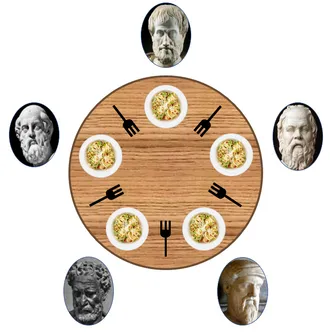
DeadLock을 이해하고 해결하기 위한 예제
- 다섯 명의 철학자가 원형 식탁에 앉아서 밥을 먹으며, 그 사이에는 다섯 개의 포크가 놓여있는 상황을 가정한다. 스파게티와 같은 면 요리이기 때문에 두 개의 포크가 필요하다. 각 철학자는 다음과 같은 행동을 반복
- 생각하기: 철학자는 자신의 머리를 생각으로 가득 채운다.
- 배고픈 상태: 철학자가 배고플 때, 그는 왼쪽 포크와 오른쪽 포크를 동시에 집으려고 시도한다.
- 먹기: 양손에 포크를 모두 들고 있을 경우, 철학자는 밥을 먹는다.
- 포만 상태: 먹은 후에 포크를 내려놓고 포만 상태가 된다.
- 문제점
- 모든 철학자가 왼쪾 포크를 집으려고 시도하면 더이상 어떤 철학자도 오른쪽 포크를 집을 수 없으므로 DeadLock이 발생한다.
- 해결방법
- 각 철학자와 젓가락에 고유한 아이디를 할당
- 포크를 나타내는 세마포어 또는 뮤텍스를 사용하여 포크를 획득하고 해제하는 과정을 동기화
- 철학자들이 순서를 일관되게 따르도록 메커니즘을 구현
결론
지금까지 Lock의 기본적인 개념부터 Java에서 사용하는 Lock관련 라이브러리들을 정리해봤다. 또 사용되는 개념인 낙관적 락 & 비관적 락, 발생할만한 문제인 DeadLock에 대해서 정리해보았다.
References

I'm not only a web developer.