UVM Testbench Architecture
Structure & data flow
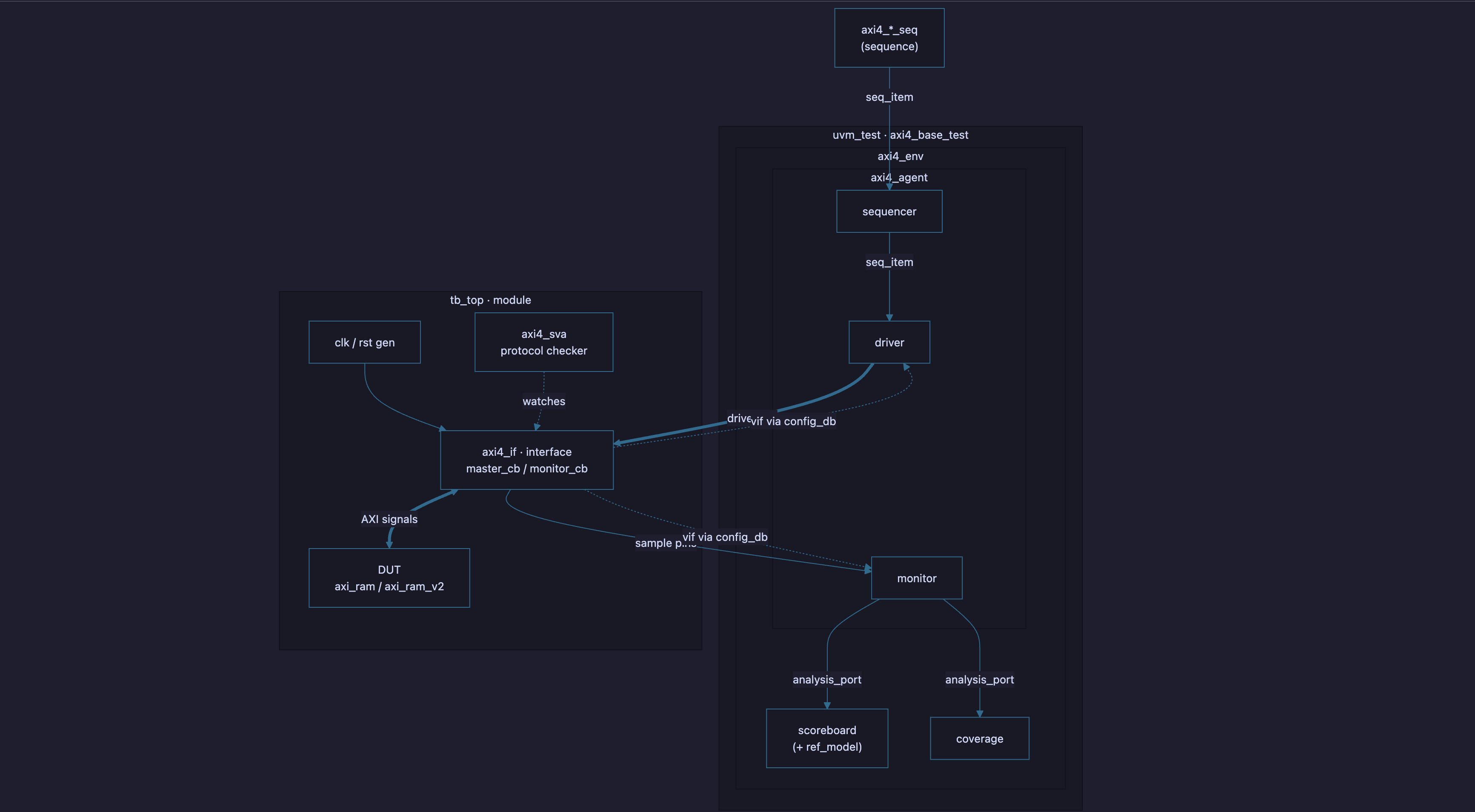
Solid arrows = the transaction data path. Dotted = setup (the virtual interface handed down through uvm_config_db) and the passive SVA checker.
Note the monitor's analysis port fans out 1→N: the same observed
transaction feeds both the scoreboard (is it correct?) and coverage (did we
exercise it?).
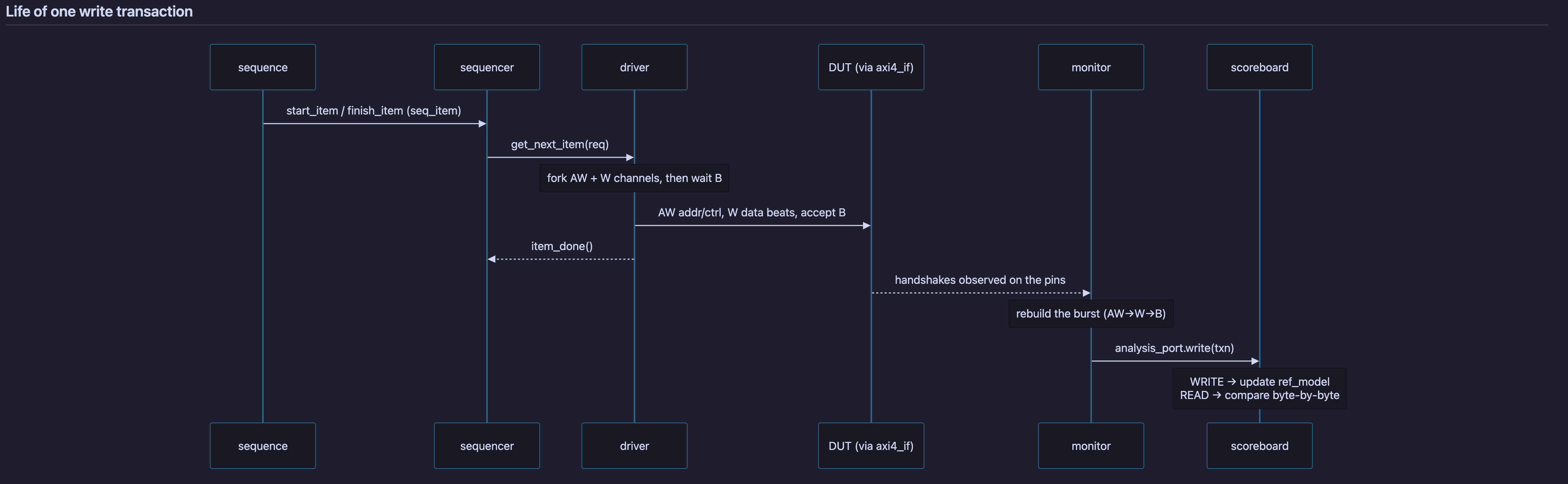
Life of one write transaction
Component responsibilities
| Component | Base class | Role |
|---|---|---|
axi4_seq_item | uvm_sequence_item | One AXI burst (write or read): addr/ctrl + data[]/strb[] + resp. Randomizable. |
axi4_agent_cfg | uvm_object | Knobs: the virtual interface handle + active/passive. |
axi4_sequencer | uvm_sequencer | Arbitrates sequences and hands items to the driver (a typedef). |
axi4_driver | uvm_driver | Pulls items from the sequencer and wiggles the AXI pins per protocol. |
axi4_monitor | uvm_monitor | Passively watches the pins, rebuilds transactions, broadcasts them. |
axi4_agent | uvm_agent | Container: sequencer + driver + monitor. Active drives; passive only watches. |
axi4_ref_model | uvm_object | Golden byte-granular memory. Models correct AXI addressing (incl. real WRAP) and write strobes. |
axi4_scoreboard | uvm_scoreboard | Subscribes to the monitor: writes update the model, reads are compared byte-by-byte against it. |
axi4_coverage | uvm_subscriber | Second monitor subscriber; samples the functional covergroup and prints a per-coverpoint report. |
axi4_env | uvm_env | Container for the agent + scoreboard + coverage. |
axi4_*_seq | uvm_sequence | Stimulus programs: what transactions to generate. |
axi4_base_test | uvm_test | Top of the hierarchy: builds env, wires cfg, launches a sequence. |
Key UVM mechanisms used
- Factory (
type_id::create+uvm_*_utils): objects/components are created
through a registry so tests can override types without editing the env. - Phases (
build_phase→connect_phase→run_phase): build top-down,
connect bottom-up, then run in parallel time-consuming threads. uvm_config_db: passes the virtual interface and the cfg object down the
hierarchy without hard-coded paths.- TLM:
- sequencer↔driver via
seq_item_port/seq_item_export
(get_next_item/item_done); - monitor→subscribers via
uvm_analysis_port(ap.write()).
- sequencer↔driver via
- Objections: the sequence/test raises an objection during
run_phaseso the
simulation stays alive until the stimulus is done, then drops it to finish.
AXI protocol notes baked into the driver/monitor
- Write: drive AW and W channels concurrently (
fork), because the DUT
only raiseswreadyafter it has acceptedAW. Collect B at the end. - Read: drive AR, then accept R beats until
rlast. - Handshake rule: hold
*valid+ payload stable until*readyis sampled high
on a rising clock edge. - DUT quirks:
bresp/rrespare hardwired toOKAY— the DUT can never report an error.WRAPbursts are treated likeINCR(address incremented linearly, never
wrapped). Confirmed by the Week 4 scoreboard — seeaxi4_wrap_test.
Checking strategy — why the WRAP bug needs an asymmetric test
A WRAP write followed by a WRAP read-back of the same region passes even
though the DUT is broken: the DUT is consistently wrong on both sides, so it
reads back from exactly the (wrong) addresses it wrote to, and the reference
model is consistently right on both sides. Both are self-consistent, so the data
agrees.
axi4_wrap_seq therefore writes with WRAP and reads the whole window back
with INCR, which reveals where the bytes physically landed:
WRAP write @0x0A08, 4 beats x 4B   (window 0x0A00..0x0A0F)
  correct : 0x0A08, 0x0A0C, 0x0A00, 0x0A04   <- wraps
  DUT     : 0x0A08, 0x0A0C, 0x0A10, 0x0A14   <- keeps incrementing
INCR read back over 0x0A00..0x0A0F
  -> 0x0A00 / 0x0A04 read as 0x00 from the DUT, mismatch vs. the model
General lesson: a self-consistent read-back can mask an addressing bug. Check
against an independent model, and cross-check with a different access pattern
than the one used to write.