implementing "ls"
Introduction
what is ls?
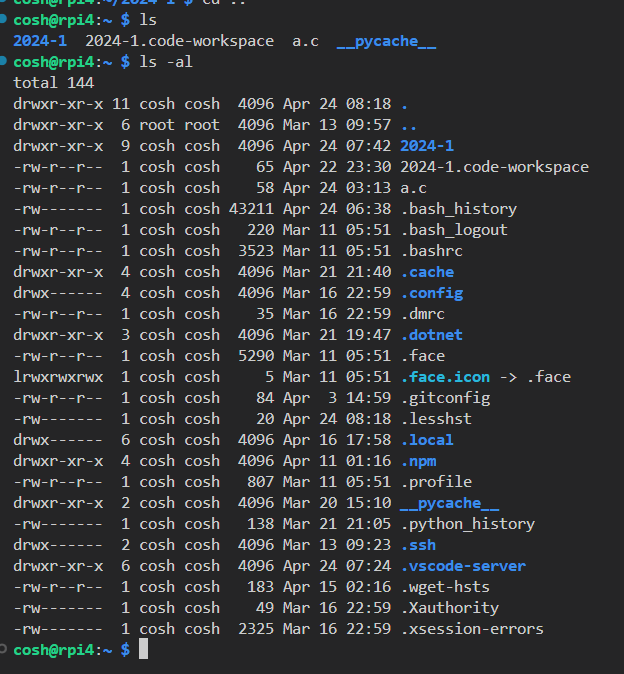
ls is program/instruction for linux which prints file list in directory or attributes(property) of each file.
Implementation
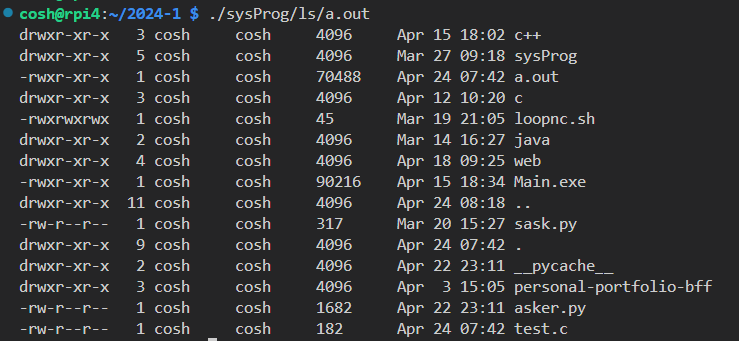
print format
it prints each information respectively
- filemode
- nlink (link count)
- owner name (uid in stat, should be converted to char *)
- group name (gid in stat, should be converted to char *)
- file size
- modified time
- file name
Required function / system calls
stat() : get metadata with file name.
getpwuid() : get struct passwd data with uid(integer).
getpwgid() : get struct passwd data with gid(integer).
ctime() : convert modified time with unix_time to timestamp.
Additional macro function
S_ISDIR() : check if it's directory. if true, modeStr[0] is 'd'.
S_ISCHR() : check if it's character device file. if true, modeStr[0] is 'c'.
S_ISBLK() : check if it's blcok device file. if true, modeStr[0] is 'b'.
flow (Roughly)
- get argument in reverse direction (the last argument is read first)
- if it can be opened with opendir, then open.
- get stat
- with stat data, make modeStr and uid, gid name
- print respectively.
Additional Constant
Constant for file mode
1. owner : S_I [R/W/X] USR
1. group : S_I [R/W/X] GRP
1. others : S_I [R/W/X] OTH
print form

개발자지망생