
import java.util.*;

class Solution {
    public int networkDelayTime(int[][] times, int n, int k) {
        Map<Integer, List<int[]>> edges = Arrays.stream(times)
            .collect(Collectors.groupingBy(t -> t[0]));
        int[] visited = new int[n+1];
        Arrays.fill(visited, Integer.MAX_VALUE);
        Queue<int[]> pq = new PriorityQueue<>((e1, e2) -> e1[1] - e2[1]);
        pq.add(new int[]{ k, 0 });
        visited[k] = 0;

        int maxTime = 0;
        int visitCount = 1;
        while (!pq.isEmpty()) {
            int[] cur = pq.remove();
            int u = cur[0], time = cur[1];
            if (visited[u] < time) continue;
            maxTime = time;

            if (!edges.containsKey(u)) continue;
            for (int[] edge : edges.get(u)) {
                int v = edge[1], w = edge[2];
                if (time + w >= visited[v]) continue;

                if (visited[v] == Integer.MAX_VALUE) visitCount++;
                visited[v] = time + w;
                pq.add(new int[]{ v, time + w });
            }
        }

        return visitCount == n ? maxTime : -1;
    }
}
문제설명
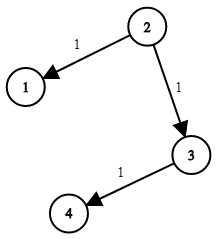
You are given a network of n nodes, labeled from 1 to n. You are also given times, a list of travel times as directed edges times[i] = (ui, vi, wi), where ui is the source node, vi is the target node, and wi is the time it takes for a signal to travel from source to target.
We will send a signal from a given node k. Return the minimum time it takes for all the n nodes to receive the signal. If it is impossible for all the n nodes to receive the signal, return -1.

https://honeypeach.tistory.com/ 로 이전했습니다.