회고
😄 느낀점
- Hash에 대한 개념을 잡을 수 있었다. (그 전까지는 Hash문제도 다른 방식으로 풀었음)
- Toby String을 처음부터 다시 코딩했는데 중간중간 막히는 부분이 있었다. (다시 한번 정리하자)
😁 목표
- 스터디 DP 유형 공부
알고리즘(Hash)
Hash란
개념
문자열을 key로 문제를 풀어야 하는 경우
Hash VS HashTable
Hash: 자체는 특정 값을 리턴하는 함수(메소드)HashTable: Hash를 써서 값에 접근하는 자료구조
속도
- Hash 속도 : O(1)
함수에서 리턴된 값을 가지고 배열에 접근하기 때문에 - Hash를 사용하지 않을 때 속도 : O(N)
구현
사이즈를 정하는 기준
🔴 공식은 없음
🔴 Hash충돌이 나지 않으면서도 메모리를 너무 많이 쓰지 않는 크기로 정함
예시
- 10000개를 설정한 경우 73 / 80 → 메모리를 더 많이 씀
- 200개를 설정한 경우 61 / 80 → 충돌하는 경우가 더 많아짐
Hash 구현
- 해당 문자열의 아스키 값들을 모두 더함
- 이 합의 나머지를 구함
🟢 나머지를 구한 이유
지정된 크기의 배열에 값을 저장하기 위해
size로 정한 배열의 어딘가로 가도록 하기 위함
    public int hash(String key) {
        int asciiSum = 0;
        for (int i = 0; i < key.length(); i++) {
            asciiSum += key.charAt(i);
        }
        return asciiSum % 1000;    // 1000개
    }
HashTable 구현
🟢 insert(key, value) : key에 value 넣기
🟢 search(key) : key에 해당하는 value 가져오기
🔴 Hash 충돌은 어떻게 구할 것인가?
👉 내일 배울 예정
public class HashTableFunction {
    private int size = 10000;
    private int[] table = new int[size];

    public HashTableFunction() {
    }

    public HashTableFunction(int size) {
        this.size = size;
        this.table = new int[size];
    }

    public int hash(String key) {
        int asciiSum = 0;
        for (int i = 0; i < key.length(); i++) {
            asciiSum += key.charAt(i);
        }
        return asciiSum % size;
    }

    public void insert(String key, Integer value) {
        int hashCode = hash(key);
        this.table[hashCode] = value;
        System.out.println(key + " " + hashCode + "방에 저장이 완료되었습니다.");
    }

    public int search(String key) {
        return this.table[hash(key)];
    }
}
Spring 입문(DAO 복습)
과정
- User, UserDao까지 작성된 참고사이트 참고하여 입력
- ConnectionMaker Class로 분리 (UserDao내에 getConnection)
- Mysql Jdbc Driver dependencies에 추가하기
- addAndGet 테스트 만들기
- Interface적용해서 분리 (ConnectionMaker)
- Factory적용
- Test Code를 ApplicationContext사용하게 수정
- UserDao에 deleteAll(), getCount() 메소드 및 테스트 추가
- Test Code에 @Autowired, @BeforeEach 적용
- findById()에서 user==null인 경우 Exception처리
- try / catch / final 처리 (deleteAll, getCount)
- StatementStrategy 인터페이스, deleteAllStatement 클래스 추가 및 deleteAll에 적용
- jdbcContextWithStatementStrategy로 분리
- AddStatement에도 적용
- DataSource 적용
- deleteAll(), add()에 익명 클래스 적용
- JdbcContext로 분리
- executeQuery() 분리 - deleteAll
- JdbcTemplate적용 deleteAll(), add(), getCount(), findById()
- getAll(), getAllTest() 추가
- romMapper 뺀 후 최종 코드
과정별 실습
1. User, UserDao까지 작성된 참고사이트 참고하여 입력
User
public class User {
    private String id;
    private String name;
    private String password;

    public User(String id, String name, String password) {
        this.id = id;
        this.name = name;
        this.password = password;
    }

    public String getId() {
        return id;
    }

    public String getName() {
        return name;
    }

    public String getPassword() {
        return password;
    }
}
UserDao
import com.likelion.domain.User;

import java.sql.*;
import java.util.Map;

public class UserDao {
    public void add(User user) {
        Map<String, String> env = System.getenv();
        try {
            Connection c = DriverManager.getConnection(env.get("DB_HOST"),
                    env.get("DB_USER"), env.get("DB_PASSWORD"));

            PreparedStatement pstmt = c.prepareStatement("INSERT INTO users(id, name, password) VALUES(?,?,?);");
            pstmt.setString(1, user.getId());
            pstmt.setString(2, user.getName());
            pstmt.setString(3, user.getPassword());

            pstmt.executeUpdate();

            pstmt.close();
            c.close();

        } catch (SQLException e) {
            throw new RuntimeException(e);
        }
    }

    public User findById(String id) {
        Map<String, String> env = System.getenv();
        Connection c;
        try {
            c = DriverManager.getConnection(env.get("DB_HOST"),
                    env.get("DB_USER"), env.get("DB_PASSWORD"));

            PreparedStatement pstmt = c.prepareStatement("SELECT * FROM users WHERE id = ?");
            pstmt.setString(1, id);

            ResultSet rs = pstmt.executeQuery();
            rs.next();
            User user = new User(rs.getString("id"), rs.getString("name"),
                    rs.getString("password"));

            rs.close();
            pstmt.close();
            c.close();

            return user;

        } catch (SQLException e) {
            throw new RuntimeException(e);
        }
    }
}
build.gradle
dependencies에 추가
    implementation 'org.springframework.boot:spring-boot-starter-test:2.7.4'
    implementation 'org.springframework.boot:spring-boot-starter-jdbc:2.7.4'
2. ConnectionMaker Class로 분리 (UserDao내에 getConnection)
🟢 중복되는 Connection 부분을 getConnection 메소드로 따로 생성
import com.likelion.domain.User;

import java.sql.*;
import java.util.Map;

public class UserDao {
    public Connection getConnection() throws SQLException {
        Map<String, String> env = System.getenv();
        Connection c = DriverManager.getConnection(env.get("DB_HOST"),
            env.get("DB_USER"), env.get("DB_PASSWORD"));
        return c;
    }

    public void add(User user) {
        try {
            Connection c = getConnection();

            PreparedStatement pstmt = c.prepareStatement("INSERT INTO users(id, name, password) VALUES(?,?,?);");
            pstmt.setString(1, user.getId());
            pstmt.setString(2, user.getName());
            pstmt.setString(3, user.getPassword());

            pstmt.executeUpdate();

            pstmt.close();
            c.close();

        } catch (SQLException e) {
            throw new RuntimeException(e);
        }
    }

    public User findById(String id) {
        try {
            Connection c = getConnection();

            PreparedStatement pstmt = c.prepareStatement("SELECT * FROM users WHERE id = ?");
            pstmt.setString(1, id);

            ResultSet rs = pstmt.executeQuery();
            rs.next();
            User user = new User(rs.getString("id"), rs.getString("name"),
                    rs.getString("password"));

            rs.close();
            pstmt.close();
            c.close();

            return user;

        } catch (SQLException e) {
            throw new RuntimeException(e);
        }
    }
}
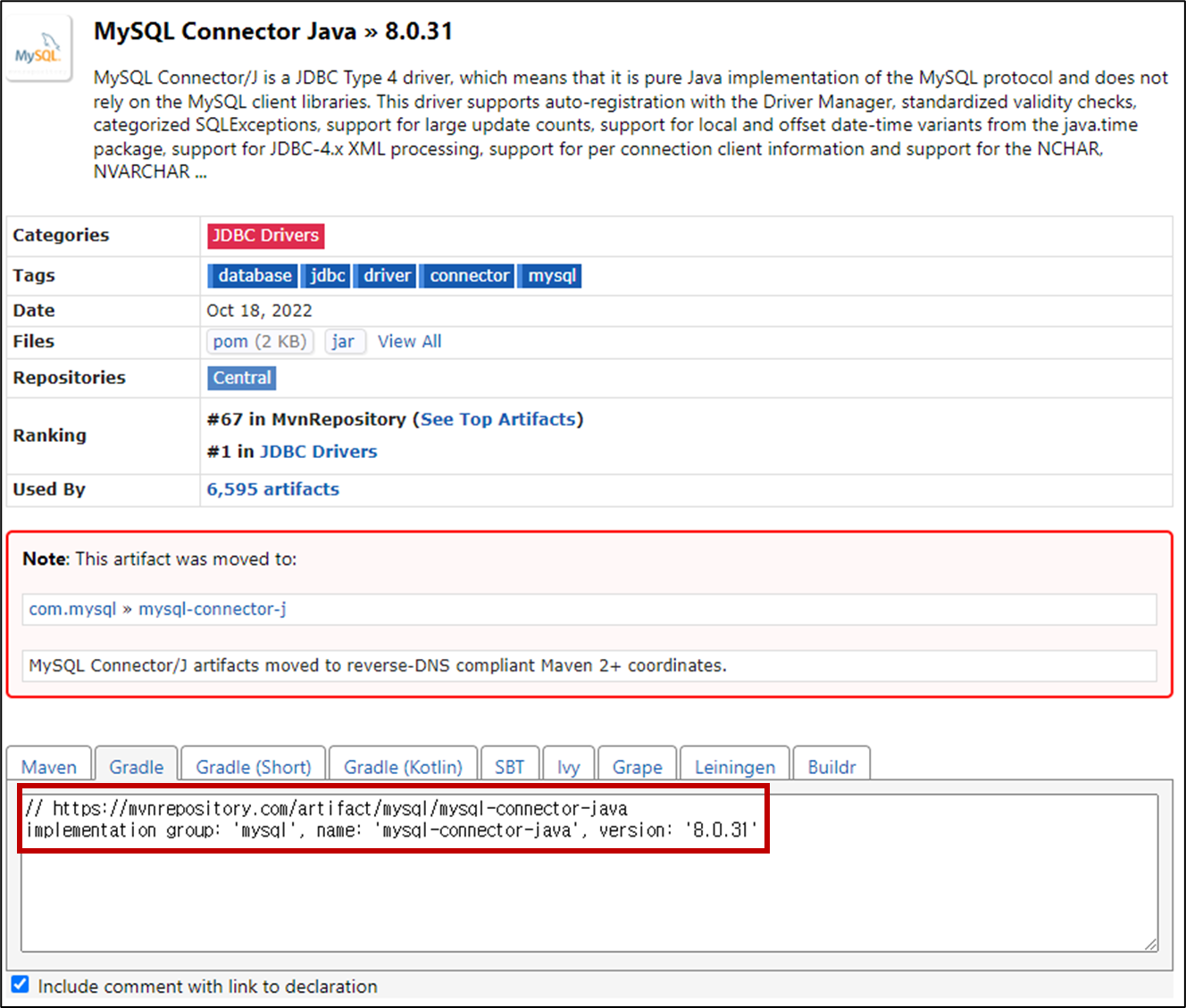
3. Mysql Jdbc Driver dependencies에 추가하기
mvnrepositroy 접속 ➡ MySQL Connector Java 검색 ➡ Central에 버전 선택 ➡ 아래 그림의 빨간 네모칸 복사 ➡ dependencies에 추가
4. addAndGet 테스트 만들기
🟢 add(), findById()를 테스트하는 테스트 클래스 생성(Gradle 이용)
import com.likelion.domain.User;
import org.junit.jupiter.api.Test;

import static org.junit.jupiter.api.Assertions.*;

class UserDaoTest {

    @Test
    void addandGet() {
        UserDao userDao = new UserDao();

        User user = new User("7", "김구글", "1234");
        userDao.add(user);

        User seletedUser = userDao.findById("7");
        assertEquals("김구글", seletedUser.getName());
    }
}
5. Interface적용해서 분리 (ConnectionMaker)
🟢 UserDao 내에 있는 getConnection을 인터페이스 적용
- ConnectionMaker 인터페이스 생성
- ConnectionMaker를 의존하는 AwsConnectionMaker 생성
(따로 인터페이스를 의존하게 만드는 의유 : Aws, Local 등 다양하게 접속할 수 있도록 하기 위해) - UserDao가 AwsConnectionMaker의 getConnection 메소드를 호출하도록 코드 변경
ConnectionMaker
import java.sql.Connection;
import java.sql.SQLException;

public interface ConnectionMaker {
    public Connection getConnection() throws SQLException;
}
AwsConnectionMaker
import java.sql.Connection;
import java.sql.DriverManager;
import java.sql.SQLException;
import java.util.Map;

public class AwsConnectionMaker implements ConnectionMaker{
    @Override
    public Connection getConnection() throws SQLException {
        Map<String, String> env = System.getenv();
        Connection c = DriverManager.getConnection(env.get("DB_HOST"),
                env.get("DB_USER"), env.get("DB_PASSWORD"));
        return c;
    }
}
UserDao
import com.likelion.domain.User;

import java.sql.*;

public class UserDao {
    private ConnectionMaker connectionMaker;

    public UserDao() {
        this.connectionMaker = new AwsConnectionMaker();
    }

    public UserDao(ConnectionMaker connectionMaker) {
        this.connectionMaker = connectionMaker;
    }

    public void add(User user) {
        try {
            Connection c = this.connectionMaker.getConnection();

            PreparedStatement pstmt = c.prepareStatement("INSERT INTO users(id, name, password) VALUES(?,?,?);");
            pstmt.setString(1, user.getId());
            pstmt.setString(2, user.getName());
            pstmt.setString(3, user.getPassword());

            pstmt.executeUpdate();

            pstmt.close();
            c.close();

        } catch (SQLException e) {
            throw new RuntimeException(e);
        }
    }

    public User findById(String id) {
        try {
            Connection c = this.connectionMaker.getConnection();

            PreparedStatement pstmt = c.prepareStatement("SELECT * FROM users WHERE id = ?");
            pstmt.setString(1, id);

            ResultSet rs = pstmt.executeQuery();
            rs.next();
            User user = new User(rs.getString("id"), rs.getString("name"),
                    rs.getString("password"));

            rs.close();
            pstmt.close();
            c.close();

            return user;

        } catch (SQLException e) {
            throw new RuntimeException(e);
        }
    }
}
6. Factory적용
🟢 UserDao와 Connection의 관계를 지어주는 역할
UserDaoFactory
public class UserDaoFactory {
    public UserDao awsUserDao() {
        return new UserDao(new AwsConnectionMaker());
    }
}
UserDaoTest
import com.likelion.domain.User;
import org.junit.jupiter.api.Test;

import static org.junit.jupiter.api.Assertions.*;

class UserDaoTest {

    @Test
    void addandGet() {
        UserDao userDao = new UserDaoFactory().awsUserDao();

//        User user = new User("7", "김구글", "1234");
//        userDao.add(user);

        User seletedUser = userDao.findById("7");
        assertEquals("김구글", seletedUser.getName());
    }
}
7. Test Code를 ApplicationContext사용하게 수정
UserDaoFactory
import org.springframework.context.annotation.Bean;
import org.springframework.context.annotation.Configuration;

@Configuration
public class UserDaoFactory {
    @Bean
    public UserDao awsUserDao() {
        return new UserDao(new AwsConnectionMaker());
    }
}
UserDaoTest
import com.likelion.domain.User;
import org.junit.jupiter.api.Test;
import org.junit.jupiter.api.extension.ExtendWith;
import org.springframework.beans.factory.annotation.Autowired;
import org.springframework.context.ApplicationContext;
import org.springframework.test.context.ContextConfiguration;
import org.springframework.test.context.junit.jupiter.SpringExtension;

import static org.junit.jupiter.api.Assertions.*;

@ExtendWith(SpringExtension.class)
@ContextConfiguration(classes = UserDaoFactory.class)
class UserDaoTest {
    @Autowired
    private ApplicationContext context;

    @Test
    void addandGet() {
        UserDao userDao = context.getBean("awsUserDao", UserDao.class);

//        User user = new User("7", "김구글", "1234");
//        userDao.add(user);

        User seletedUser = userDao.findById("7");
        assertEquals("김구글", seletedUser.getName());
    }
}
8. UserDao에 deleteAll(), getCount() 메소드 및 테스트 추가
🟢 deleteAll() : 테이블 내용 삭제
🟢 getCount() : 테이블 데이터 개수 리턴
UserDaoFactory
import com.likelion.domain.User;

import java.sql.*;

public class UserDao {
    private ConnectionMaker connectionMaker;

    public UserDao() {
        this.connectionMaker = new AwsConnectionMaker();
    }

    public UserDao(ConnectionMaker connectionMaker) {
        this.connectionMaker = connectionMaker;
    }

    public void add(User user) {
        try {
            Connection c = this.connectionMaker.getConnection();

            PreparedStatement pstmt = c.prepareStatement("INSERT INTO users(id, name, password) VALUES(?,?,?);");
            pstmt.setString(1, user.getId());
            pstmt.setString(2, user.getName());
            pstmt.setString(3, user.getPassword());

            pstmt.executeUpdate();

            pstmt.close();
            c.close();

        } catch (SQLException e) {
            throw new RuntimeException(e);
        }
    }

    public User findById(String id) {
        try {
            Connection c = this.connectionMaker.getConnection();

            PreparedStatement pstmt = c.prepareStatement("SELECT * FROM users WHERE id = ?");
            pstmt.setString(1, id);

            ResultSet rs = pstmt.executeQuery();
            rs.next();
            User user = new User(rs.getString("id"), rs.getString("name"),
                    rs.getString("password"));

            rs.close();
            pstmt.close();
            c.close();

            return user;

        } catch (SQLException e) {
            throw new RuntimeException(e);
        }
    }

    public void deleteAll() throws SQLException {
        Connection c = this.connectionMaker.getConnection();

        PreparedStatement pstmt = c.prepareStatement("delete from users");
        pstmt.executeUpdate();

        pstmt.close();
        c.close();
    }

    public int getCount() throws SQLException {
        Connection c = this.connectionMaker.getConnection();

        PreparedStatement pstmt = c.prepareStatement("select count(*) from users");

        ResultSet rs = pstmt.executeQuery();
        rs.next();
        int count = rs.getInt(1);

        rs.close();
        pstmt.close();
        c.close();

        return count;
    }
}
UserDaoTest
import com.likelion.domain.User;
import org.junit.jupiter.api.Test;
import org.junit.jupiter.api.extension.ExtendWith;
import org.springframework.beans.factory.annotation.Autowired;
import org.springframework.context.ApplicationContext;
import org.springframework.test.context.ContextConfiguration;
import org.springframework.test.context.junit.jupiter.SpringExtension;

import java.sql.SQLException;

import static org.junit.jupiter.api.Assertions.*;

@ExtendWith(SpringExtension.class)
@ContextConfiguration(classes = UserDaoFactory.class)
class UserDaoTest {
    @Autowired
    private ApplicationContext context;

    @Test
    void addandGet() throws SQLException {
        UserDao userDao = context.getBean("awsUserDao", UserDao.class);
        userDao.deleteAll();

        User user = new User("7", "김구글", "1234");
        userDao.add(user);

        User seletedUser = userDao.findById("7");
        assertEquals("김구글", seletedUser.getName());
    }

    @Test
    void deleteAndGetCount() throws SQLException {
        UserDao userDao = context.getBean("awsUserDao", UserDao.class);
        userDao.deleteAll();
        assertEquals(0, userDao.getCount());

        User user1 = new User("1", "김구글", "1234");
        User user2 = new User("2", "강다음", "2345");
        User user3 = new User("3", "박토익", "3456");
        userDao.add(user1);
        userDao.add(user2);
        userDao.add(user3);
        assertEquals(3, userDao.getCount());
    }
}
9. Test Code에 @Autowired, @BeforeEach 적용
UserDaoTest
import com.likelion.domain.User;
import org.junit.jupiter.api.BeforeEach;
import org.junit.jupiter.api.Test;
import org.junit.jupiter.api.extension.ExtendWith;
import org.springframework.beans.factory.annotation.Autowired;
import org.springframework.context.ApplicationContext;
import org.springframework.test.context.ContextConfiguration;
import org.springframework.test.context.junit.jupiter.SpringExtension;

import java.sql.SQLException;

import static org.junit.jupiter.api.Assertions.*;

@ExtendWith(SpringExtension.class)
@ContextConfiguration(classes = UserDaoFactory.class)
class UserDaoTest {
    @Autowired
    private ApplicationContext context;
    UserDao userDao;
    User user1;
    User user2;
    User user3;

    @BeforeEach
    void setUp() {
        userDao = context.getBean("awsUserDao", UserDao.class);
        user1 = new User("1", "김구글", "1234");
        user2 = new User("2", "강다음", "2345");
        user3 = new User("3", "박토익", "3456");
    }

    @Test
    void addandGet() throws SQLException {
        userDao.deleteAll();

        userDao.add(user1);

        User seletedUser = userDao.findById("1");
        assertEquals(user1.getName(), seletedUser.getName());
    }

    @Test
    void deleteAndGetCount() throws SQLException {
        userDao.deleteAll();
        assertEquals(0, userDao.getCount());

        userDao.add(user1);
        userDao.add(user2);
        userDao.add(user3);
        assertEquals(3, userDao.getCount());
    }
}
10. findById()에서 user==null인 경우 Exception처리
UserDao의 findById()
    public User findById(String id) {
        try {
            Connection c = this.connectionMaker.getConnection();

            PreparedStatement pstmt = c.prepareStatement("SELECT * FROM users WHERE id = ?");
            pstmt.setString(1, id);

            ResultSet rs = pstmt.executeQuery();

            User user = null;
            if(rs.next()){
                user = new User(rs.getString("id"), rs.getString("name"),
                        rs.getString("password"));
            }

            rs.close();
            pstmt.close();
            c.close();

            if(user == null) throw new EmptyResultDataAccessException(1);

            return user;
        } catch (SQLException e) {
            throw new RuntimeException(e);
        }
    }
11. try / catch / final 처리 (deleteAll, getCount)
UserDao의 deleteAll()
    public void deleteAll() throws SQLException {
        Connection c = null;
        PreparedStatement pstmt = null;

        try {
            c = this.connectionMaker.getConnection();

            pstmt = c.prepareStatement("delete from users");
            pstmt.executeUpdate();
        } catch (SQLException e) {
            throw e;
        } finally {
            if(pstmt != null) {
                try {
                    pstmt.close();
                } catch (SQLException e) {
                }
            }
            if(c != null) {
                try {
                    c.close();
                } catch (SQLException e) {
                }
            }
        }
    }
UserDao의 getCount()
    public int getCount() throws SQLException {
        Connection c = null;
        PreparedStatement pstmt = null;
        ResultSet rs = null;

        try {
            c = this.connectionMaker.getConnection();

            pstmt = c.prepareStatement("select count(*) from users");
            rs = pstmt.executeQuery();
            rs.next();

            return rs.getInt(1);
        } catch (SQLException e) {
            throw e;
        } finally {
            if(rs != null) {
                try {
                    rs.close();
                } catch (SQLException e) {
                }
            }
            if(pstmt != null) {
                try {
                    pstmt.close();
                } catch (SQLException e) {
                }
            }
            if(c != null) {
                try {
                    c.close();
                } catch (SQLException e) {
                }
            }
        }
    }
12. StatementStrategy 인터페이스, deleteAllStatement 클래스 추가 및 deleteAll에 적용
🟢 deleteAll의 쿼리문을 따로 생성하는 deleteAllStatement 생성 (이것은 StatementStrategy을 의존)
StatementStrategy
import java.sql.Connection;
import java.sql.PreparedStatement;
import java.sql.SQLException;

public interface StatementStrategy {
    PreparedStatement makePreparedStatement(Connection c) throws SQLException;
}
deleteAllStatement
import java.sql.Connection;
import java.sql.PreparedStatement;
import java.sql.SQLException;

public class deleteAllStatement implements StatementStrategy{
    @Override
    public PreparedStatement makePreparedStatement(Connection c) throws SQLException {
        return c.prepareStatement("delete from users");
    }
}
UserDao의 deleteAll()
    public void deleteAll() throws SQLException {
        Connection c = null;
        PreparedStatement pstmt = null;

        try {
            c = this.connectionMaker.getConnection();

            StatementStrategy strategy = new deleteAllStatement();
            pstmt = strategy.makePreparedStatement(c);

            pstmt.executeUpdate();
        } catch (SQLException e) {
            throw e;
        } finally {
            if(pstmt != null) {
                try {
                    pstmt.close();
                } catch (SQLException e) {
                }
            }
            if(c != null) {
                try {
                    c.close();
                } catch (SQLException e) {
                }
            }
        }
    }
13. jdbcContextWithStatementStrategy로 분리
🔴 deleteAll안의 코드를 jdbcContextWithStatementStrategy로 분리
UserDao의 deleteAll, jdbcContextWithStatementStrategy
    public void jdbcContextWithStatementStrategy(StatementStrategy stmt) throws SQLException {
        Connection c = null;
        PreparedStatement pstmt = null;

        try {
            c = this.connectionMaker.getConnection();

            pstmt = stmt.makePreparedStatement(c);

            pstmt.executeUpdate();
        } catch (SQLException e) {
            throw e;
        } finally {
            if(pstmt != null) {
                try {
                    pstmt.close();
                } catch (SQLException e) {
                }
            }
            if(c != null) {
                try {
                    c.close();
                } catch (SQLException e) {
                }
            }
        }
    }

    public void deleteAll() throws SQLException {
        jdbcContextWithStatementStrategy(new deleteAllStatement());
    }
14. AddStatement에도 적용
🔴 User를 리턴해야하기 때문에 AddStatement에도 User변수 선언
AddStatement
import com.likelion.domain.User;

import java.sql.Connection;
import java.sql.PreparedStatement;
import java.sql.SQLException;

public class AddStatement implements StatementStrategy{
    User user;

    public AddStatement(User user) {
        this.user = user;
    }

    public PreparedStatement makePreparedStatement(Connection c) throws SQLException {
        PreparedStatement pstmt = c.prepareStatement("INSERT INTO users(id, name, password) VALUES(?,?,?);");
        pstmt.setString(1, user.getId());
        pstmt.setString(2, user.getName());
        pstmt.setString(3, user.getPassword());

        return pstmt;
    }
}
UserDao의 add()
    public void add(User user) throws SQLException {
        jdbcContextWithStatementStrategy(new AddStatement(user));
    }
15. DataSource 적용
🔴 Connection 방식을 내재되어 있는 DataSource 인터페이스 적용
UserDaoFactory
import org.springframework.context.annotation.Bean;
import org.springframework.context.annotation.Configuration;
import org.springframework.jdbc.datasource.SimpleDriverDataSource;

import javax.sql.DataSource;
import java.util.Map;

@Configuration
public class UserDaoFactory {
    @Bean
    public UserDao awsUserDao() {
        return new UserDao(awsDateSource());
    }

    DataSource awsDateSource() {
        Map<String, String> env = System.getenv();
        SimpleDriverDataSource dataSource =new SimpleDriverDataSource();
        dataSource.setDriverClass(com.mysql.cj.jdbc.Driver.class);
        dataSource.setUrl(env.get("DB_HOST"));
        dataSource.setUsername(env.get("DB_USER"));
        dataSource.setPassword(env.get("DB_PASSWORD"));

        return dataSource;
    }
}
UserDao
import com.likelion.domain.User;
import org.springframework.dao.EmptyResultDataAccessException;

import javax.sql.DataSource;
import java.sql.*;

public class UserDao {
    private DataSource dataSource;

    public UserDao(DataSource dataSource) {
        this.dataSource = dataSource;
    }

    public void jdbcContextWithStatementStrategy(StatementStrategy stmt) throws SQLException {
        Connection c = null;
        PreparedStatement pstmt = null;

        try {
            c = this.dataSource.getConnection();

            pstmt = stmt.makePreparedStatement(c);

            pstmt.executeUpdate();
        } catch (SQLException e) {
            throw e;
        } finally {
            if(pstmt != null) {
                try {
                    pstmt.close();
                } catch (SQLException e) {
                }
            }
            if(c != null) {
                try {
                    c.close();
                } catch (SQLException e) {
                }
            }
        }
    }

    public void add(User user) throws SQLException {
        jdbcContextWithStatementStrategy(new AddStatement(user));
    }

    public User findById(String id) {
        try {
            Connection c = this.dataSource.getConnection();

            PreparedStatement pstmt = c.prepareStatement("SELECT * FROM users WHERE id = ?");
            pstmt.setString(1, id);

            ResultSet rs = pstmt.executeQuery();

            User user = null;
            if(rs.next()){
                user = new User(rs.getString("id"), rs.getString("name"),
                        rs.getString("password"));
            }

            rs.close();
            pstmt.close();
            c.close();

            if(user == null) throw new EmptyResultDataAccessException(1);

            return user;
        } catch (SQLException e) {
            throw new RuntimeException(e);
        }
    }

    public void deleteAll() throws SQLException {
        jdbcContextWithStatementStrategy(new deleteAllStatement());
    }

    public int getCount() throws SQLException {
        Connection c = null;
        PreparedStatement pstmt = null;
        ResultSet rs = null;

        try {
            c = this.dataSource.getConnection();

            pstmt = c.prepareStatement("select count(*) from users");
            rs = pstmt.executeQuery();
            rs.next();

            return rs.getInt(1);
        } catch (SQLException e) {
            throw e;
        } finally {
            if(rs != null) {
                try {
                    rs.close();
                } catch (SQLException e) {
                }
            }
            if(pstmt != null) {
                try {
                    pstmt.close();
                } catch (SQLException e) {
                }
            }
            if(c != null) {
                try {
                    c.close();
                } catch (SQLException e) {
                }
            }
        }
    }
}
16. deleteAll(), add()에 익명 클래스 적용
🟢 메소드 내부에서 StatementStrategy 메소드 생성
🟢 add()의 경우 따로 User를 선언해주지 않기 때문에 장점
UserDao의 add(), deleteAll()
    public void add(User user) throws SQLException {
        jdbcContextWithStatementStrategy(new StatementStrategy() {
            @Override
            public PreparedStatement makePreparedStatement(Connection c) throws SQLException {
                PreparedStatement pstmt = c.prepareStatement("INSERT INTO users(id, name, password) VALUES(?,?,?);");
                pstmt.setString(1, user.getId());
                pstmt.setString(2, user.getName());
                pstmt.setString(3, user.getPassword());

                return pstmt;
            }
        });
    }

    public void deleteAll() throws SQLException {
        jdbcContextWithStatementStrategy(new StatementStrategy() {
            @Override
            public PreparedStatement makePreparedStatement(Connection c) throws SQLException {
                return c.prepareStatement("delete from users");
            }
        });
    }
17. JdbcContext로 분리
🟢 따로 JdbcContext 클래스를 생성
JdbcContext
import javax.sql.DataSource;
import java.sql.Connection;
import java.sql.PreparedStatement;
import java.sql.SQLException;

public class JdbcContext {
    private DataSource dataSource;

    public JdbcContext(DataSource dataSource) {
        this.dataSource = dataSource;
    }

    public void workWithStatementStrategy(StatementStrategy stmt) throws SQLException {
        Connection c = null;
        PreparedStatement pstmt = null;

        try {
            c = this.dataSource.getConnection();

            pstmt = stmt.makePreparedStatement(c);

            pstmt.executeUpdate();
        } catch (SQLException e) {
            throw e;
        } finally {
            if(pstmt != null) {
                try {
                    pstmt.close();
                } catch (SQLException e) {
                }
            }
            if(c != null) {
                try {
                    c.close();
                } catch (SQLException e) {
                }
            }
        }
    }
}
UserDao 바뀐 부분
import com.likelion.domain.User;
import org.springframework.dao.EmptyResultDataAccessException;

import javax.sql.DataSource;
import java.sql.*;

public class UserDao {
    private DataSource dataSource;
    private JdbcContext jdbcContext;

    public UserDao(DataSource dataSource) {
        this.dataSource = dataSource;
        this.jdbcContext = new JdbcContext(dataSource);
    }

    public void add(User user) throws SQLException {
        this.jdbcContext.workWithStatementStrategy(new StatementStrategy() {
            @Override
            public PreparedStatement makePreparedStatement(Connection c) throws SQLException {
                PreparedStatement pstmt = c.prepareStatement("INSERT INTO users(id, name, password) VALUES(?,?,?);");
                pstmt.setString(1, user.getId());
                pstmt.setString(2, user.getName());
                pstmt.setString(3, user.getPassword());

                return pstmt;
            }
        });
    }

    public void deleteAll() throws SQLException {
        this.jdbcContext.workWithStatementStrategy(new StatementStrategy() {
            @Override
            public PreparedStatement makePreparedStatement(Connection c) throws SQLException {
                return c.prepareStatement("delete from users");
            }
        });
    }
}
18. executeQuery() 분리 - deleteAll
🟢 쿼리문만 따로 넣을 수 있도록 JdbcContext에 executeQuery() 추가
JdbcContext의 executeQuery()
    public void executeSql(final String query) throws SQLException {
        workWithStatementStrategy(new StatementStrategy() {
            @Override
            public PreparedStatement makePreparedStatement(Connection c) throws SQLException {
                return c.prepareStatement(query);
            }
        });
    }
UserDao의 deleteAll()
    public void deleteAll() throws SQLException {
        this.jdbcContext.executeSql("delete from users");
    }
19. JdbcTemplate적용 deleteAll(), add(), getCount(), findById()
import com.likelion.domain.User;
import org.springframework.jdbc.core.JdbcTemplate;
import org.springframework.jdbc.core.RowMapper;

import javax.sql.DataSource;
import java.sql.*;

public class UserDao {
    private DataSource dataSource;
    private JdbcTemplate jdbcTemplate;

    public UserDao(DataSource dataSource) {
        this.dataSource = dataSource;
        this.jdbcTemplate = new JdbcTemplate(dataSource);
    }

    public void add(User user) {
        jdbcTemplate.update("INSERT INTO users(id, name, password) VALUES(?,?,?);",
                user.getId(), user.getName(), user.getPassword());
    }

    public User findById(String id) {
        String sql = "SELECT * FROM users WHERE id = ?";

        RowMapper<User> rowMapper = new RowMapper<User>() {
            @Override
            public User mapRow(ResultSet rs, int rowNum) throws SQLException {
                User user = new User(rs.getString("id"), rs.getString("name"),
                        rs.getString("password"));
                return user;
            }
        };
        return this.jdbcTemplate.queryForObject(sql, rowMapper, id);
    }

    public void deleteAll() {
        this.jdbcTemplate.update("delete from users");
    }

    public int getCount() {
        return this.jdbcTemplate.queryForObject("select count(*) from users", Integer.class);
    }
}
20. getAll(), getAllTest() 추가
UserDao의 getAll()
    public List<User> getAll() {
        String sql = "SELECT * FROM users order by id";

        RowMapper<User> rowMapper = new RowMapper<User>() {
            @Override
            public User mapRow(ResultSet rs, int rowNum) throws SQLException {
                User user = new User(rs.getString("id"), rs.getString("name"),
                        rs.getString("password"));
                return user;
            }
        };
        return this.jdbcTemplate.query(sql, rowMapper);
    }
UserDaoTest의 getAll()
    @Test
    void getAll() {
        userDao.deleteAll();
        List<User> userList = userDao.getAll();
        assertEquals(0, userList.size());

        userDao.add(user1);
        userDao.add(user2);
        userDao.add(user3);
        userList = userDao.getAll();
        assertEquals(3, userList.size());
    }
21. romMapper 뺀 후 최종 코드
UserDao
import com.likelion.domain.User;
import org.springframework.jdbc.core.JdbcTemplate;
import org.springframework.jdbc.core.RowMapper;

import javax.sql.DataSource;
import java.sql.*;
import java.util.List;

public class UserDao {
    private DataSource dataSource;
    private JdbcTemplate jdbcTemplate;

    public UserDao(DataSource dataSource) {
        this.dataSource = dataSource;
        this.jdbcTemplate = new JdbcTemplate(dataSource);
    }

    RowMapper<User> rowMapper = new RowMapper<User>() {
        @Override
        public User mapRow(ResultSet rs, int rowNum) throws SQLException {
            User user = new User(rs.getString("id"), rs.getString("name"),
                    rs.getString("password"));
            return user;
        }
    };

    public void add(User user) {
        jdbcTemplate.update("INSERT INTO users(id, name, password) VALUES(?,?,?);",
                user.getId(), user.getName(), user.getPassword());
    }

    public User findById(String id) {
        String sql = "SELECT * FROM users WHERE id = ?";
        return this.jdbcTemplate.queryForObject(sql, rowMapper, id);
    }

    public List<User> getAll() {
        String sql = "SELECT * FROM users order by id";
        return this.jdbcTemplate.query(sql, rowMapper);
    }

    public void deleteAll() {
        this.jdbcTemplate.update("delete from users");
    }

    public int getCount() {
        return this.jdbcTemplate.queryForObject("select count(*) from users", Integer.class);
    }
}
UserDaoTest
import com.likelion.domain.User;
import org.junit.jupiter.api.BeforeEach;
import org.junit.jupiter.api.Test;
import org.junit.jupiter.api.extension.ExtendWith;
import org.springframework.beans.factory.annotation.Autowired;
import org.springframework.context.ApplicationContext;
import org.springframework.test.context.ContextConfiguration;
import org.springframework.test.context.junit.jupiter.SpringExtension;

import java.sql.SQLException;
import java.util.List;

import static org.junit.jupiter.api.Assertions.*;

@ExtendWith(SpringExtension.class)
@ContextConfiguration(classes = UserDaoFactory.class)
class UserDaoTest {
    @Autowired
    private ApplicationContext context;
    UserDao userDao;
    User user1;
    User user2;
    User user3;

    @BeforeEach
    void setUp() {
        userDao = context.getBean("awsUserDao", UserDao.class);
        user1 = new User("1", "김구글", "1234");
        user2 = new User("2", "강다음", "2345");
        user3 = new User("3", "박토익", "3456");
    }

    @Test
    void addandGet() throws SQLException {
        userDao.deleteAll();

        userDao.add(user1);

        User seletedUser = userDao.findById("1");
        assertEquals(user1.getName(), seletedUser.getName());
    }

    @Test
    void deleteAndGetCount() throws SQLException {
        userDao.deleteAll();
        assertEquals(0, userDao.getCount());

        userDao.add(user1);
        userDao.add(user2);
        userDao.add(user3);
        assertEquals(3, userDao.getCount());
    }

    @Test
    void getAll() {
        userDao.deleteAll();
        List<User> userList = userDao.getAll();
        assertEquals(0, userList.size());

        userDao.add(user1);
        userDao.add(user2);
        userDao.add(user3);
        userList = userDao.getAll();
        assertEquals(3, userList.size());
    }
}