How to Transcribe Audio to Text Free: The Simple Guide Anyone Can Follow in 2025
If you've ever recorded a voice note, filmed a video, saved a meeting, or captured an interview, you already know one thing: listening back takes forever.
That’s why people today want a fast, easy way to transcribe audio to text free—without paying for expensive software or spending hours typing. Whether you're a student, content creator, business owner, or just someone who wants clean notes, transcription has become one of the easiest ways to save time and stay organized.
And the best part? You don’t need to be a tech expert.
Modern AI tools do almost everything for you.
In this guide, I’ll break everything down in super simple, everyday language. No complicated jargon, no confusing steps—just the easiest way to turn audio into text for free, with practical examples you can use right now.
Let’s dive in.
Why Everyone Needs Transcription Today
In 2025, so much of our daily life happens in audio:
- YouTube videos
- Zoom meetings
- Online classes
- Podcast episodes
- Interviews
- Voice memos
- TikTok voiceovers
- Screen recordings
But here’s the problem: audio is slow to review.
You can’t skim it.
You can’t search inside it.
You can’t copy-paste it.
You can’t repurpose it quickly.
That’s why tools that allow you to transcribe audio to text free are now essential.
With text, you can:
- read faster
- find important info instantly
- create content faster
- share notes with others
- turn spoken words into blog posts, captions, or scripts
- save everything neatly for later
Once you start using transcription, you’ll wonder how you lived without it.
The Benefits of Audio-to-Text (Explained in Plain English)
Here’s what transcription really helps with—without any fancy words:
1. It Saves a Ton of Time
Reading is way faster than listening.
A 30-minute recording becomes a 3-minute read.
2. It Helps You Stay Organized
Instead of a phone full of voice notes, you get clean written notes you can store anywhere.
3. It Makes Learning Easier
Students can turn lectures into written summaries.
Language learners can study how words are pronounced.
4. It Helps Creators Make More Content
One recording can become:
- blogs
- captions
- newsletters
- scripts
- quotes
- social posts
It’s basically content multiplication.
5. It Helps Teams Stay on the Same Page
Meetings become searchable notes.
No more “What did we decide again?”
6. It Improves Accessibility
Not everyone can listen to audio.
Text makes information available to everyone.
This is why transcription is spreading everywhere—from classrooms to companies to content studios.
Real-Life Situations Where Transcription Helps
Let me give you a few simple examples:
Scenario 1: You’re a Student
Your professor talks fast.
Your notes are messy.
Record the lecture → transcribe it → read calmly later.
Scenario 2: You’re a YouTuber
You talk for 8 minutes.
Now you need a title, tags, description, and captions.
Transcription gives you everything instantly.
Scenario 3: You Work in an Office
Meetings never stop.
But you can’t remember every detail.
Record → transcribe → convert into tasks.
Scenario 4: You Run a Podcast
Editing becomes easier with text.
Show notes take 5 minutes instead of an hour.
Scenario 5: You Interview Someone
Transcription helps you pull quotes and write articles faster.
Scenario 6: You Just Have Lots of Voice Notes
Instead of scrolling through audio files, you can just read summaries.
In every situation, transcription makes life simpler.
The Easiest Way to Transcribe Audio to Text Free (No Skills Required)
Thanks to AI, you don’t need special software or expensive tools.
Web-based platforms now handle everything automatically.
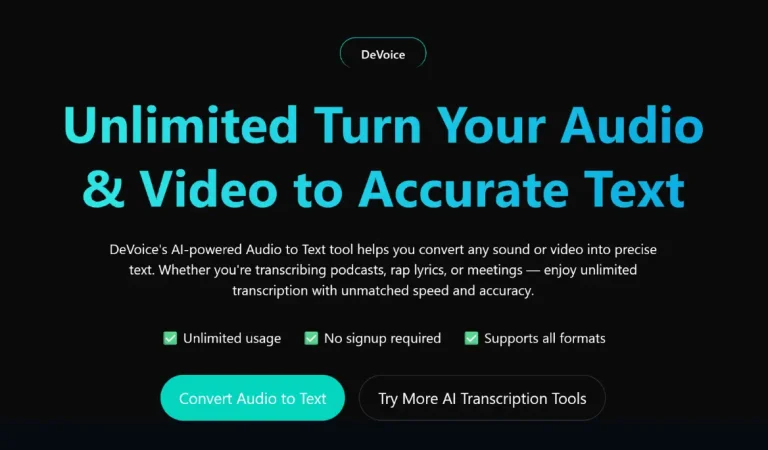
One of the easiest tools I’ve tried is DeVoice.
It cleans your audio, removes noise, and produces readable text even if the original recording wasn’t perfect.
Here’s how simple the process is anywhere online:
Step 1: Upload Your Audio File
Choose any file:
- .mp3
- .wav
- .m4a
- .mp4
- .mov
- .webm
If you recorded it, you can upload it.
Step 2: Let the AI Process It
The tool listens for you.
It detects:
- words
- sentences
- pauses
- speakers
- accents
You just watch it load.
Step 3: Copy, Edit, or Download the Text
You now have clean text you can:
- save
- send
- edit
- share
- publish
- organize
You can even use it to create new content immediately.
That’s the magic of modern transcription—almost no work for you.
Why Free Tools Are Good Enough Today
This is something a lot of people still don’t realize:
Free AI tools today are more accurate than paid tools from three years ago.
You’re getting:
- better accuracy
- smarter punctuation
- language detection
- noise reduction
- speaker separation
- faster processing
And you’re getting it at zero cost.
As long as your audio is clear, free tools handle 95% of tasks perfectly.
This is a huge win for creators, students, freelancers, and anyone who wants to save time.
Tips to Get Better Transcripts (Even With Free Tools)
You don’t need tech knowledge—but these small tips help a lot:
1. Speak clearly
Not slowly, just clearly.
2. Avoid talking over others
AI struggles with overlap.
3. Reduce background noise
Fans, traffic, wind—try to avoid them.
4. Use your phone’s microphone
It’s better than you think.
5. Record in a quiet room
Even 50% less noise helps.
6. Rename your file
It helps you stay organized.
Small habits = much better results.
How Transcripts Can Boost SEO (Explained Simply)
If you publish online—videos, podcasts, blogs—transcription is your secret weapon.
Here’s why:
- Google can’t “hear” audio
- Google can read text
- more text = more keywords
- more keywords = more people find you
If you're trying to grow an audience, this matters a lot.
Creators who add transcripts:
- rank higher
- get more views
- get more traffic
- repurpose content faster
- publish consistently
It’s one of the easiest SEO upgrades available today.
The Smart Way to Use Transcription for Content Creation
Here’s my personal workflow that saves hours every week:
Record Once → Repurpose Everywhere
Just take one 5-minute recording and turn it into:
- a 1,000-word blog
- 3 short videos
- 10 tweet ideas
- a newsletter summary
- 5 TikTok captions
- a LinkedIn post
- a YouTube description
Transcription doesn’t just give you text—it gives you ideas.
And ideas become content.
Why I Recommend Trying DeVoice
You’ll find many transcription tools online, but DeVoice stands out for one simple reason:
It improves your audio before turning it into text.
So even if:
- your recording is noisy
- you filmed outside
- you used earbuds
- you were walking
- the wind was blowing
DeVoice still produces clean text.
It also supports creators who want an easy, free way to transcribe audio to text without complicated steps.
If you're new to transcription, this is one of the easiest places to start.
Final Thoughts: Everyone Should Be Using Transcription in 2025
We’re all dealing with more audio than ever before.
Meetings, content, lessons, interviews—everything is recorded.
Learning how to transcribe audio to text free is one of the simplest ways to stay organized, save time, and create more.
And with tools like DeVoice, the process is fast, automatic, and beginner-friendly.
If you want to work smarter, publish faster, and keep your ideas searchable, transcription is easily one of the most useful skills you can add this year.