TradingView Alerts Automation
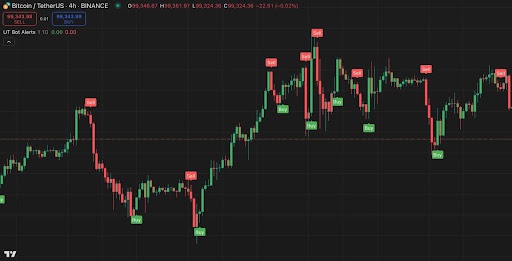
From Signals to Real Trades Across Multiple Platforms
TradingView has become the primary environment for traders who build systematic, rule-based strategies. Indicators, strategies, backtests, and alert logic all live inside one platform. For many traders, TradingView is not just a charting tool — it is the core decision engine.
Yet TradingView stops at a critical boundary.
It generates alerts, but it does not execute trades.
This gap between decision and execution is where most operational problems begin. Alerts alone do not trade. They notify. Everything that happens next depends on the trader’s reaction speed, discipline, and technical setup. For anyone aiming at consistency or scale, this is not sustainable.
TradingView alerts automation exists to close this gap.
Why alerts alone are not execution
An alert represents a condition being met. Nothing more.
It does not:
- open a position,
- define execution logic,
- manage risk,
- apply stop-loss or take-profit,
- or guarantee consistent behavior.
Manual execution introduces uncertainty. Two identical alerts can lead to two different outcomes depending on timing, emotion, or simple human error. In fast markets, even a few seconds can change entry quality or invalidate a setup entirely.
Automation removes this variability. It ensures that when a condition is met, the same action is taken every time — without hesitation, interpretation, or delay.
TradingView as the strategy and decision layer
In a modern automated workflow, TradingView remains the brain of the system.
All logic stays there:
- entry conditions,
- exit conditions,
- confirmations and filters,
- strategy rules.
Nothing is duplicated elsewhere. The alert itself becomes a structured instruction rather than a visual or sound notification. The value of automation lies not in moving logic away from TradingView, but in extending its reach.
TradingView decides. Automation executes.
The missing layer between alerts and brokers
Most traders discover quickly that there is no universal, native bridge between TradingView alerts and real execution platforms. Each broker, exchange, or trading environment speaks its own language. Direct, one-to-one connections are fragile and difficult to maintain.
This is where an automation layer becomes necessary.
AlgoWay is designed as a technical middleware that sits between TradingView and execution platforms. It does not generate signals, does not modify strategy logic, and does not provide trading advice. Its role is purely infrastructural.
Conceptually, the flow is straightforward:
TradingView → AlgoWay → Execution platform
This separation is intentional. By centralizing alert handling, execution becomes predictable, traceable, and scalable.
From alert to real trade
When a TradingView alert is sent to AlgoWay, it is processed as an actionable instruction. Depending on the alert content and configuration, this can result in:
- opening a position using a market order,
- closing an existing position,
- reversing a position,
- applying stop-loss and take-profit parameters at execution time.
The goal is not partial automation or assistance. It is full of execution. Alerts are not reminders — they are commands.
This approach allows traders to focus on strategy development while execution happens automatically and consistently in the background.
Execution speed and reaction time
One of the most underestimated advantages of automation is the removal of human delay.
AlgoWay operates as a server-side system. Alerts are received, processed, and routed within seconds under normal conditions. This is not about competing on microsecond latency. It is about ensuring that trades are executed when conditions are met — not when someone notices an alert on a screen or phone.
Consistency in timing often matters more than raw speed.
Parallel execution and alert cloning
A defining capability of AlgoWay is multi-destination execution.
A single TradingView alert can be routed and executed simultaneously across multiple accounts or platforms. This is often referred to as alert cloning.
Common use cases include:
- running the same strategy on multiple accounts,
- parallel execution across different platforms,
- copy-style setups without duplicating TradingView alerts.
The trading logic remains centralized in TradingView. Execution scales independently. There is no need to maintain multiple alert sets or duplicate strategy logic.
Multi-platform execution flexibility
Modern traders rarely operate in a single execution environment forever. Requirements change. Platforms evolve. Infrastructure must adapt.
AlgoWay is built as a multi-platform automation system. TradingView alerts are not locked to one broker or exchange. The same alert logic can be routed to different supported platforms without rewriting or restructuring the strategy.
This flexibility allows traders to:
- diversify execution environments,
- avoid single-platform dependency,
- adjust infrastructure without redesigning their TradingView logic.
Automation becomes portable rather than restrictive.
Risk management at execution level
Automation without control is dangerous.
That is why execution transparency and logging are essential. Centralized alert processing allows traders to see exactly:
- what alert data was received,
- how it was interpreted,
- what execution instruction was sent.
This visibility is critical for troubleshooting, refinement, and confidence. When something behaves unexpectedly, the execution path can be traced without guesswork.
Automation does not eliminate responsibility — it enforces clarity.
Market orders, structure, and realism
AlgoWay focuses on realistic execution models. TradingView alerts are converted into market-based actions rather than hypothetical fills.
This aligns automation with how real markets operate:
- orders are executed when sent,
- stop-loss and take-profit levels are applied as part of execution,
- behavior matches live trading conditions rather than backtest assumptions.
The result is an automation layer that respects market mechanics instead of abstract simulations.
Automation is infrastructure, not a shortcut
TradingView alerts automation is often misunderstood. It is not a shortcut to profitability. It does not improve strategy quality. It does not replace risk management or decision-making.
It is infrastructure.
Automation ensures that whatever logic the trader defines is executed consistently, repeatedly, and without operational friction. By removing manual execution, traders reduce errors, improve discipline, and gain the ability to scale without increasing complexity.
Conclusion
TradingView alerts are powerful — but incomplete on their own.
Automation bridges the gap between analysis and action. It transforms alerts from notifications into executed trades.
AlgoWay provides a technical automation layer that converts TradingView alerts into real trades, supports market execution with stop-loss and take-profit handling, enables parallel execution across multiple platforms, and maintains transparency through centralized processing and logging.
For traders who rely on TradingView as their strategy engine, automation is not an optional enhancement. It is the foundation for consistent, scalable, and realistic execution.