Classic Example
Withdrawing money form a bank account
- 친구들과 같이 돈을 관리하는 계좌에 30만원이 들어 있는 상황
A와 B가 서로 다른 ATM에 가서 동시에 10만원 씩 출금한다면?
int withdraw(account, amount){
	balance = get_balance(account);
    balance = balance - amount;
    put_balance(account, balance);

    return balance;
}
Sharing Resources
Local variables are NOT shared among threads
- Refer to data on the stack
- Each Thread has its own stack
- Never pass/share/store a pointer to a local variable on anoter thread's stack
공유 가능한 것들
- Global variables (전역변수)
Stored in static data segment, accessible by any thread - Dynamic objects (동적 할당된 객체)
Stored in heap, shared through the pointers
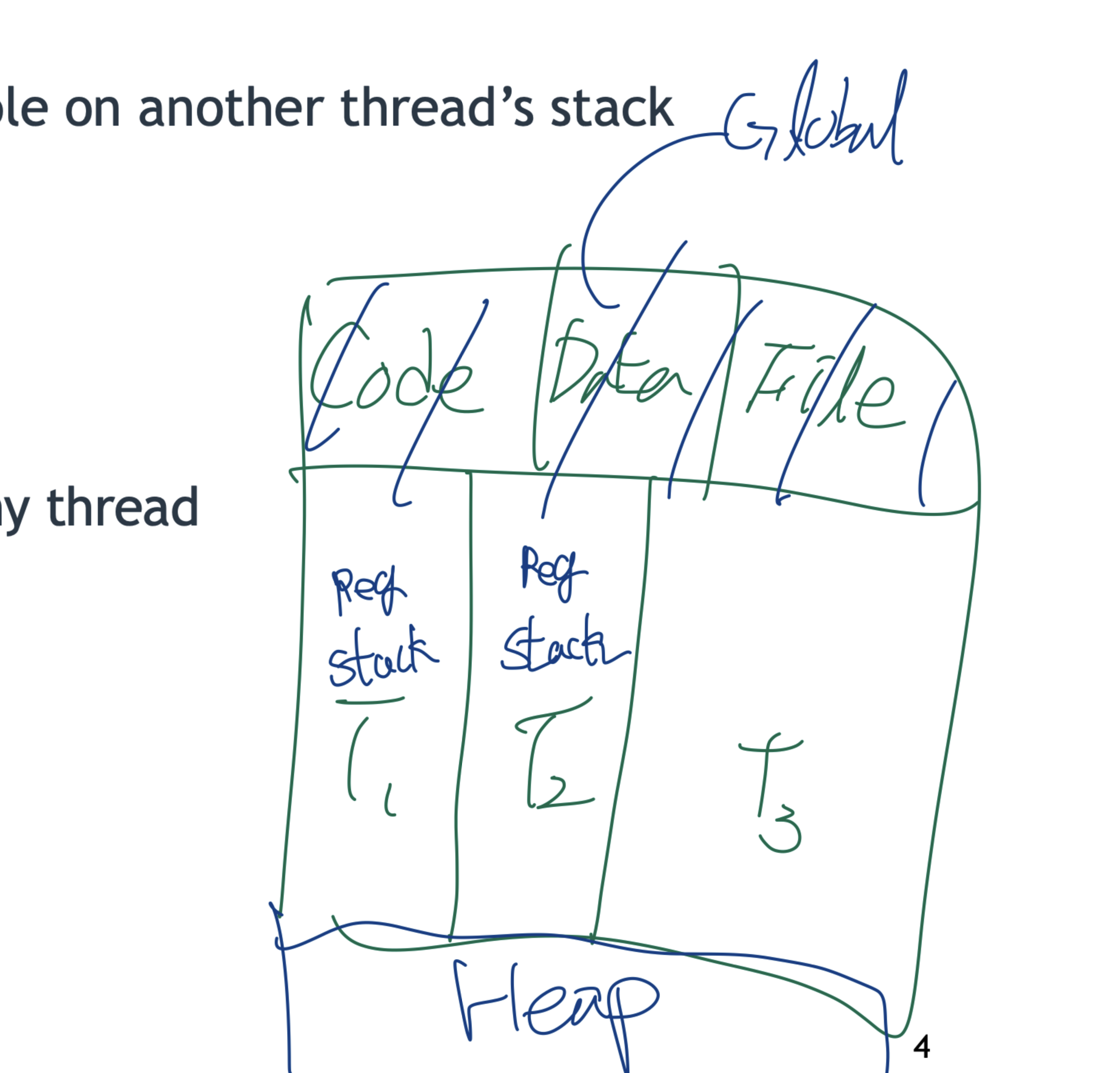
각각의 Thread는 ()는 자신의 Register, Stack을 가지고 있고 다른 Thread의 Stack에는 접근할 수 없다.
Code, Data, File을 공유한다.
Race Condition
Concurrency leads to non-deterministic results!
- Program results vary from run to run even with same inputs, depending on timing
공유 데이터에 대한 동시 접근은 데이터의 일관성(Consistency)를 해치는 결과를 낳을 수 있음
- Race Condition
공유 데이터에 대해 여러 Process가 동시에 접근, 변경을 시도하는 상황
데이터 일관성을 유지하기 위해서는 서로 협력하여 수행되는 Process들(Cooperating Process)이 순차적으로 수행하게 만드는 기법이 필요함
-
Process 간의 동기화 (Process Synchronization)
-
Synchronization restricts the concurrency
(모순적이게도 Concurrency를 해칠 수 밖에...) -
Scheduling is not under programmer's control
Critical Section
Critical Section
- 여러 Process들이 공유하는 데이터에 접근하는 Code 영역
- 한 번에 오직 하나의 Proecess만이 Critical Section에 진입해야 함
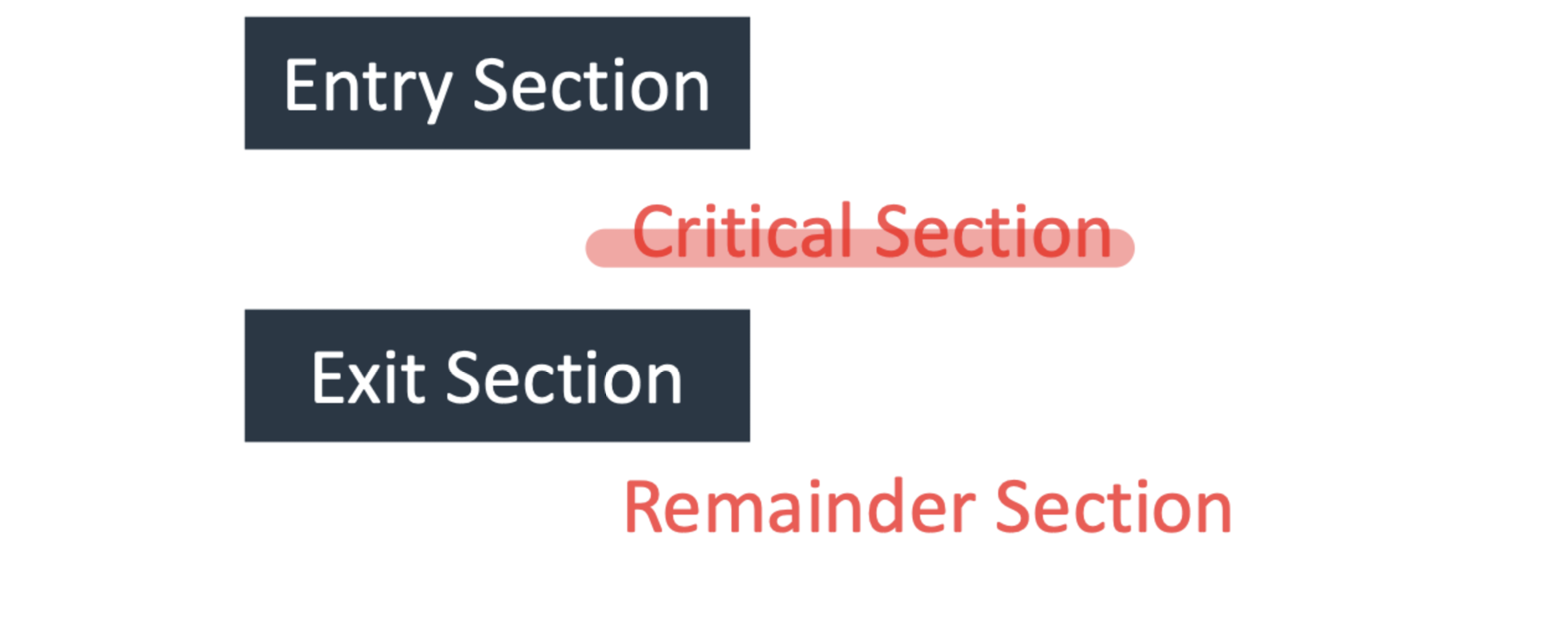
Critical Section을 가지는 Process의 Modeling
Critical Section 해결의 조건들
Critical Section 문제를 해결하는 Algorithm은 아래와 같은 세 가지 조건을 만족해야 함
-
Mutual Exclusion (상호 배제)
만약 Process A가 Critical Section에 진입해 있다면, 다른 모든 Process는 진입할 수 없어야 함 -
Progress (진행)
만약 어떤 Process도 Critical Section내에 있지 않고, Critical Section에 진입하려는 Process가 존재한다면, Remainder Section에서 실행 중이 아닌 Process들 (= 진입하려는 Process들) 만이 누가 진입할지 결정할 수 있어야 함 -결정은 무한히 연기될 수 없음 (Deadlock-free) -
Bounded Waiting
Process가 Critical Section에 진입할 때까지 걸리는 시간에 Limit이 존재해야 함(Starvation-free)
두 Process를 위한 Algorithm
Shared Variables:
- int turn = 0; 으로 초기화
- turn = 0일 때,
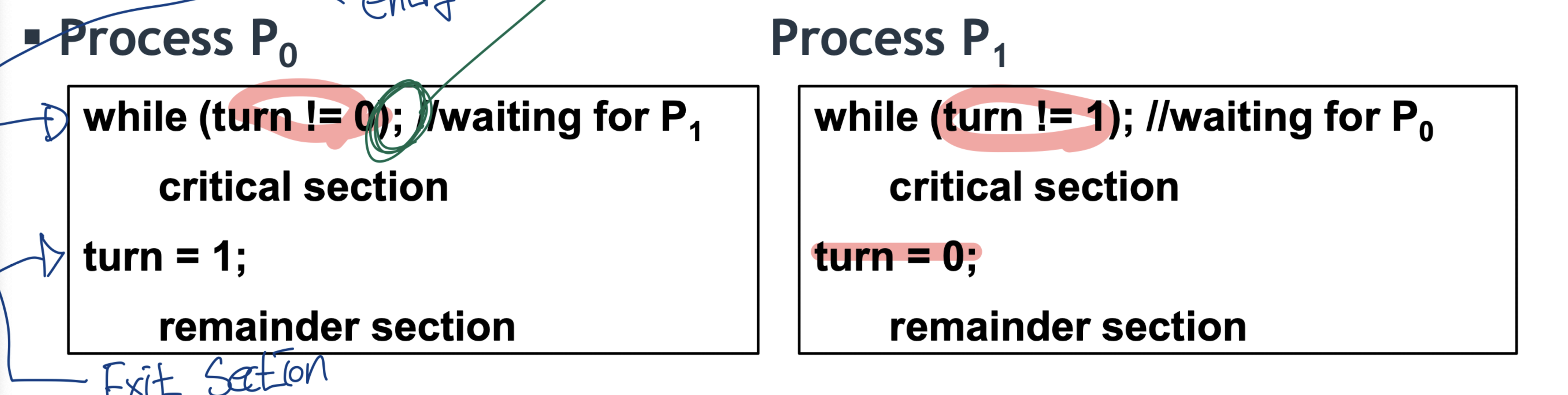
만족 조건 : Mutual Exclusion
불만족 조건 : Progress, Bounded Waiting
turn=0으로 초기화 된 것이 문제이다.
프로세스 가 언제 실행될지 모르는 상황에서 이 실행되면은 은 무한 루프를 돌고 있다. (Progress, Bounded Waiting 불만족)
다른 알고리즘(Flag)
Shared Variables:
- boolean flag[2]; flag[0] = flag[1] = flase로 초기화
- flag[0] = true일 때, 가 critical section에 진입 가능
- flag[1] = true일 때, 가 critical section에 진입 가능
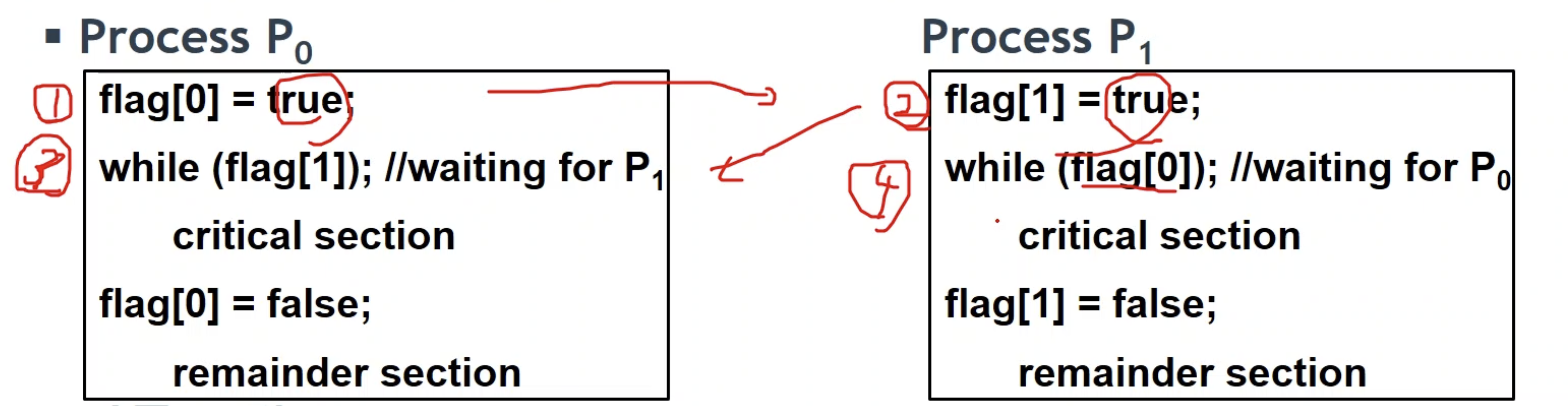
만족 조건 : Mutual Exclusion
불만족 조건 : Progress, Bounded Waiting
그림과 같이 1,2,3,4 순서대로 코드가 실행되버리면, flag[0]와 flag[1]이 모두 true의 값을 가지게 되고 두 프로세스는 무한 루프에 빠져버려 진행되지 않는다.
Peterson Solution
Shared Variables:
- int turn;
- boolean flag[2]; flag[0] = flag[1] = flase로 초기화
flag와 turn을 모두 사용하는 방식이지만, turn을 0으로 초기화하지 않음.
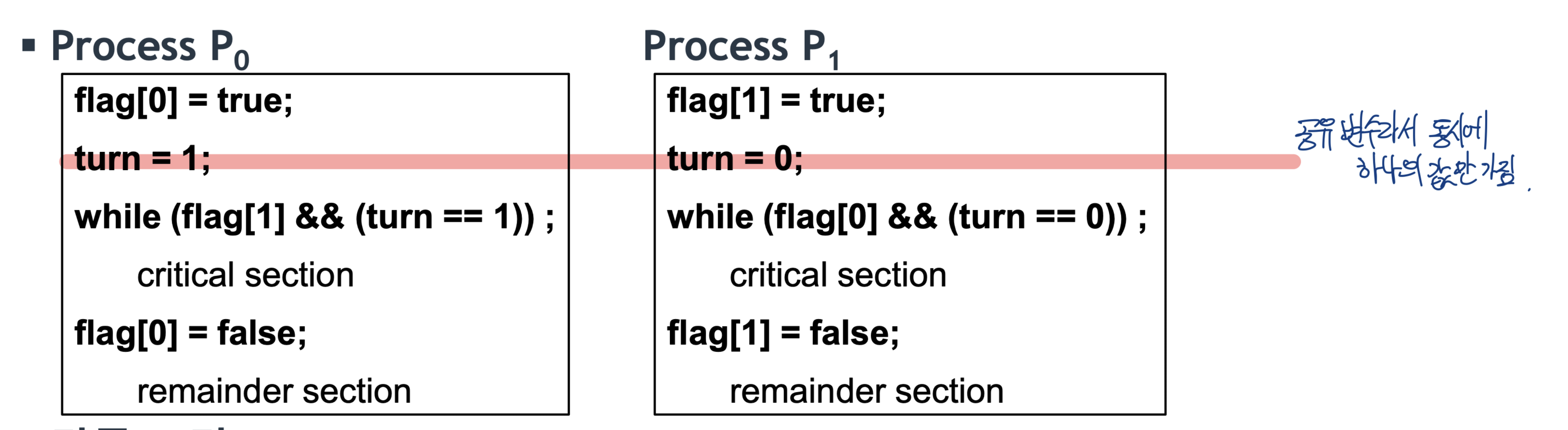
만족 조건 : Mutual Exclusion, Progress, Bounded Waiting
- 두 Process가 동시에 수행되더라도, Turn 값에 의하여 결정됨
Peterson Solution의 한계
3개 이상의 Process에서는 구현이 쉽지 않음.
하드웨어로 처리하면 알고리즘이 매우 간단하게 됨
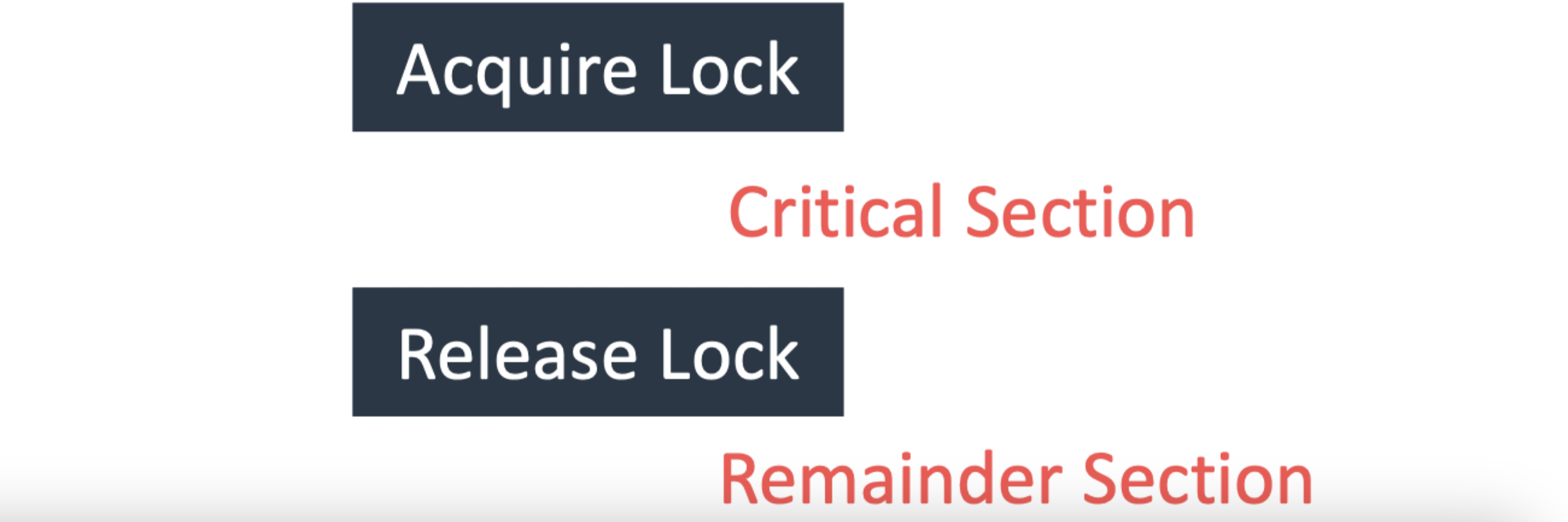
간단한 방법
Critical Section에 들어가면서 Interrupt를 Disable함
User Program이 Interrupt를 Control하는 것은 바람직하지 않음
Scalable 하지 않음
- Process의 숫자가 많아 질 때 문제가 생길 소지
동기화를 위한 Instruction이 도입됨
Synchronization Instruction
CPU에서 지원하여 원자적(Atomic)으로 수행되는 명령어(Instruction)를 이용
- 원자적이란?
명령어가 수행되는 동안 방해 받지 않음(= Uninterruptible)
Test and Set 명령어
- 아래의 코드는 Atomic하게 동작함
boolean TestAndSet(boolean *target){
	boolean rv = *target;
    *target = true;
    return rv;
}
Mutual Exclusion with Test-and-set
Shared Variables:
- boolean lock = false;
Process
do {
	while(TestAndSet(&lock));
    	critical section
    lock = false;
    	remainder section
}
critical section에 들어오면서 lock을 true로 변경해줌 + return값은 아직 false
Mutual Exclusion with Swap
Shared Variables:
- boolean lock;
- boolean waiting[n];
Process
do {
	waiting[i] = true;
    while(waiting[i] == true)
    	swap(&lock, &waiting[i]);
    		critical section
    lock = false;
    	remainder section
}
H/W에서 제공하는 Instruction인 TestAndSet()과swap() 연산은 Atomic하기 때문에, Mutual Exclusion과 Progress(Deadlock-free)를 만족하지만, Bounded Waiting 같은 조건은 User Program에서 제공해야 한다.
# Example : Bounded Waiting Solution

// Shared Data
boolean waiting[n];
boolean lock;

do {
	waiting[i] = TRUE;
    key = TRUE;
    while(waiting[i] && key)
    	key = TestAndSet(&lock);
    waiting[i] = FALSE;

    // critical section

    j = (i + 1) % n;				// i 이후의 프로세스들부터 보겠다.
    while((j != i) && !waiting[j])  // 순회하면서 waiting = TRUE인 프로세스를 찾음
    	j = (j + 1) % n;			// 순차적으로 다음 프로세스를 본다
    if (j == i)   					// 대기중인 프로세스가 없다면, lock을 해제한다
    	lock = FALSE;
    else
    	waiting[j] = FALSE;			// 대기중인 프로세스가 있다면 해당 프로세스를 critical section으로...

    // remainder section

} while (TRUE);
Semaphores
세마포어: 두 개의 원자적 연산을 가지는 정수 변수
- 원자적인 연산:
- Wait() 또는 P()
- Signal() 또는 V()
이 변수는 2개의 원자적인 연산(Atomic Operation)에 의해서만 접근됨
P는 Critical Section 들어가기 전에, V는 나와서 수행함
P와 V연산은 서로 독립적으로, 그리고 원자적으로 수행됨
- 하나의 Process가 P를 수행하여 세마포어의 값을 수정하는 동안,
다른 Process에서 P나 V를 수행하여 같은 세마포어의 값을 수정하지 못함
Semaphores의 구현 - Busy Waiting
Busy Waiting 이용 (Original)
P(Sem) {
	while (Sem <= 0);
    Sem = Sem - 1;
}

S(Sem) {
	S = S + 1;
}
Busy Waiting은 Critical Section에 진입할 조건이 될 때까지 Loop를 돌며 기다린다.
- 단점
CPU Cycle을 낭비할 수 있음
대기 중인 Process 중에서 누가 Critical Section에 진입할지 결정할 수 없음 (Bounded Waiting (= Starvation)
Semaphores의 구현 - Sleep Queue
Sleep Queue를 이용한 구현
-
Busy Waiting 방식의 CPU Cycle을 낭비하는 문제를 해결
-
Semaphore의 자료구조에 Sleep Queue를 추가하여, 대기 중인 Process를 관리
- Semaphore의 값이 양수가 되어 Critical Section에 진입이 가능하게 되면, Sleep Queue에서 대기 중인 Process를 깨워 실행시킴
typedef struct {
	int value;					// 세마포어 값
    struct process *list;		// 세마포어를 대기하는 프로세스의 sleep queue
} semaphore;

P(semaphore *S){
	S -> value--;
    if (S -> value < 0){
		add this process to S -> list;	// 프로세스를 sleep queue에 삽입
        sleep();
    }
}

V(semaphore *S){
	S -> value++;
    if (S -> value <= 0)
    	remove a process P from S -> list;  // 프로세스를 sleep queue에서 꺼내온 후,
        wakeup(P);							// 실행
    }
}
Semaphores의 종류
2가지의 Semaphore
- Counting Semaphore
- Semaphore 값은 범위가 정해져 있지 않음- 초기값은 가능한 자원의 수로 정해짐
- Binary Semaphore
- Semaphore value가 가질 수 있는 값은 0과 1- Counting Semaphore보다 구현이 간단함
Binary Semaphore를 이용하여 Counting Semaphore를 구현할 수 있음
Binary Semaphore는 TestAndSet()과 같은 Hardware의 도움을 받아서 구현할 수 있음
H/W Instruction(TestAndSet) -> Binary Sem -> Counting Sem
Binary Semaphore의 구현
TestAndSet()을 이용하여 구현
Semaphore S : 현재 Critical Section에 진입한 Process가 있는지 나타냄 (True or False)
P(S)
- while (test_and_set(&S));
S의 값이 리턴되고, S는 true로 바뀜
V(S)
- S = false;
진입한 Process가 없음을 나타내어 wait()에서 대기 중인 Process를 진입 가능하도록 함
Counting Semaphore의 구현
Binary Semaphore를 이용하여 구현
- Counting Semaphore를 CS라 하고, value는 C = 0이라 하자.
- 2개의 Binary Semaphore S1, S2를 이용 (S1 for Mutex, S2 for delay)
- S1 = 1, S2 = 0 으로 초기화 (C가 양수라고 가정)
# Wait Operation (P)
P(S1);
C--;
if (C < 0){
	V(S1);
    P(S2);
}
else
	V(S1);


# Signal Operation (V)
P(S1);
C++;
if (C <= 0) {
	V(S2);
}
V(S1);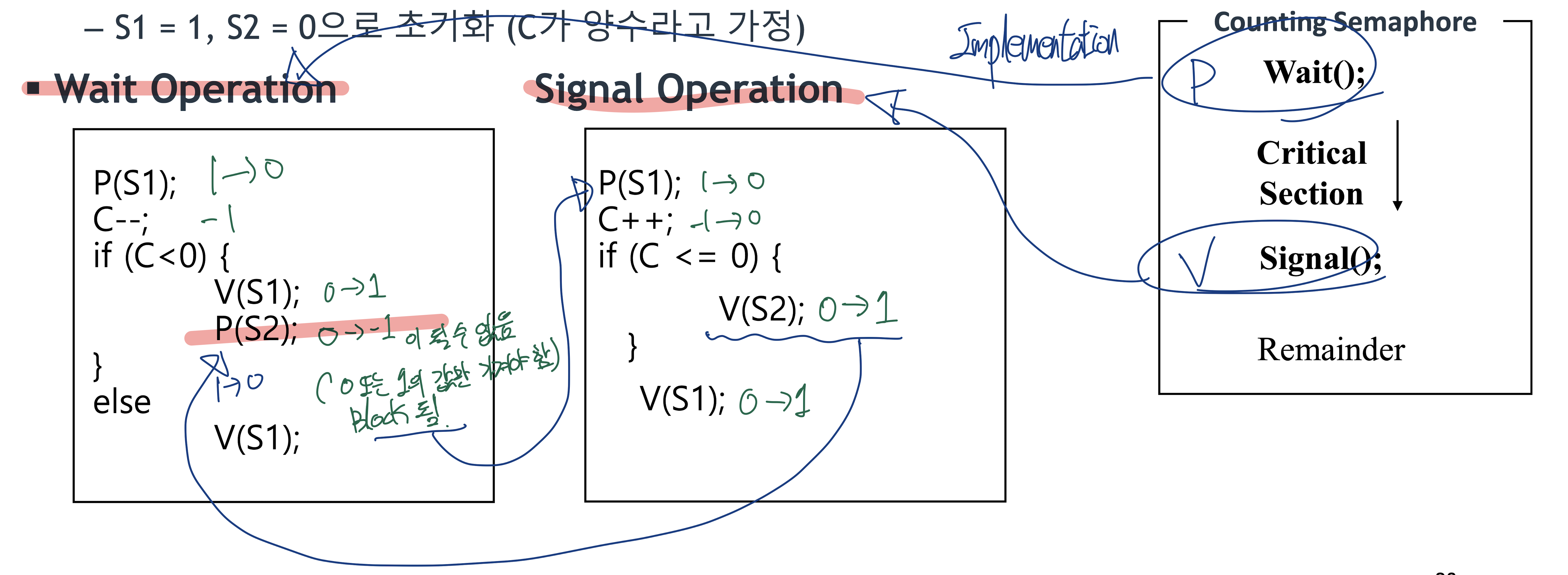
Semaphore의 구현
Kernel이 Single Thread인 경우
- P/V를 System Call로
- kernel내에서 처리하여 Semaphore 동작을 구현함
- Kernel내의 수행이 Non Preemptive이므로, Kernel에 들어간 것이 Critical Section에 들어간 것임
Kernel이 Multithread인 경우
- P/V를 System Call로
- Kernel 내에서 별도로 동기화를 진행
Semaphore의 단점
Deadlock이 발생할 가능성이 존재함
P와 V의 연산이 분리되어 있기 때문에 잘못 사용할 경우에 대책이 없음
-
P(); -> Critical Section -> P();
Critical Section 후에 Lock을 풀어주는 V()가 없으므로, 한 Process가 Critical Section에 진입하면, 나올 수 없다.
(다른 Process들이 Critical Section에 진입 못하므로 Deadlock 발생) -
V(); -> Critical Section -> P();
Critical Section 전에 Lock을 걸어주는 P()가 없으므로, 여러 Process가 동시에 Critical Section에 진입 할 수 있으므로, Mutual Exclusion을 보장 못함
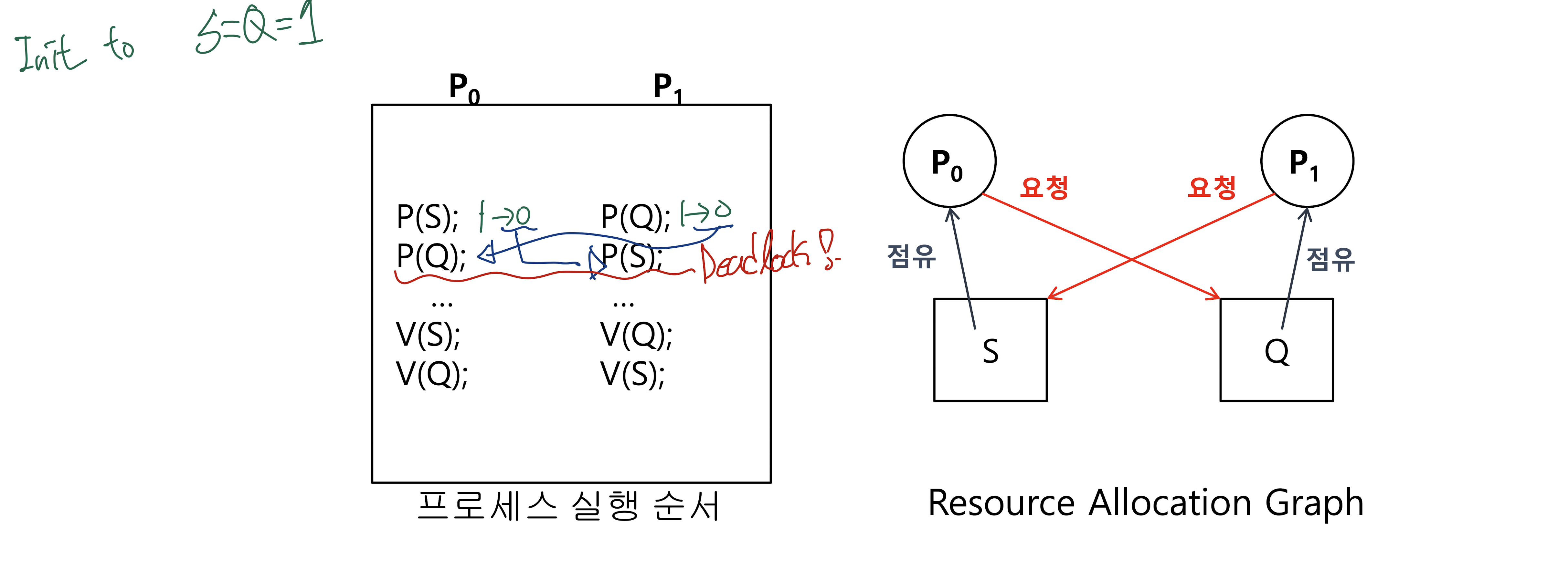
Deadlock
Deadlock
- 두 개 이상의 Process들이 끝없이 이벤트를 기다리고 있는 상황
- 그 이벤트는 기다리고 있는 Process만이 발생 시킬 수 있는 것
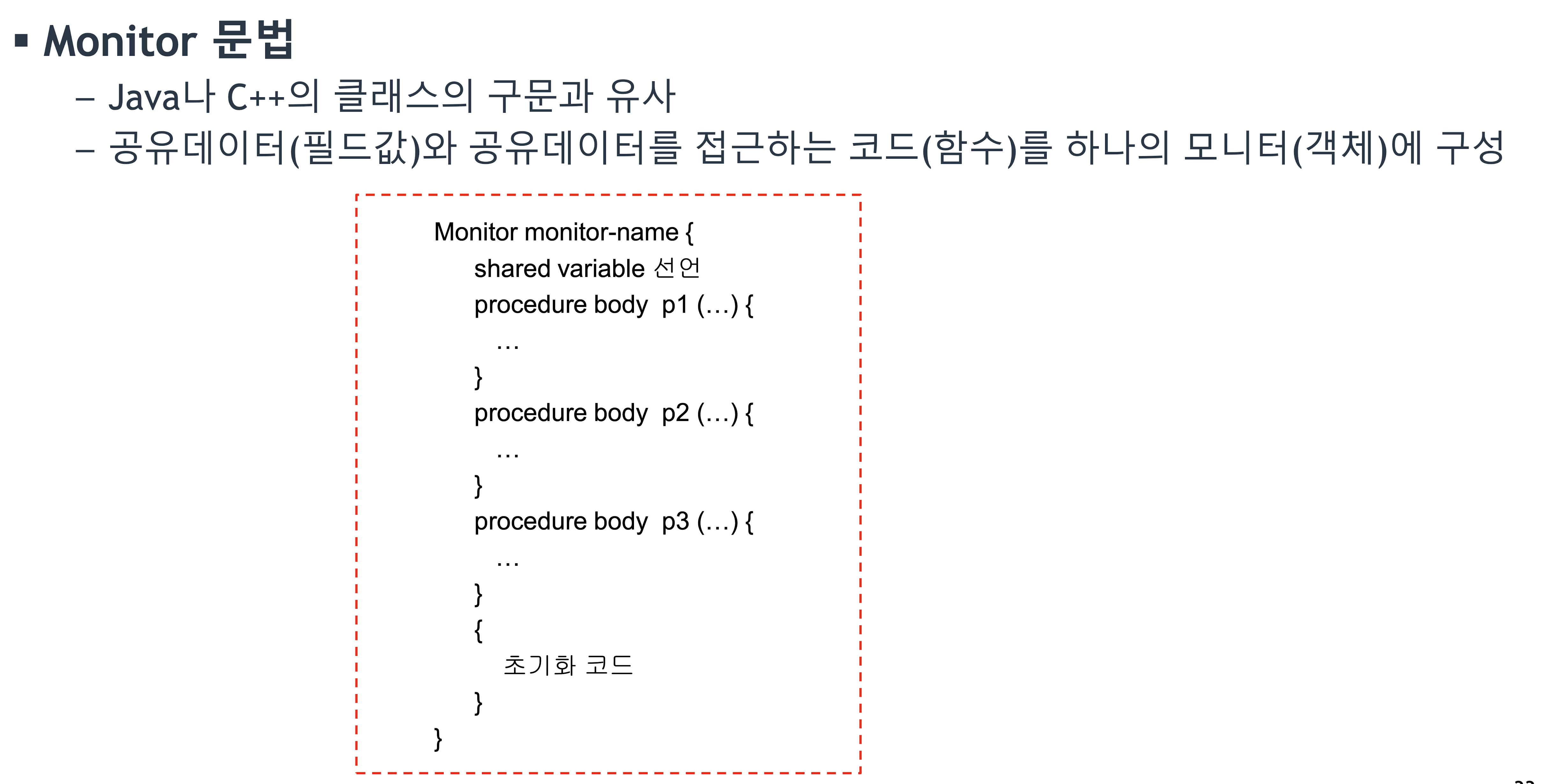
Monitor
High-level 언어에서의 동기화 방법
- Java의 Thread에서 동기화를 위한 방법으로 Monitor가 사용됨
한 순간에 하나의 Process만 Monitor에서 할동하도록 보장
- 공유데이터(필드값)와 공유데이터를 접근하는 코드(함수)를 하나의 모니터(객체)에 구성
Application은 Semaphore와 같이 P와 V연산에 대한 고려 없이 Procedure를 호출하는 것 만으로 동기화를 해결할 수 있음
- Procgrammer는 동기화 제약 조건(P, V)을 명시적으로 코드화 할 필요 없음