How Tesla, BMW, and Audi Approach Automotive Software Differently
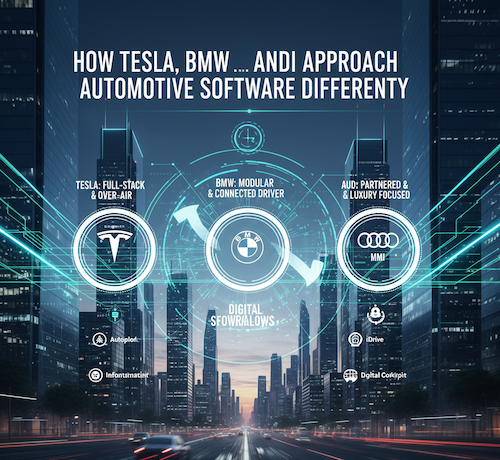
The automotive industry has undergone a significant transformation over the past decade, moving from purely mechanical engineering to a fusion of software and hardware. Modern vehicles are no longer just modes of transportation—they are complex software-driven systems. At the forefront of this evolution are companies like Tesla, BMW, and Audi, each taking unique approaches to automotive software development. Understanding these differences not only sheds light on the future of mobility but also offers insights into how automotive software development companies can innovate and adapt.
Tesla: The Software-First Approach
Tesla has redefined what it means to develop a car in the 21st century. Unlike traditional automakers, Tesla approaches vehicles as computers on wheels, with software at the heart of their design. This philosophy allows Tesla to release over-the-air (OTA) updates, continuously improving features and performance even after a car has left the factory.
One of Tesla’s key advantages is its in-house software development team. By controlling both hardware and software, Tesla can tightly integrate systems such as Autopilot, energy management, and user interfaces. This vertical integration reduces dependency on third-party suppliers and accelerates innovation.
For instance, Tesla’s Autopilot system relies heavily on machine learning algorithms that improve over time. Real-world data from millions of Tesla vehicles feeds back into the system, enabling the company to refine its autonomous driving capabilities faster than traditional automakers. This approach demonstrates the power of treating software not as an accessory, but as the core of the vehicle experience.
Tesla’s strategy highlights a major trend in the automotive world: vehicles as software platforms. By emphasizing software first, Tesla creates opportunities for new features, improved safety, and enhanced customer experience, all through remote updates.
BMW: The Premium Experience Through Modular Software
BMW, known for its premium vehicles, takes a slightly different approach. While Tesla prioritizes software as the primary driver of innovation, BMW focuses on modular software architecture. This approach allows for flexibility and scalability across a wide range of vehicle models.
BMW’s iDrive system is a prime example of modular software development. The system integrates infotainment, navigation, and vehicle settings into a seamless interface while allowing customization for different models. This modularity ensures that new features can be deployed across multiple vehicles without requiring a complete redesign of the software architecture.
Another key aspect of BMW’s strategy is collaboration with external tech partners. By leveraging specialized expertise, BMW enhances its automotive software while maintaining high-quality standards. This combination of in-house and outsourced development allows BMW to balance innovation with reliability, a critical factor in maintaining brand loyalty among premium customers.
Furthermore, BMW invests heavily in connected car technologies. Its ConnectedDrive platform integrates cloud services, mobile applications, and vehicle sensors to create a more personalized driving experience. The focus here is on enhancing user experience and safety, rather than creating a fully autonomous system like Tesla.
Audi: Safety and Efficiency Through Standardized Platforms
Audi, part of the Volkswagen Group, approaches automotive software with a strong emphasis on safety, efficiency, and standardization. Unlike Tesla’s software-first model or BMW’s modular approach, Audi leverages standardized software platforms that ensure reliability across its vehicle lineup.
Audi’s MMI (Multi Media Interface) system demonstrates its commitment to intuitive interfaces and driver assistance. While the system may not be as aggressive in innovation as Tesla’s Autopilot, it prioritizes consistent performance, safety, and integration with other vehicle systems.
Another hallmark of Audi’s strategy is its focus on compliance and long-term maintainability. Automotive software development in a highly regulated environment requires robust testing and certification processes. Audi’s platform-centric approach allows it to deploy updates safely while adhering to global safety standards.
Moreover, Audi invests in energy-efficient algorithms and predictive maintenance features, enhancing vehicle longevity and reducing operational costs. This approach highlights how automotive software can optimize not just user experience but also the overall lifecycle efficiency of vehicles.
Comparing the Approaches
While Tesla, BMW, and Audi all rely on software to define their vehicles, their approaches reflect different priorities and philosophies:
Tesla: Prioritizes software innovation and autonomy, using in-house development and OTA updates to continuously improve vehicle functionality.
BMW: Balances modularity and collaboration, offering flexibility across models while maintaining a premium driving experience.
Audi: Focuses on standardized platforms, safety, and efficiency, ensuring reliability and regulatory compliance across its lineup.
These differences illustrate the diverse strategies within automotive software development. Companies looking to enter this space can learn from these approaches, whether by emphasizing software-first solutions, modular architectures, or standardized and reliable platforms.
Implications for Automotive Software Development Companies
The strategies of Tesla, BMW, and Audi provide valuable lessons for automotive software development company. For startups and established firms alike, the key takeaway is the importance of aligning software strategy with overall business objectives.
Companies focusing on innovation may adopt Tesla’s in-house, data-driven approach.
Those targeting diverse vehicle platforms might prefer BMW’s modular model.
Firms prioritizing safety and efficiency may follow Audi’s standardized software platforms.
Additionally, the rise of electric and autonomous vehicles has blurred the line between automotive and other tech sectors. For instance, aviation software development services share similarities with automotive software in terms of safety, real-time processing, and regulatory compliance. Lessons from aerospace engineering, such as rigorous testing and fail-safe design, can inform the development of vehicle software systems.
The Future of Automotive Software
As the automotive industry evolves, software will continue to drive innovation. Tesla, BMW, and Audi will likely refine their strategies further, embracing technologies like artificial intelligence, edge computing, and vehicle-to-everything (V2X) communication. Companies entering the market must stay agile, continuously learning from industry leaders while developing their own unique approaches.
The convergence of automotive, IT, and aerospace technologies signals a new era for vehicles—one where software, rather than hardware alone, defines competitiveness. For automotive software development companies, this means a growing demand for skilled developers, robust testing frameworks, and cross-industry collaboration.
Conclusion
Tesla, BMW, and Audi demonstrate that there is no one-size-fits-all approach to automotive software. Each company reflects its priorities: Tesla focuses on innovation and autonomy, BMW on modularity and premium experience, and Audi on safety and standardized efficiency. By studying these strategies, automotive software development companies can understand emerging trends, adopt best practices, and create software solutions that redefine the future of mobility.
The automotive world is rapidly changing, and software is at the center of this transformation. For developers, businesses, and tech enthusiasts, keeping an eye on these industry leaders is essential to understanding where the roads—and code—are headed next.