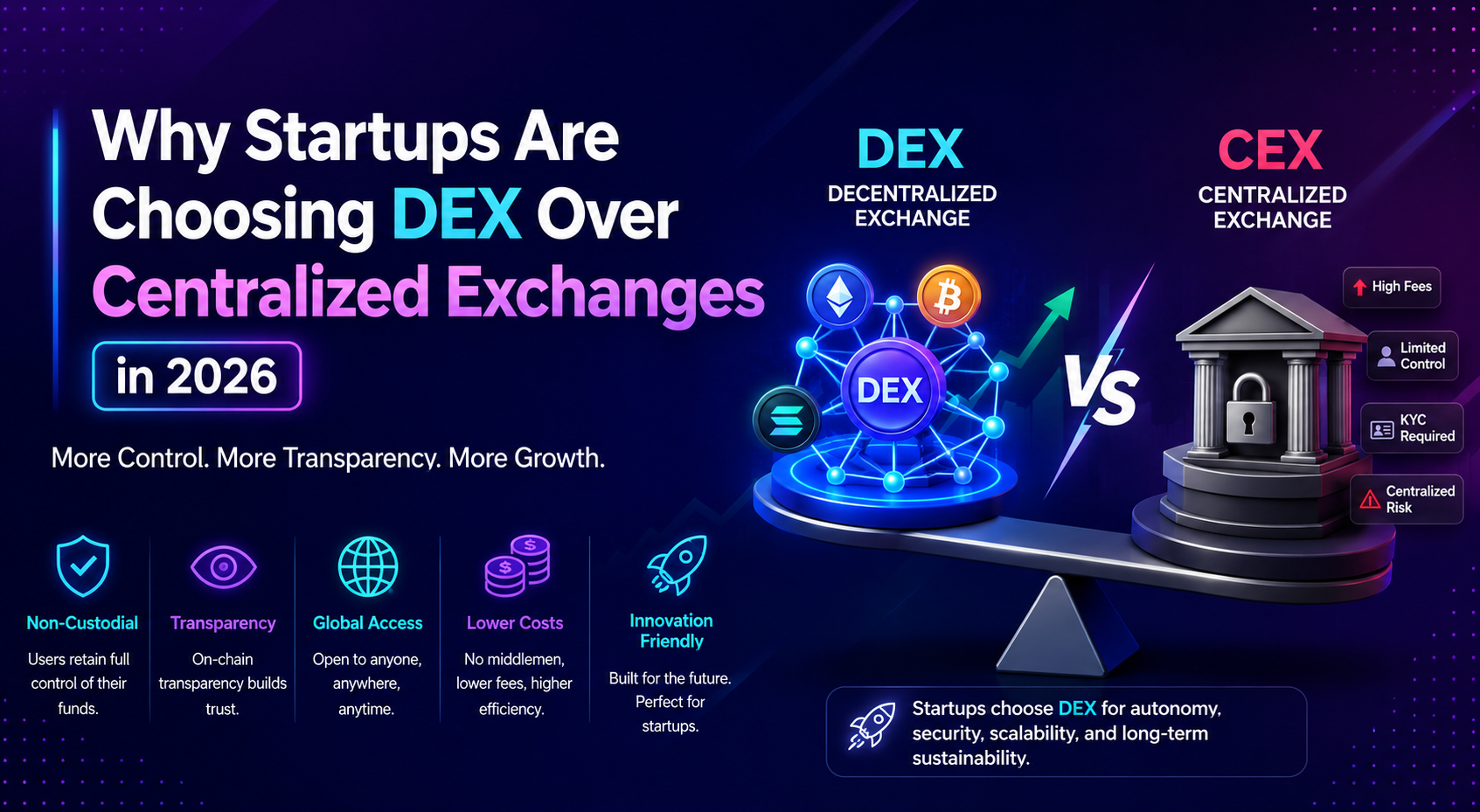
Why Startups Are Choosing DEX Over Centralized Exchanges in 2026
Introduction
Capital raising, liquidity management and token distribution have undergone a great transformation in the last few years for startups. For any crypto-native start-up, getting listed on a centralized exchange (CEX), such as Binance or Coinbase, used to be the ideal goal. It meant credibility, volume and visibility.
In 2026, however, it's changing and changing quickly.
Many early-stage startups today are using decentralized exchanges (DEXs) such as Uniswap, dYdX, Aerodrome, and Camelot to bootstrap liquidity, launch tokens and operate independently. Established teams at all cryptocurrency exchange development companies are rethinking their default architecture and moving from centralized to on-chain, permissionless infrastructure. The motivations are not only philosophical, but also very practical.
This article dissects the reasons why the startup community is opting for the DEX over CEX, implications for the Indian and global tech ecosystem and what founders must know before they make this choice.
What's the Difference? CEX vs DEX A Quick Refresher
First, let's clear the decks before we get to the "why.Before we get to the "why," let's first clear the decks.
Centralized Exchanges (CEX) are exchanges such as Binance, Coinbase, Kraken and India's CoinDCX and WazirX. They are considered intermediaries because they hold user funds, maintain order books, establish order criteria and are regulated.
Decentralized Exchanges (DEX) are smart-contract powered protocols such as Uniswap (Ethereum), Trader Joe (Avalanche), Raydium (Solana), and others where trades take place directly between wallets on an automated market maker (AMM) or an on-chain order book. No middleman. No custodian.
The main difference: With a DEX, you always have control over liquidity and you own the assets.
5 Core Reasons Startups Are Moving to DEX in 2026
1. The CEX Listing Cost Has Become Prohibitive
The process of being listed on a leading CEX is not only challenging it's costly. The listing fees, market-making and token reserve requirements are generally accepted by industry to range between $50,000 and more than $500,000 per exchange at major exchanges. That's a budget-busting obstacle to contend with for Series A or pre-revenue startups.
The listing on DEX, on the other hand, is permissionless. A liquidity pool could be deployed on Uniswap V4 or another protocol for a couple of hundred dollars worth of gas. The rest is up to the market.
For bootstrapped startups and early-stage Web3 projects especially those coming out of India's growing blockchain ecosystem this cost difference is a game-changer. Even if you're hiring a centralized cryptocurrency exchange development company to construct your very own trading platform, you will obtain real data and user traction before you invest in the overhead of integrating your entire trading platform into an entire CEX.
2. Regulatory Uncertainty Is Making CEX Partnerships Riskier
The world of cryptocurrencies continues to shift in its regulation. Centralized exchanges (CEs) are cautious about the projects they list due to the EU's MiCA framework, the SEC's enforcement activity in the United States, and the changes in India's TDS/GST treatment.
Today, CEXs carry out thorough investigations, which has become equal to a comprehensive legal audit, before approvaling the listing of a token. This can take months, and is never certain, for a startup in its early stages.
DEXs are based on open protocols. No gate to appease. Your token, your timeline, your liquidity model. This does not mean that DEX is not subject to regulation (smart contract audits and legal wrappers still play their part), but it does mean that there is no single point of failure in a DEX partnership.
3. Liquidity Ownership Is a Strategic Asset
On a CEX, the exchange controls liquidity. The order book becomes empty when you pull out. When an exchange is frozen, down or bankrupt (as FTX tragically proved), so is the liquidity of your project!
A Model that is popularized and widely adopted by OlympusDAO and is applicable to any DEX is that of Protocol-Owned Liquidity (POL) where Startups can own and control their liquidity. Instead of relying on external market makers that can exit at any point, Projects offer liquidity to the AMM pools, in exchange for their shares of the trading fees.
In this model, liquidity is a long-term asset and not a dependency on the balance sheet.
4. Community-First Token Distribution Is Easier on DEX
The operational aspects of modern startups, particularly DAOs, DePIN projects, RWA platforms, or GameFi ecosystems, greatly benefit from community-led token distribution. Flexibility is needed to air drop tokens to early adopters, reward contributors, and establish governance from the get go.
CEXs have tight control over the distribution and trading of tokens, both before and after listing. DEXs, along with some tools such as Merkl, Boost, or Layer3, enable startups to organize highly customizable incentive marketing campaigns, liquidity mining programs, and community reward constructions, all without the approval of the exchange.
This means an active user base and a more distributed cap table right off the bat.
5. Composability: DEX as Infrastructure, Not Just a Marketplace
Perhaps the most underrated reason DEXs are composable infrastructure.
When your token is live on Uniswap or Curve, it's instantly compatible with the entire DeFi ecosystem: lending protocols like Aave or Compound can use it as collateral, yield aggregators like Yearn can route through it, and liquidity management tools like Arrakis or Gamma Strategies can optimize it automatically.
A CEX listing is a destination. A DEX listing is a foundation.
For startups building in DeFi, NFT finance, or any composable vertical, being on-chain from day one is not just preferred it's architecturally necessary.
What About the Downsides? Being Honest with Founders
This article would be incomplete without acknowledging the challenges of choosing DEX.
Impermanent Loss: Providing liquidity to AMM pools exposes startups to impermanent loss the risk that the relative price of your token pair shifts unfavorably. Smart concentration strategies and range orders (available in Uniswap V3/V4) can mitigate this, but require active management.
Lower Discoverability: A DEX listing won't give you the press release buzz of a Binance listing. User discoverability is harder you need to build your own distribution pipeline through social media, KOL marketing, and community channels.
Smart Contract Risk: DEX protocols and your own liquidity contracts can have vulnerabilities. A thorough smart contract audit from reputable firms like Trail of Bits, Certik, or Hacken is non-negotiable.
UX Friction: DEX interfaces are improving rapidly, but retail users still find MetaMask + Uniswap less intuitive than a centralized app. If your target user is non-crypto-native, you may need a CEX at some point in your journey.
The honest takeaway: DEX first, CEX later is becoming the playbook not DEX only forever.
The Indian Startup Angle
India's Web3 startup ecosystem is maturing rapidly. From DePIN projects building real-world infrastructure networks to RWA (Real World Asset) tokenization platforms targeting MSME lending, Indian founders are increasingly building globally from day one.
For these founders, the DEX route offers additional advantages:
- Avoid KYC/listing gatekeepers that may be unfamiliar with Indian regulatory nuances
- Access global DeFi liquidity without waiting for exchange relationships to develop
- Launch faster — Indian fintech and blockchain startups compete on speed in global markets
Organizations like NASSCOM's DeepTech Club and IFSCA's regulatory sandbox are creating space for these experiments. Founders who understand on-chain liquidity mechanics will be better positioned as India's GIFT City evolves into a crypto-friendly financial hub. Notably, partnering with the right cryptocurrency exchange development company one that understands both DEX protocol architecture and local compliance requirements is increasingly becoming a competitive advantage for Indian Web3 startups going global.
Looking Ahead: The Hybrid Future
By 2027, the "DEX vs CEX" distinction will further become indistinct. Hybrid models, with centralized interfaces appearing on top of decentralized settlement layers are already showing up. Coinbase's Base chain, Binance's opBNB, and OKX's X Layer are all to fix the dichotomy of CEX reach and DEX infrastructure.
The message for startups: it's no longer an option to know both worlds. Technical and strategic literacy will be the key that will distinguish which teams of startups can be part of the global game.
Conclusion
The move towards DEX is no ideological move, but a pragmatic one. On its own, there are enough arguments to make it compelling to lower costs, increase autonomy, composability with the DeFi ecosystem and protection from centralized counterparty risk.
The next step for startups in the development of 2026 and beyond will not be, "Should we explore listing on a DEX?," but rather, "Why should we not have built our liquidity strategy around DEX from the beginning?". The on-chain route is now the smarter alternative when it comes to launching a new platform or a token on a new protocol, whether you are building your own platform with a cryptocurrency exchange development company or building a token on an existing platform.
Protocols are well-developed. The tooling is very good. The community is prepared.
The only thing left is to ask if your startup is.