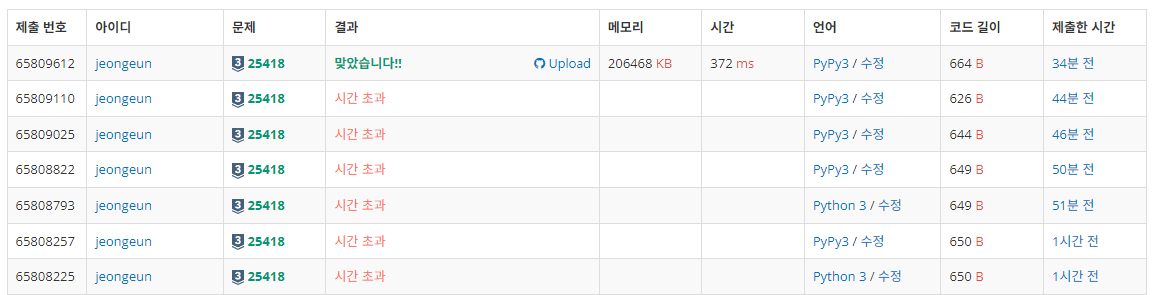
BaekJoon 에서 Python으로 알고리즘 문제를 풀다보면 계속 부딪히는 문제가 있다.
바로 시간 초과 ❗
이를 해결하기 위해 무엇을 해야할까 ❓
→ 시간 복잡도를 생각하여 문제를 풀어야한다!
이때까지 편하게 사용했던 Python 함수가 알고보니 이라면❓
당연히, 다른 언어들과 동일하게 알고리즘을 설계하였어도 시간초과가 날 수 밖에 없다.
그래서 파이썬 자료형 중 가장 많이 쓰이는 List, Set, Dictionary의 함수별 시간 복잡도를 알아보자 💡
List
| Operation | Example | Class | Notes |
|---|---|---|---|
| Index | l[i] | O(1) | |
| Store | l[i] = 0 | O(1) | |
| Length | len(l) | O(1) | |
| Append | l.append(5) | O(1) | mostly: ICS-46 covers details |
| Pop | l.pop() | O(1) | same as l.pop(-1), popping at end |
| Clear | l.clear() | O(1) | similar to l = [] |
| Slice | l[a:b] | O(b-a) | l[1:5]:O(l)/l[:]:O(len(l)-0)=O(N) |
| Extend | l.extend(...) | O(len(...)) | depends only on len of extension |
| Construction | list(...) | O(len(...)) | depends on length of ... iterable |
| check ==, != | l1 == l2 | O(N) | |
| Insert | l[a:b] = ... | O(N) | |
| Delete | del l[i] | O(N) | depends on i; O(N) in worst case |
| Containment | x in/not in l | O(N) | linearly searches list |
| Copy | l.copy() | O(N) | Same as l[:] which is O(N) |
| Remove | l.remove(...) | O(N) | |
| Pop | l.pop(i) | O(N) | O(N-i): l.pop(0):O(N) (see above) |
| Extreme value | min(l)/max(l) | O(N) | linearly searches list for value |
| Reverse | l.reverse() | O(N) | |
| Iteration | for v in l: | O(N) | Worst: no return/break in loop |
| Sort | l.sort() | O(N Log N) | key/reverse mostly doesn't change |
| Multiply | k*l | O(k N) | 5l is O(N): len(l)l is O(N**2) |
Set
| Operation | Example | Class | Notes |
|---|---|---|---|
| Length | len(s) | O(1) | |
| Add | s.add(5) | O(1) | |
| Containment | x in/not in s | O(1) | compare to list/tuple - O(N) |
| Remove | s.remove(..) | O(1) | compare to list/tuple - O(N) |
| Discard | s.discard(..) | O(1) | |
| Pop | s.pop() | O(1) | popped value "randomly" selected |
| Clear | s.clear() | O(1) | similar to s = set() |
| Construction | set(...) | O(len(...)) | depends on length of ... iterable |
| check ==, != | s != t | O(len(s)) | same as len(t); False in O(1) if the lengths are different |
| <=/< | s <= t | O(len(s)) | issubset |
| >=/> | s >= t | O(len(t)) | issuperset s <= t == t >= s |
| Union | s | t | O(len(s)+len(t)) |
| Intersection | s & t | O(len(s)+len(t)) | |
| Difference | s - t | O(len(s)+len(t)) | |
| Symmetric Diff | s ^ t | O(len(s)+len(t)) | |
| Iteration | for v in s: | O(N) | Worst: no return/break in loop |
| Copy | s.copy() | O(N) |
- Set 자료형은 리스트 자료형에 비해 의 연산이 많은 편이다.
Dictionary
| Operation | Example | Class | Notes |
|---|---|---|---|
| Index | d[k] | O(1) | |
| Store | d[k] = v | O(1) | |
| Length | len(d) | O(1) | |
| Delete | del d[k] | O(1) | |
| get/setdefault | d.get(k) | O(1) | |
| Pop | d.pop(k) | O(1) | |
| Pop item | d.popitem() | O(1) | popped item "randomly" selected |
| Clear | d.clear() | O(1) | similar to s = {} or = dict() |
| View | d.keys() | O(1) | same for d.values() |
| Construction | dict(...) | O(len(...)) | depends # (key,value) 2-tuples |
| Iteration | for k in d: | O(N) | all forms: keys, values, items Worst: no return/break in loop |
- Dictionary 자료형은 거의 대부분 이란 것을 기억하자.
[References]
Complexity of Python Operations

정니의 이런거 저런거 기록 일지 😛